

Posted on September 18 2026
Top 10 Countries for Molecular Scientists to Work Abroad: Salary, Demand & PR Opportunities Compared

By , Editor & Director
Updated September 18 2026
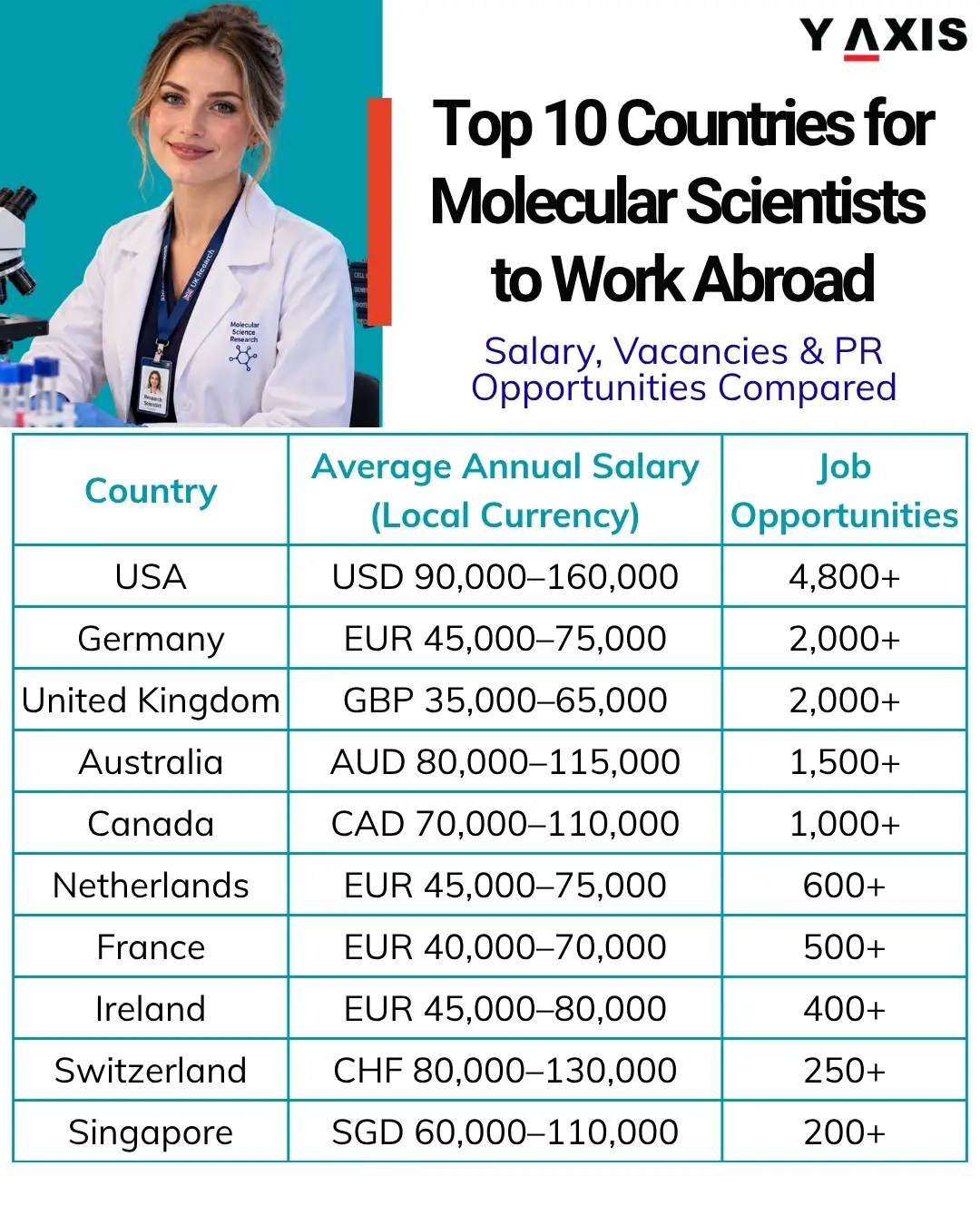
The top 10 countries for molecular scientists to work abroad include the USA, Germany, Switzerland, the UK, Canada, Australia, Ireland, the Netherlands, France, and Singapore. These destinations offer competitive salaries, work visa options, and permanent residency pathways for molecular scientists seeking international career opportunities.
The global biotechnology market is projected to reach USD 4.33 trillion by 2034, growing at a CAGR of 14.3%. Rising investment in genetic engineering, precision medicine, and drug discovery is increasing demand for molecular scientists in molecular biology, genomics, biotechnology, pharmaceutical research, and molecular diagnostics. This growth is creating more job opportunities in molecular research, drug development, and advanced laboratory work worldwide.
*Want to work abroad? Avail Y-Axis Resume Marketing Services to find the right job faster
Why is Global Demand for Molecular Scientists Increasing?
Global demand for molecular scientists is increasing because of rising investment in gene therapy, precision medicine, genomic research, and biopharmaceutical development. The World Economic Forum estimates that generative biology could have an economic impact of USD 4 trillion, creating new opportunities for molecular scientists in healthcare research, pharmaceutical development, and biotechnology.
- Gene Therapy: Developing treatments for inherited and complex diseases.
- Genomic Research: Using DNA sequencing and genetic analysis to understand diseases.
- Drug Development: Supporting the discovery and testing of new medicines.
- Molecular Diagnostics: Developing tests for early and accurate disease detection.
- Biopharmaceuticals: Applying molecular biology to develop advanced biological medicines.
How to Choose the Right Country for Molecular Scientists to Work Abroad?
Choosing the right country depends on your specialisation, salary expectations, research opportunities, visa requirements, and permanent residency options. Consider countries with strong biotechnology and pharmaceutical industries, established research facilities, and demand for molecular science expertise.
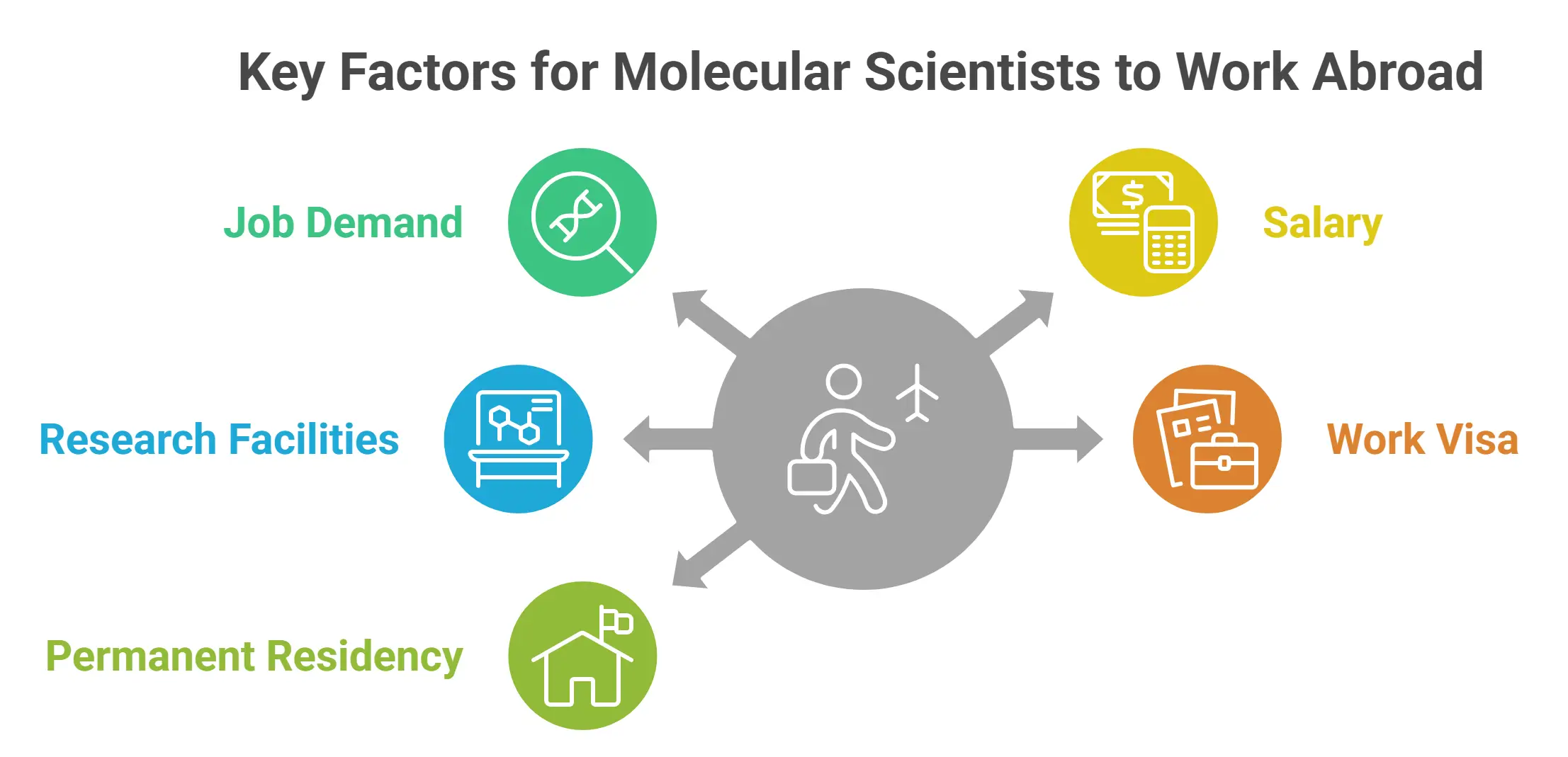
- Job Demand: Check opportunities in genomics, molecular diagnostics, drug development, and biotechnology.
- Salary: Compare average salaries with living costs and tax rates.
- Research Facilities: Look for countries with advanced laboratories and funded research programmes.
- Work Visa: Review eligibility requirements, employer sponsorship, and visa conditions.
- Permanent Residency: Compare available PR pathways, required work experience, and settlement conditions.
Top 10 Countries for Molecular Scientists to Work Abroad
The USA, Germany, Switzerland, the UK, Canada, and Australia offer molecular scientists career opportunities in genomics, molecular biology, biotechnology, pharmaceutical research, and molecular diagnostics. Roles such as Molecular Scientist, Research Scientist, Molecular Biologist, and Biotechnologist offer opportunities for career growth, with salaries exceeding GBP 50,000 annually.
These countries have advanced laboratories, strong research funding, and growing biotechnology industries, creating opportunities to build specialised skills and progress into senior roles. Work visa options and permanent residency pathways also make them attractive destinations for molecular scientists seeking long-term careers abroad.
|
Country |
Average Annual Salary (Local Currency) |
Estimated |
|
USA |
USD 90,000–160,000 |
4,800+ |
|
Germany |
EUR 45,000–75,000 |
2,000+ |
|
Switzerland |
CHF 80,000–130,000 |
250+ |
|
United Kingdom |
GBP 35,000–65,000 |
2,000+ |
|
Canada |
CAD 70,000–110,000 |
1,000+ |
|
Australia |
AUD 80,000–115,000 |
1,500+ |
|
Ireland |
EUR 45,000–80,000 |
400+ |
|
Netherlands |
EUR 45,000–75,000 |
600+ |
|
France |
EUR 40,000–70,000 |
500+ |
|
Singapore |
SGD 60,000–110,000 |
200+ |
*Want to work abroad? Avail Y-Axis Resume Marketing Services to find the right job faster
Best Countries for Molecular Scientists to Work and Settle Abroad
Canada, Australia, Germany, the UK, and the USA offer molecular scientists opportunities to build successful careers and settle abroad. These countries provide access to biotechnology, genomics, pharmaceutical research, and molecular diagnostics roles, along with opportunities for professional growth and long-term stability.
When choosing a destination, consider permanent residency pathways, job demand, salary potential, career progression, healthcare, and quality of life. The right country will depend on your qualifications, research experience, and long-term settlement goals.
Molecular Scientist Jobs in the USA
The USA has molecular science jobs in genomics, gene therapy, drug development, biotechnology, and molecular diagnostics. Pharmaceutical companies, universities, biotechnology firms, and research institutions hire Molecular Biologists, Research Scientists, Biochemists, and Medical Scientists. The Bureau of Labor Statistics projects 13% employment growth for medical scientists by 2035, driven by research into genetic diseases, drug discovery, and medical treatments.
Molecular scientists can specialise in gene therapy, cell biology, molecular diagnostics, and biotechnology research. The H-1B visa offers a work route, while EB-1, EB-2, and EB-2 National Interest Waiver pathways also support permanent settlement. The country’s advanced research infrastructure and biotechnology industry create opportunities for long-term scientific career development.
|
Factor |
Details |
|
Molecular Scientist Job Market & Job Vacancies for the Next Decade |
The USA is expected to generate more than 4,800 Molecular Scientist job opportunities over the next decade, with demand in genomics, gene therapy, molecular diagnostics, drug discovery, and biotechnology research. |
|
Investment in Biotechnology & Biomedical Research |
The NIH receives more than USD 47 billion annually, supporting molecular research in gene editing, DNA sequencing, cancer biology, precision medicine, and therapeutic development. |
|
Top Companies Hiring Molecular Scientists |
Pfizer, Moderna, Genentech, Amgen, Merck, Regeneron, Illumina, and Thermo Fisher Scientific hire Molecular Scientists for drug development, genetic research, diagnostics, and biotechnology projects. |
|
Top Cities for Molecular Scientist Jobs |
Boston, San Diego, San Francisco, Washington, DC, Raleigh–Durham, and New York–New Jersey offer opportunities in molecular research, genomics, pharmaceutical science, and biotechnology. |
|
In-Demand Molecular Scientist Roles & Skills |
Roles include Molecular Biologist, Genomics Scientist, Research Scientist, Cell Biology Scientist, and Molecular Diagnostics Scientist. Key skills include PCR, qPCR, CRISPR, DNA/RNA sequencing, cell culture, molecular cloning, and bioinformatics. |
|
Work Visa Options |
The H-1B visa provides a work route for Molecular Scientists in specialised scientific positions. Universities and research institutions may offer cap-exempt H-1B employment. |
|
Fast-Track Hiring Options |
Molecular Scientists with outstanding research achievements may pursue the O-1A visa. USCIS Premium Processing offers faster processing for qualifying immigration petitions. |
|
PR / Long-Term Residence Opportunities |
Green Card pathways include EB-2, EB-3, EB-2 National Interest Waiver, and EB-1A. The appropriate route depends on research achievements, qualifications, and employment. |
|
Eligibility for Dependents |
Molecular Scientists on H-1B visas can bring their spouse and unmarried children under 21 through H-4 status. O-1A visa holders can use O-3 dependent status. |
|
Benefits for Family Members |
H-4 and O-3 children can study in the USA. Certain H-4 spouses may obtain work authorisation, while O-3 dependents generally cannot work. |
*Want to Work in United States? Let Y-Axis guide you through every step of the process.
Molecular Scientist Jobs in Germany
Germany has approximately 1,020 biotechnology companies employing 56,000 people, creating jobs in pharmaceutical research, molecular biology, and laboratory science. Pharmaceutical companies, universities, and biotechnology firms hire Molecular Biologists, Research Scientists, Biochemists, and Laboratory Scientists for drug development, genetic research, and biotechnology projects. A German job offer can support a work residence permit, research visa, or EU Blue Card.
EU Blue Card holders may qualify for settlement after 27 months with A1-level German or 21 months with B1-level German. Germany’s pharmaceutical and biotechnology industries offer molecular scientists opportunities to develop specialised research careers and permanent settlement. Germany’s established pharmaceutical industry and research institutions provide opportunities to develop specialised expertise and build a long-term career.
|
Factor |
Details |
|
Molecular Scientist Job Market & Job Vacancies for the Next Decade |
Germany is projected to generate more than 2,000 Molecular Scientist job opportunities over the next decade, with demand in genomics, drug discovery, gene therapy, molecular diagnostics, and biotechnology research. |
|
Investment in Biotechnology & Biomedical Research |
Germany invests more than EUR 4.6 billion annually in medical biotechnology R&D, while its pharmaceutical companies spend over EUR 10.7 billion on research and development. This investment supports molecular research, gene therapy, and biopharmaceutical innovation. |
|
Top Companies Hiring Molecular Scientists |
BioNTech, Bayer, Merck, Roche, Qiagen, Boehringer Ingelheim, and Evotec hire Molecular Scientists for drug development, genetic research, molecular diagnostics, and biotechnology. Universities and research institutes also offer research positions. |
|
Top Cities for Molecular Scientist Jobs |
Berlin, Munich, Frankfurt, Hamburg, and Heidelberg are major locations for Molecular Scientist jobs in pharmaceutical research, biotechnology, molecular diagnostics, and biomedical science. |
|
In-Demand Molecular Scientist Roles & Skills |
German employers recruit Molecular Biologists, Genomics Scientists, Research Scientists, Cell Biology Scientists, and Molecular Diagnostics Scientists. Key skills include PCR, CRISPR, DNA/RNA sequencing, cell culture, molecular cloning, protein analysis, and bioinformatics. |
|
Work Visa Options |
The EU Blue Card provides a work residence route for Molecular Scientists with recognised academic qualifications and a qualifying German employment contract. Research positions can also lead to a research residence permit. |
|
Fast-Track Hiring Options |
Germany’s Accelerated Skilled Worker Procedure allows employers to coordinate the residence process with the foreigners authority before the Molecular Scientist submits a visa application. |
|
PR / Long-Term Residence Opportunities |
Molecular Scientists holding an EU Blue Card can apply for settlement after 27 months with A1-level German or 21 months with B1-level German. Researchers can also use settlement routes under German residence law. |
|
Eligibility for Dependents |
Molecular Scientists with an EU Blue Card can generally bring their spouse and minor children through family reunification. Family members receive residence permits to live in Germany. |
|
Benefits for Family Members |
Spouses can generally work in Germany without a separate work permit, while children can attend school. Family reunification allows Molecular Scientists to live with their immediate family in Germany. |
*Want to Work in Germany? Let Y-Axis guide you through every step of the process.
Molecular Scientist Jobs in Switzerland
Switzerland’s pharmaceutical and biotechnology industries create opportunities in drug discovery, molecular diagnostics, genetic research, and biomedical science. Pharmaceutical companies, universities, and research laboratories hire Molecular Biologists, Research Scientists, Biochemists, and Laboratory Scientists for research and product development.
Non-EU/EFTA applicants generally need an employer-supported work permit. Employers must usually show that suitable Swiss or EU/EFTA candidates are unavailable for the position. Experienced researchers may access specialised employment routes, while long-term residents may qualify for a C settlement permit. Switzerland’s pharmaceutical research environment offers opportunities for advanced scientific work and career progression.
|
Factor |
Details |
|
Molecular Scientist Job Market & Job Vacancies for the Next Decade |
Switzerland is projected to generate more than 250 Molecular Scientist job opportunities over the next decade, particularly in genomics, molecular diagnostics, pharmaceutical research, biotechnology, and biomedical science. |
|
Investment in Biotechnology & Biomedical Research |
Switzerland’s biotechnology industry has attracted CHF 2.6 billion in total funding and CHF 2.5 billion in R&D investment. This financial support advances molecular research, genomics, drug discovery, and advanced therapies. |
|
Top Companies & Organisations Hiring Molecular Scientists |
Roche, Novartis, Lonza, CSL Behring, Thermo Fisher Scientific, and Syngenta offer opportunities in molecular research, drug development, diagnostics, and biotechnology. Universities, hospitals, and research institutes also employ Molecular Scientists. |
|
Top Cities for Molecular Scientist Jobs |
Basel, Zurich, Lausanne, Geneva, and Bern are key locations for Molecular Scientist jobs. Basel has a strong concentration of pharmaceutical companies, biotechnology firms, and life sciences research facilities. |
|
In-Demand Molecular Scientist Roles & Skills |
Swiss employers recruit Molecular Biologists, Research Scientists, Genomics Scientists, Molecular Diagnostics Scientists, and Cell Biology Scientists. Important laboratory skills include PCR, CRISPR, DNA/RNA sequencing, cell culture, molecular cloning, and bioinformatics. |
|
Work Visa Options |
Molecular Scientists from outside the EU/EFTA generally need an employer-supported L or B residence permit. The L permit covers short-term employment, while the B permit supports longer-term residence. |
|
Fast-Track Hiring Options |
Swiss employers submit work-permit applications to the relevant cantonal authorities. The process depends on the Molecular Scientist’s nationality, employment contract, and professional qualifications. |
|
PR / Long-Term Residence Opportunities |
Molecular Scientists can generally apply for a C settlement permit after 10 years of residence. Citizens of certain countries may qualify after five years, depending on their nationality and residence conditions. |
|
Eligibility for Dependents |
Molecular Scientists holding a Swiss residence permit can generally bring their spouse or registered partner and unmarried children under 18 through family reunification. |
|
Benefits for Family Members |
Spouses and registered partners can generally work under Swiss regulations, while dependent children can attend Swiss schools. Family reunification allows families to live together in Switzerland. |
Molecular Scientist Jobs in the UK
The UK’s life sciences sector employs approximately 360,000 people across 7,320 companies, with projections indicating 66,000 additional jobs in priority occupations by 2035. Pharmaceutical companies, universities, hospitals, and research institutions hire Molecular Biologists, Biochemists, and Research Scientists for genomics, drug development, and molecular diagnostics.
Molecular scientists with a relevant job offer from a licensed UK employer can apply for a Skilled Worker visa. The visa route can lead to Indefinite Leave to Remain (ILR) after five years. The UK’s pharmaceutical research network and university laboratories provide opportunities for scientific specialisation and long-term career growth.
|
Factor |
Details |
|
Molecular Scientist Job Market & Job Vacancies for the Next Decade |
The UK is expected to create more than 2,000 Molecular Scientist job opportunities over the next decade. Hiring demand is likely to remain strong in genomics, molecular diagnostics, gene therapy, vaccine research, and drug discovery. |
|
Investment in Biotechnology & Biomedical Research |
The UK’s life sciences sector has attracted more than £3 billion in investment, supported by over £2 billion in government funding for genomics, molecular diagnostics, drug development, and biomedical research. |
|
Top Companies & Organisations Hiring Molecular Scientists |
Major employers include AstraZeneca, GSK, Oxford Nanopore, BioNTech, Lonza, Charles River Laboratories, Thermo Fisher Scientific, and Abcam. Molecular Scientists also find research opportunities in universities, NHS laboratories, and specialist research institutes. |
|
Top Cities for Molecular Scientist Jobs |
London, Cambridge, Oxford, Manchester, Edinburgh, and Glasgow offer opportunities across pharmaceutical research, genomics, molecular diagnostics, cell biology, and biotechnology. |
|
In-Demand Molecular Scientist Roles & Skills |
Employers recruit for positions such as Molecular Biologist, Research Scientist, Genomics Scientist, Molecular Diagnostics Scientist, and Assay Development Scientist. Practical knowledge of PCR, qPCR, CRISPR, DNA/RNA sequencing, cell culture, molecular cloning, and bioinformatics is highly relevant. |
|
Work Visa Options |
The Skilled Worker visa allows Molecular Scientists to work for approved UK employers in qualifying occupations. Applicants need a sponsored job offer and must meet the applicable salary requirement. |
|
Fast-Track Hiring Options |
The UK offers priority visa processing for qualifying applications. Molecular Scientists with recognised research achievements may also qualify for the Global Talent visa, which does not require employer sponsorship. |
|
PR / Long-Term Residence Opportunities |
The Skilled Worker route generally allows Molecular Scientists to apply for Indefinite Leave to Remain after five years of qualifying residence. Global Talent holders may qualify for settlement after three or five years, depending on their circumstances. |
|
Eligibility for Dependents |
Skilled Worker and Global Talent visa holders can generally bring their spouse, partner, and dependent children to the UK through the dependant visa route. |
|
Benefits for Family Members |
Dependant partners can generally work in the UK, while dependent children can attend school. Family members may also qualify for settlement after meeting the relevant residence requirements. |
*Want to Work in the UK? Let Y-Axis guide you through the steps.
Molecular Scientist Jobs in Canada
Canada has approximately 30,900 biological scientists and 12,100 biochemistry research scientists, with employment across pharmaceutical companies, universities, and research institutions. Molecular Biologists, Research Scientists, and Biochemists work on drug development, genetic research, disease studies, and medical innovation. Molecular scientists with a suitable job offer can apply for an employer-specific work permit.
Express Entry and Provincial Nominee Programs (PNPs) offer permanent residence pathways based on factors such as work experience, education, language skills, and provincial criteria. Canada’s research institutions and biotechnology sector offer opportunities to build a scientific career and pursue permanent residence.
|
Factor |
Details |
|
Molecular Scientist Job Market & Job Vacancies for the Next Decade |
Canada is expected to generate more than 1,000 Molecular Scientist job opportunities over the next decade, particularly in genomics, molecular diagnostics, gene therapy, drug discovery, vaccine development, and biotechnology research. |
|
Investment in Biotechnology & Biomedical Research |
Through its Biomanufacturing and Life Sciences Strategy, Canada is investing more than CAD 2.2 billion over seven years. The funding strengthens research in genomics, vaccine development, therapeutics, molecular diagnostics, and biomedical science. |
|
Top Companies Hiring Molecular Scientists |
AbCellera, STEMCELL Technologies, BioVectra, Sanofi, Moderna, Pfizer, Roche, and Thermo Fisher Scientific offer opportunities in molecular research, cell biology, diagnostics, drug development, and biomanufacturing. |
|
Top Cities for Molecular Scientist Jobs |
Toronto, Vancouver, Montreal, Ottawa, Calgary, and Edmonton are key locations for Molecular Scientist careers. Opportunities span pharmaceutical R&D, genomics, molecular diagnostics, cell biology, and biomedical research. |
|
In-Demand Molecular Scientist Roles & Skills |
Canadian employers recruit Molecular Biologists, Genomics Scientists, Research Scientists, Molecular Diagnostics Scientists, and Assay Development Scientists. Important technical skills include PCR, qPCR, CRISPR, DNA/RNA sequencing, cell culture, molecular cloning, and bioinformatics. |
|
Work Visa Options |
A Canadian job offer can support an employer-specific work permit. Depending on the position, the employer may need an LMIA, while certain research and biotechnology roles may qualify for an LMIA-exempt permit. |
|
Fast-Track Hiring Options |
The Global Talent Stream provides faster processing for qualifying positions in specialised fields such as biotechnology, genomics, molecular diagnostics, and pharmaceutical research. The Canadian employer must satisfy the programme’s requirements. |
|
PR / Long-Term Residence Opportunities |
Molecular Scientists may apply for permanent residence through Express Entry, including the Federal Skilled Worker Program and Canadian Experience Class. Provincial Nominee Programs offer additional routes linked to regional workforce requirements. |
|
Eligibility for Dependents |
A permanent residence application can generally include a spouse or common-law partner and dependent children under 22, provided the family meets Canada’s immigration requirements. |
|
Benefits for Family Members |
A spouse or common-law partner may qualify for an open work permit, depending on the applicable rules. Dependent children can pursue education in Canada, while healthcare access depends on the province, immigration status, and local eligibility criteria. |
*Want to Work in Canada? Let Y-Axis guide you through application process.
Molecular Scientist Jobs in Australia
Australia’s universities, medical research institutes, biotechnology companies, and pharmaceutical organisations hire Molecular Biologists, Research Scientists, Biochemists, and Laboratory Scientists for molecular diagnostics, drug discovery, disease research, and genomics. Research teams work across medical innovation, genetic testing, and clinical science.
Molecular scientists may pursue employer-sponsored employment through the Skills in Demand (subclass 482) visa. Permanent residence options include the Employer Nomination Scheme (subclass 186) and relevant skilled migration pathways. Australia’s medical research institutions and biotechnology companies provide opportunities for scientific specialisation, professional growth, and long-term settlement.
|
Factor |
Details |
|
Molecular Scientist Job Market & Job Vacancies for the Next Decade |
Australia’s molecular science sector is expected to generate more than 1,500 job opportunities over the next decade. Genomics, gene therapy, molecular diagnostics, drug discovery, and biotechnology are expected to drive demand. |
|
Investment in Biotechnology & Biomedical Research |
The Medical Research Future Fund (MRFF) is supporting Australia’s medical research sector with more than AUD 2 billion in funding for precision medicine, genomics, cell therapies, vaccine development, and molecular research. |
|
Top Companies Hiring Molecular Scientists |
CSL, Cochlear, AstraZeneca, Pfizer, ResMed, Thermo Fisher Scientific, QIAGEN, and Vaxxas offer opportunities in molecular research, diagnostics, drug development, and biotechnology. Universities, medical research institutes, and biotechnology firms also hire Molecular Scientists. |
|
Top Cities for Molecular Scientist Jobs |
Melbourne and Sydney are major centres for biomedical research and pharmaceutical development. Brisbane, Adelaide, and Perth also provide opportunities in genomics, molecular diagnostics, cell biology, and biotechnology. |
|
In-Demand Molecular Scientist Roles & Skills |
Australian employers seek Molecular Biologists, Research Scientists, Genomics Scientists, Cell Biology Scientists, Molecular Diagnostics Scientists, and Assay Development Scientists. Strong laboratory skills in PCR, qPCR, CRISPR, DNA/RNA sequencing, cell culture, molecular cloning, and bioinformatics are valuable. |
|
Work Visa Options |
The Skills in Demand visa (subclass 482) allows approved Australian employers to sponsor Molecular Scientists for qualifying positions. Other skilled migration routes depend on the nominated occupation, qualifications, and work experience. |
|
Fast-Track Hiring Options |
Employer sponsorship through the Skills in Demand visa can support a direct employment pathway when the employer and position meet the visa criteria. Scientists with exceptional achievements may also consider the National Innovation visa (subclass 858). |
|
PR / Long-Term Residence Opportunities |
Molecular Scientists may pursue permanent residence through subclass 189, subclass 190, or subclass 186. Those living and working in regional Australia may transition from subclass 491 to subclass 191 after meeting the required criteria. |
|
Eligibility for Dependents |
Depending on the visa category, Molecular Scientists may include their spouse or de facto partner and dependent children in their application. Identity documents and evidence of family relationships are required. |
|
Benefits for Family Members |
Approved family members can live in Australia with the primary visa holder. Partners’ work rights depend on their visa conditions, children may attend Australian schools, and Medicare access varies according to visa status and applicable eligibility rules. |
Molecular Scientist Jobs in Ireland
Ireland’s pharmaceutical and biotechnology industries employ scientists in drug development, biochemistry, genetic research, and molecular diagnostics. Multinational pharmaceutical companies, specialist laboratories, and research institutions hire Molecular Biologists, Research Scientists, Biochemists, and Medical Scientists.
Molecular scientists in qualifying occupations may apply for an Ireland Critical Skills Employment Permit with a suitable job offer and salary. Eligible permit holders may move to Stamp 4 permission after two years, while long-term residency may be available after 60 months of qualifying residence. Ireland’s pharmaceutical industry offers opportunities for research careers and long-term settlement.
|
Factor |
Details |
|
Molecular Scientist Job Market & Job Vacancies for the Next Decade |
Ireland’s expanding life sciences sector is expected to create more than 400 Molecular Scientist job opportunities over the next decade. Demand is likely to span molecular biology, genomics, molecular diagnostics, drug discovery, biotechnology, and pharmaceutical research. |
|
Investment in Biotechnology & Biomedical Research |
Ireland has committed €460 million to seven new research centres specialising in advanced therapies, pharmaceuticals, and biopharmaceuticals. The investment is expected to create 577 research positions and strengthen work in molecular science, genomics, and biotechnology. |
|
Top Companies Hiring Molecular Scientists |
Pfizer, MSD, Johnson & Johnson, Regeneron, Alexion, AbbVie, BioMarin, and Thermo Fisher Scientific recruit Molecular Scientists for drug development, molecular research, diagnostics, and biopharmaceutical production. Universities and research institutes also provide research-based career opportunities. |
|
Top Cities for Molecular Scientist Jobs |
Dublin, Cork, Galway, Limerick, and Waterford host opportunities in pharmaceutical R&D, biotechnology, molecular diagnostics, biomanufacturing, and biomedical research. |
|
In-Demand Molecular Scientist Roles & Skills |
Ireland’s employers hire Molecular Biologists, Research Scientists, Genomics Scientists, Molecular Diagnostics Scientists, Cell Biology Scientists, and Assay Development Scientists. Practical expertise in PCR, qPCR, CRISPR, DNA/RNA sequencing, cell culture, molecular cloning, and bioinformatics is valuable. |
|
Work Visa Options |
Molecular Scientists may qualify for the General Employment Permit, which covers a wide range of scientific and biotechnology positions. Those working in occupations listed under the Critical Skills framework may apply for a Critical Skills Employment Permit. |
|
Fast-Track Hiring Options |
The Critical Skills Employment Permit provides a direct employment route for qualifying occupations and does not require a Labour Market Needs Test. The position must meet the relevant salary, occupation, and employment criteria. |
|
PR / Long-Term Residence Opportunities |
Critical Skills Employment Permit holders can generally apply for Stamp 4 after two years of employment. Long-term residence may become available after 60 months of qualifying residence, subject to the applicable conditions. |
|
Eligibility for Dependents |
Critical Skills Employment Permit holders can generally apply for family reunification for their spouse, partner, and dependent children, subject to Ireland’s immigration requirements. |
|
Benefits for Family Members |
Spouses and partners of qualifying permit holders can generally work in Ireland without obtaining a separate employment permit. Dependent children can live in Ireland and attend school under the applicable arrangements. |
Molecular Scientist Jobs in the Netherlands
The Netherlands has a developed life sciences sector spanning genomics, molecular biology, drug discovery, and biomedical research. Universities, research institutes, pharmaceutical companies, and biotechnology firms hire Molecular Biologists, Research Scientists, Biochemists, and Laboratory Scientists for scientific research and product development.
Molecular scientists may qualify for an EU Blue Card, highly skilled migrant residence permit, or researcher residence permit. Permanent residence may be available after five years of continuous lawful residence. The Netherlands’ research institutions and biotechnology companies provide opportunities to develop specialised expertise and build a long-term scientific career.
|
Factor |
Details |
|
Molecular Scientist Job Market & Job Vacancies for the Next Decade |
The Netherlands is projected to create more than 600 Molecular Scientist job opportunities over the next decade, with demand spanning molecular biology, genomics, molecular diagnostics, drug discovery, and biotechnology research. |
|
Investment in Biotechnology & Biomedical Research |
Through its National Growth Fund programmes, the Netherlands has allocated more than EUR 1.27 billion to biotechnology research and commercialisation. This investment supports genomics, biomedical research, cellular therapies, and pharmaceutical innovation. |
|
Top Companies Hiring Molecular Scientists |
Genmab, Galapagos, QIAGEN, Thermo Fisher Scientific, Merck, Wageningen University & Research, and Leiden University Medical Center recruit Molecular Scientists for research, drug development, diagnostics, and biotechnology projects. |
|
Top Cities for Molecular Scientist Jobs |
Amsterdam, Leiden, Utrecht, Rotterdam, Delft, and Eindhoven are key locations for Molecular Scientist careers, with opportunities in genomics, pharmaceutical R&D, molecular diagnostics, and biotechnology. |
|
In-Demand Molecular Scientist Roles & Skills |
Employers seek Molecular Biologists, Research Scientists, Genomics Scientists, Molecular Diagnostics Scientists, and Cell Biology Scientists. Relevant technical skills include PCR, CRISPR, DNA/RNA sequencing, cell culture, molecular cloning, and bioinformatics. |
|
Work Visa Options |
The Highly Skilled Migrant permit is a primary route for Molecular Scientists employed by an IND-recognised sponsor. The EU Blue Card offers another option for those meeting the required salary, qualification, and employment criteria. |
|
Fast-Track Hiring Options |
IND-recognised employers can submit Highly Skilled Migrant applications directly to the Immigration and Naturalisation Service (IND), simplifying the residence permit application process. |
|
PR / Long-Term Residence Opportunities |
Molecular Scientists may generally apply for permanent residence after five consecutive years of lawful residence, provided they meet the applicable income, residence, permit, and civic integration requirements. |
|
Eligibility for Dependents |
Residence permit holders can generally bring their spouse, registered partner, and dependent children to the Netherlands through family reunification. |
|
Benefits for Family Members |
A Highly Skilled Migrant’s spouse or partner can generally work without a separate work permit. Dependent children can live in the Netherlands and attend Dutch schools, subject to the relevant rules. |
Molecular Scientist Jobs in France
France’s pharmaceutical companies, universities, hospitals, and public research institutions offer molecular science jobs in biotechnology, genetic research, drug development, and molecular diagnostics. Molecular Biologists, Biochemists, Research Scientists, and Laboratory Scientists contribute to medical research and pharmaceutical innovation.
Researchers may apply for the Talent Passport residence permit through qualifying research positions supported by a hosting agreement. Other highly skilled employees may qualify through relevant Talent Passport categories. After five years of lawful residence, eligible non-EU residents may pursue long-term residence. France’s research institutions and pharmaceutical industry offer opportunities for scientific development and career advancement.
|
Factor |
Details |
|
Molecular Scientist Job Market & Job Vacancies for the Next Decade |
France is expected to generate more than 500 Molecular Scientist job opportunities over the next decade in genomics, molecular diagnostics, gene therapy, drug discovery, and biotechnology. |
|
Investment in Biotechnology & Biomedical Research |
France has allocated EUR 800 million through the France 2030 strategy to advance biotherapies and innovative biomanufacturing, including gene therapies, cell therapies, and biological medicines. |
|
Top Companies Hiring Molecular Scientists |
Sanofi, Institut Pasteur, Servier, bioMérieux, Cellectis, Ipsen, Pierre Fabre, and Thermo Fisher Scientific recruit Molecular Scientists for research, diagnostics, drug development, and biotechnology. |
|
Top Cities for Molecular Scientist Jobs |
Paris, Lyon, Grenoble, Toulouse, Strasbourg, and Montpellier offer opportunities in genomics, molecular diagnostics, pharmaceutical R&D, cell biology, and biotechnology. |
|
In-Demand Molecular Scientist Roles & Skills |
Key roles include Molecular Biologist, Research Scientist, Genomics Scientist, Molecular Diagnostics Scientist, and Cell Biology Scientist. Employers value skills in PCR, qPCR, CRISPR, DNA/RNA sequencing, cell culture, and bioinformatics. |
|
Work Visa Options |
The Talent–Researcher residence permit is available to Molecular Scientists conducting research with an approved French research institution. Company-employed scientists may qualify for other Talent residence categories based on their role and salary. |
|
Fast-Track Hiring Options |
France has no dedicated fast-track visa for Molecular Scientists. However, the Talent–Researcher permit provides a specific residence route for qualifying research activities. |
|
PR / Long-Term Residence Opportunities |
Molecular Scientists may qualify for a 10-year long-term resident card after five years of lawful residence, subject to residence, income, and integration requirements. |
|
Eligibility for Dependents |
Talent residence permit holders can generally bring their spouse and minor children through the accompanying-family procedure. |
|
Benefits for Family Members |
Spouses holding a Talent–Family residence permit can generally work in France without a separate work permit. Dependent children can live in France and attend school. |
Molecular Scientist Jobs in Singapore
Singapore has more than 60 biomedical sciences manufacturing plants, including facilities operated by eight of the world’s ten largest biopharmaceutical companies. Pharmaceutical companies, research institutions, and biotechnology firms hire Molecular Biologists, Research Scientists, Biochemists, and Laboratory Scientists for biomedical research, pharmaceutical manufacturing, and biotechnology development.
Molecular scientists with a suitable job offer may apply for an Employment Pass through an eligible employer. Employment Pass holders can apply for Singapore Permanent Residence (PR) through the Immigration and Checkpoints Authority (ICA). Singapore’s biomedical manufacturing base and research sector offer opportunities for specialised scientific work and long-term career development.
|
Factor |
Details |
|
Molecular Scientist Job Market & Job Vacancies for the Next Decade |
Singapore’s biotechnology and biomedical research industries are expected to create more than 200 Molecular Scientist job opportunities over the next decade. Key areas include genomics, molecular diagnostics, drug discovery, cell biology, and biopharmaceutical research. |
|
Investment in Biotechnology & Biomedical Research |
Singapore’s Research, Innovation and Enterprise (RIE) 2030 plan includes S$37 billion in funding for research and innovation, covering human health, biotechnology, biomedical science, and advanced therapies. The country has also allocated S$2.4 billion to healthcare research over five years. |
|
Top Companies Hiring Molecular Scientists |
A*STAR, Thermo Fisher Scientific, Illumina, BioNTech, Roche, Novartis, and Pfizer offer opportunities in molecular research, drug development, diagnostics, and biotechnology. Pharmaceutical companies, universities, and research institutes also recruit Molecular Scientists. |
|
Top Cities for Molecular Scientist Jobs |
Singapore is the country’s primary centre for Molecular Scientist careers. one-north, Biopolis, Tuas, and Jurong host research institutions, pharmaceutical facilities, and biotechnology companies working in genomics, molecular diagnostics, and biomedical science. |
|
In-Demand Molecular Scientist Roles & Skills |
Employers recruit Molecular Biologists, Research Scientists, Genomics Scientists, Molecular Diagnostics Scientists, Cell Biology Scientists, and Assay Development Scientists. Relevant technical expertise includes PCR, qPCR, CRISPR, DNA/RNA sequencing, cell culture, molecular cloning, and bioinformatics. |
|
Work Visa Options |
The Employment Pass (EP) is the main work-pass option for Molecular Scientists in professional positions. The S Pass may be available for certain technical roles, subject to salary thresholds, quotas, and employer requirements. |
|
Fast-Track Hiring Options |
Singapore’s ONE Pass supports high-earning individuals and those with exceptional achievements in research, innovation, or related fields. Applications are generally processed within four weeks, although processing times can vary. |
|
PR / Long-Term Residence Opportunities |
Employment Pass and S Pass holders can apply for Singapore Permanent Residence. The assessment considers factors such as salary, qualifications, employment history, length of residence, and contribution to Singapore’s economy. |
|
Eligibility for Dependents |
Employment Pass holders who meet the required salary threshold can generally bring their legally married spouse and unmarried children under 21 through Dependant’s Passes. |
|
Benefits for Family Members |
Dependant’s Pass holders can live in Singapore with the primary pass holder. Spouses require the appropriate work authorisation to work, while dependent children can attend Singapore schools subject to admission requirements. |
Job Outlook for Molecular Scientists over the Next Decade
The job outlook for Molecular Scientists is very positive, driven by rapid advances in biotechnology, genomics, precision medicine, and pharmaceutical research. The global biotechnology market is projected to reach USD 1,391 billion by 2034, growing at a CAGR of 6.02%. This expansion is expected to create opportunities in molecular diagnostics, gene therapy, drug discovery, and biopharmaceutical development.
Molecular Scientists with expertise in CRISPR, PCR, DNA/RNA sequencing, cell culture, and bioinformatics will be in demand across pharmaceutical companies, research institutions, diagnostic laboratories, and biotechnology firms. Growing investment in advanced therapies and personalised medicine will further support global career opportunities over the next decade.
*Want to work abroad? Avail Y-Axis Resume Marketing Services to find the right job faster
FAQs
Which countries offer the most opportunities for Molecular Scientists?
The USA, Germany, the UK, Canada, Australia, France, the Netherlands, Ireland, Switzerland, and Singapore offer opportunities for Molecular Scientists. Demand is concentrated in genomics, molecular diagnostics, drug discovery, gene therapy, pharmaceutical research, and biotechnology. The number of vacancies varies according to research investment, industry growth, and local workforce requirements.
Is Molecular Science a good career for working abroad?
Yes. Molecular Science offers international career opportunities in genomics, molecular diagnostics, drug development, biotechnology, and biomedical research. Pharmaceutical companies, diagnostic laboratories, universities, and research institutes recruit scientists for laboratory and research positions. Strong technical skills and experience in specialised molecular techniques can support career progression across international markets.
What qualifications are required to work as a Molecular Scientist abroad?
Most entry-level Molecular Scientist positions require a bachelor’s or master’s degree in molecular biology, biotechnology, biochemistry, genetics, or a related subject. Research-intensive roles may require a PhD. Employers may also seek practical experience in PCR, DNA sequencing, cell culture, molecular cloning, or other specialised laboratory techniques.
Which countries pay the highest salaries to Molecular Scientists?
The USA, Switzerland, Australia, Germany, and the Netherlands offer competitive salaries for Molecular Scientists. Earnings depend on the employer, location, specialisation, academic qualifications, and work experience. Scientists working in pharmaceutical R&D, gene therapy, genomics, and biotechnology may receive higher salaries than those in entry-level laboratory positions.
What skills do employers seek in Molecular Scientists?
Employers commonly seek expertise in PCR, qPCR, CRISPR, DNA/RNA sequencing, molecular cloning, cell culture, and bioinformatics. Experience with laboratory instruments, experimental design, data analysis, quality control, and scientific documentation is also valuable. The required skills depend on whether the role focuses on research, diagnostics, drug development, or biomanufacturing.
Can Molecular Scientists get jobs abroad without a PhD?
Yes. A PhD is not required for every Molecular Scientist position. Graduates with bachelor’s or master’s degrees can apply for laboratory scientist, research assistant, molecular diagnostics, quality control, and biotechnology roles. Doctoral qualifications are more commonly required for independent research, senior scientist positions, and academic research careers.
Can fresh graduates find Molecular Scientist jobs abroad?
Fresh graduates can apply for entry-level laboratory and research positions abroad, although some employers require previous practical experience. Internships, academic research projects, laboratory training, and experience with PCR or cell culture can strengthen applications. Graduates should also check the destination country’s qualification recognition and work authorisation requirements.
Can Molecular Scientists get a Skilled Worker visa in the UK?
Molecular Scientists may qualify for a UK Skilled Worker visa if their position is eligible, their employer is approved by the Home Office, and they meet the salary and other visa requirements. The employer must provide a Certificate of Sponsorship. Eligibility depends on the specific occupation code and employment offer.
What is the salary requirement for a Molecular Scientist Skilled Worker visa?
The applicable Skilled Worker salary depends on the occupation’s going rate and the relevant salary threshold. The standard threshold is generally £41,700 per year, although eligible applicants may qualify for a reduced threshold. Molecular Scientists must check the current occupation code, salary rules, and any applicable discounts before applying.
Can Molecular Scientists get UK ILR after five years?
Molecular Scientists on a qualifying Skilled Worker route may apply for Indefinite Leave to Remain after five years of qualifying residence. Applicants must meet additional conditions, including continuous residence, the required salary, and settlement requirements. They may also need to pass the Life in the UK Test and meet the applicable English-language rules.
Can Molecular Scientists apply for the UK Global Talent visa?
Yes. Molecular Scientists with recognised research achievements may qualify for the Global Talent visa through an eligible award or endorsement. The route does not require employer sponsorship and can provide a pathway to settlement. Applicants must demonstrate the required research achievements and meet the relevant Home Office criteria.
Which visa is required for Molecular Scientists to work abroad?
The required visa depends on the destination country, job offer, and occupation classification. Potential routes include the H-1B visa in the USA, Skilled Worker visa in the UK, employer-specific work permit in Canada, Skills in Demand visa in Australia, and EU Blue Card in Germany.
Can Molecular Scientists apply for permanent residence abroad?
Yes. Molecular Scientists may qualify for permanent residence through skilled migration, employer sponsorship, or research-based immigration routes. Examples include Express Entry in Canada, skilled migration pathways in Australia, settlement permits in Germany, and Indefinite Leave to Remain in the UK. Each programme has separate residence and eligibility requirements.
Which industries hire Molecular Scientists?
Molecular Scientists work in pharmaceuticals, biotechnology, molecular diagnostics, clinical research, healthcare, agriculture, academic research, and biomanufacturing. Their responsibilities may include genetic analysis, laboratory testing, drug development, experimental research, and process development. Required qualifications and technical skills vary according to the industry and the complexity of the position.
Which companies hire Molecular Scientists internationally?
International employers include Pfizer, Roche, Thermo Fisher Scientific, Sanofi, AstraZeneca, Merck, BioNTech, QIAGEN, and Novartis. These organisations recruit for molecular research, drug development, diagnostics, and biotechnology positions. Vacancy availability varies by location, so applicants should review official company career portals for current openings and specific qualification requirements.
Can Molecular Scientists bring their families abroad?
Many countries allow eligible Molecular Scientists to bring their spouse or partner and dependent children. Requirements vary according to the destination country and visa category. Applicants may need marriage or birth certificates, proof of financial support, valid passports, and other documents requested by the relevant immigration authority.
Do Molecular Scientists need a licence to work abroad?
Molecular Scientists do not need a professional licence for every research or biotechnology position. However, roles involving clinical diagnostics, regulated laboratory testing, or healthcare responsibilities may require professional registration or recognised qualifications. Applicants should check the destination country’s regulations and the specific requirements stated in the job description.
Is work experience necessary to get a Molecular Scientist job abroad?
Work experience depends on the position and employer. Entry-level laboratory roles may accept recent graduates with relevant academic training, while research scientist and pharmaceutical positions often require practical experience. Knowledge of PCR, sequencing, cell culture, experimental procedures, and scientific data analysis can strengthen applications for international Molecular Scientist jobs.
What is the difference between a Molecular Biologist and a Molecular Scientist?
A Molecular Biologist generally studies biological processes at the molecular level, including DNA, RNA, proteins, and cellular mechanisms. Molecular Scientist is a broader job title that can cover molecular research, diagnostics, biotechnology, and laboratory science. Responsibilities differ according to the employer, industry, research project, and required technical expertise.
How can I find Molecular Scientist jobs abroad?
Search official company career portals, university recruitment pages, biotechnology job boards, and government employment websites. Use job titles such as Molecular Scientist, Molecular Biologist, Genomics Scientist, Research Scientist, and Molecular Diagnostics Scientist. Check each vacancy for qualifications, laboratory skills, salary, work visa support, location, and application requirements.
Tags:
Molecular Scientist Jobs Abroad
Best Countries for Molecular Scientists
Molecular Scientist Salary by Country
Molecular Scientist Job Demand
Molecular Scientist Work Visa
Molecular Scientist PR Opportunities
Molecular Scientist Career Abroad
Share
Y-Axis Services

Get it on your mobile

Get News alerts

Contact Y-Axis
Latest Article
Popular Post
Trending Article

Posted On October 23 2026
Australia vs. Germany for Engineering Professionals: Which Country Should You Choose?