

Study Abroad
Study abroad allows every student to discover and broaden their horizons. Become an adaptable global contender by Studying Abroad!
You are a

Don't know What to do ?
Get Free Counselling
Study Opportunity
By Country


By University


Choose your career path
Choosing to work, study, or settle overseas is a significant decision. Y-Path offers a structured framework to help you make an informed decision.


How does it work?
Discover your perfect study stream with our unique, scientific approach to career guidance.

Inquiry
Welcome! Your journey starts here...



Expert counselling
Our experts will interact with you and guide you based on your requirements.

Eligibility
Sign up with us to check your eligibility
Documentation
Expert assistance in organizing the required documents.

Processing
Assist you in every step of visa application.
Student Visa
Studying abroad is a life-changing experience. Find the right course and university with Y-Axis.


Coaching
World-class coaching program to cater to your needs
Why Choose Y-Axis as your immigrant consultant
We want to transform you to become a global Indian
Last Updated: November 11, 2026
Study Abroad from the UK: Best Countries, Courses and Student Visa
Planning to study abroad in 2026 or 2027? Studying in another country gives you the chance to gain an international qualification, experience a new culture, develop new skills and explore better career opportunities. Whether you want to pursue a bachelor's degree, master's degree, MBA or PhD, choosing the right country and university is an important step towards your future.
Y-Axis has study abroad consultants in the UK who help you choose a country and course, shortlist universities, prepare applications and understand student visa requirements. We cover popular destinations such as the USA, Canada, Australia, Germany, Ireland and more. Our counsellors also guide you on tuition fees, living costs, scholarships, education funding and work opportunities after graduation.
Every country has different admission rules, visa fees, financial requirements and post-study work options. Understanding these details early can help you make a better decision and prepare your application with confidence. Explore the latest study abroad information for 2026, compare popular destinations and understand the costs involved before choosing your preferred university.
Study Abroad: Key Facts
Before applying to a university overseas, it is important to understand the main costs and visa requirements. These include student visa fees, healthcare charges, proof of living expenses and post-study work options. The following figures give you a quick overview of important student visa and financial requirements in some of the most popular study destinations for 2026. Use them as a starting point when planning your education budget and comparing countries.
| Item | Figure |
|---|---|
| UK Student visa fee | £558 |
| UK healthcare surcharge | £776 a year |
| UK Graduate visa | 2 years if you apply by 31 December 2026; 18 months from 1 January 2027 |
| Canada study permits | 408,000 cap |
| Australia student visa fee | AUD 2,500 |
| Germany blocked account | EUR 11,904 a year |
| USA F-1 visa | $185 application fee + $350 SEVIS fee |
*Want to study abroad? Sign-up with Y-Axis for complete guidance
How Y-Axis helps you Study Abroad
Studying abroad is a big step, and the process has many moving parts. Our study abroad consultants in the UK give you end-to-end support, from choosing a programme to applying to universities, filing your visa and getting ready to travel, so you can focus on building a global career.
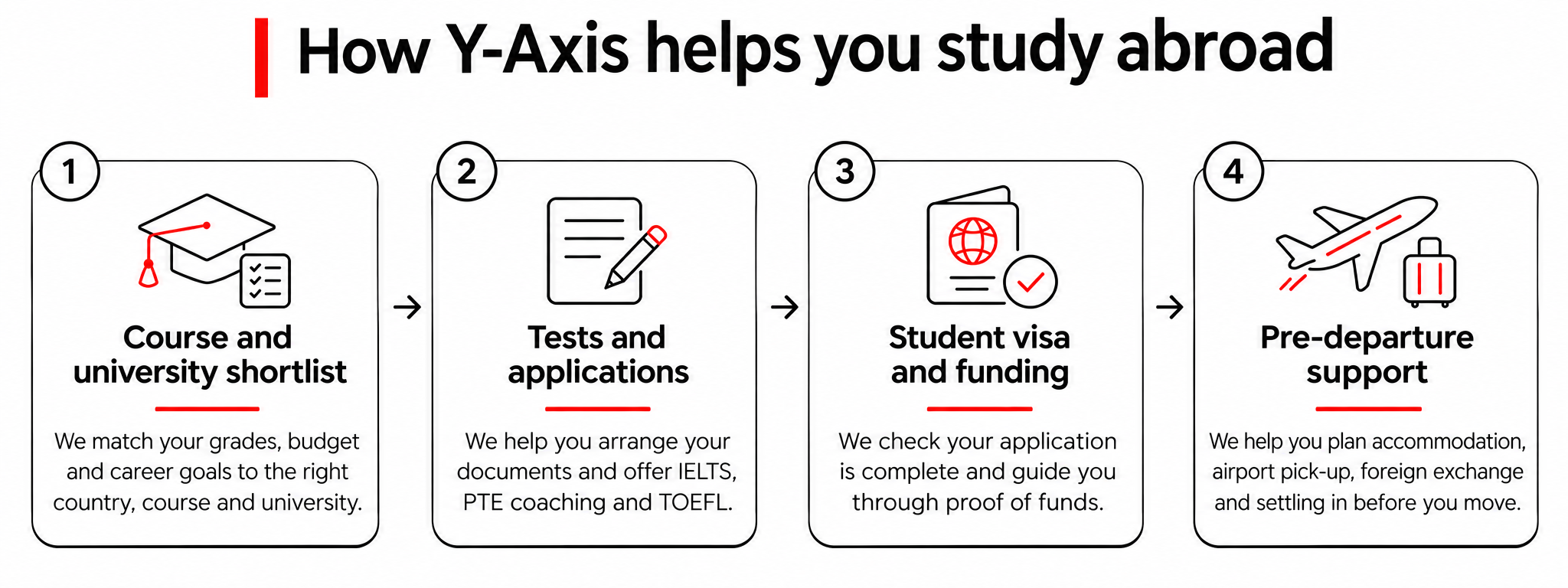
- Course and university shortlist: we match your grades, budget and career goals to the right country, course and university.
- Tests and applications: we help you arrange your documents, SOP, CV and recommendation letters, and offer IELTS and PTE coaching (link: /coaching/) as well as TOEFL.
- Student visa and funding: we check that your visa application is complete and follows the current rules, and guide you through proof of funds and financial aid.
- Pre-departure support: we help you plan accommodation, airport pick-up, foreign exchange and settling in before you move.
Best Places to Study Abroad
The UK, the USA, Canada, Australia, Germany and Ireland are the best places to study abroad for most students. Each offers strong universities and a clear route to work after you graduate, but costs and rules differ a lot.
| Country | Visa fee | Money to show for living | Work after studies |
|---|---|---|---|
| UK | £558 | £1,529/month in London; £1,171 elsewhere, for up to 9 months | Graduate visa: 2 years (18 months from 1 January 2027); 3 years for PhD graduates |
| USA | $185 + $350 SEVIS | As shown on your I-20 | OPT: 12 months + 24-month STEM extension for eligible graduates |
| Canada | CAD 150 + CAD 85 biometrics | CAD 23,448 a year | PGWP: up to 3 years, subject to eligibility |
| Australia | AUD 2,500 | AUD 29,710 a year | Temporary Graduate visa: generally 2–3 years, depending on qualification |
| Germany | EUR 75 | EUR 11,904 a year in a blocked account | Up to 18 months to find qualified employment |
| Ireland | Check Irish Immigration Service | Check Irish Immigration Service | Stamp 1G: 12–24 months |
| France | EUR 50 for eligible applications under the Etudes en France procedure; EUR 99 for other long-stay applications | At least EUR 877.50 per month | Up to 12 months under the eligible graduate job-search or business-creation route |
| Netherlands | EUR 254 | EUR 1,130.77 per month for university and higher professional education students | 12-month Orientation Year residence permit |
| New Zealand | From NZD 850 | NZD 20,000 a year for tertiary students | Post-Study Work Visa: up to 3 years, depending on qualification |
| Switzerland | Check the Swiss representation handling your application | Financial requirements are determined by the relevant canton; check the university and cantonal authority | Up to 6 months to look for work for eligible graduates of Swiss higher education institutions |
| Sweden | SEK 1,500 | SEK 10,656 per month | Up to 12 months to look for work or explore starting a business after eligible studies |
- UK: suits students who want a one-year master's and a short, lower-cost route to a degree.
- USA: suits STEM students who want the widest choice of universities and up to 3 years of OPT work.
- Canada: suits students who want work rights during study and a post-graduation work permit.
- Australia: suits students who want up to 48 hours of work per fortnight in term and 2-3 years of post-study work.
- Germany: suits budget-focused students, as most public universities charge little or no tuition.
- Ireland: suits master's students who want up to 2 years to stay and work in an English-speaking EU country.
Top Universities to Study Abroad: QS World University Rankings 2027
The QS World University Rankings 2027, released on 18 June 2026, feature more than 1,500 universities across 106 higher education systems. Massachusetts Institute of Technology (MIT) holds the number one position for the 15th consecutive year. The USA has 184 ranked universities, while the UK has 93.
The table below highlights the world's highest-ranked universities, giving you a starting point when comparing international study destinations.
| QS 2027 rank | University | Country |
|---|---|---|
| 1 | Massachusetts Institute of Technology (MIT) | USA |
| =2 | Imperial College London | UK |
| =2 | Stanford University | USA |
| 4 | University of Oxford | UK |
| 5 | Harvard University | USA |
| 6 | University of Cambridge | UK |
| 7 | California Institute of Technology (Caltech) | USA |
| =8 | ETH Zurich | Switzerland |
| =8 | University College London (UCL) | UK |
| 10 | National University of Singapore (NUS) | Singapore |
| 11 | The University of Hong Kong | Hong Kong SAR, China |
| 12 | Nanyang Technological University, Singapore (NTU Singapore) | Singapore |
| 13 | Peking University | China |
| 14 | Tsinghua University | China |
| 15 | University of Pennsylvania | USA |
| =16 | Cornell University | USA |
| =16 | Yale University | USA |
| 18 | The Chinese University of Hong Kong (CUHK) | Hong Kong SAR, China |
| 19 | The University of New South Wales (UNSW Sydney) | Australia |
| =20 | Johns Hopkins University | USA |
| =20 | University of California, Berkeley (UCB) | USA |
Study Abroad Programmes: Which type suits you?
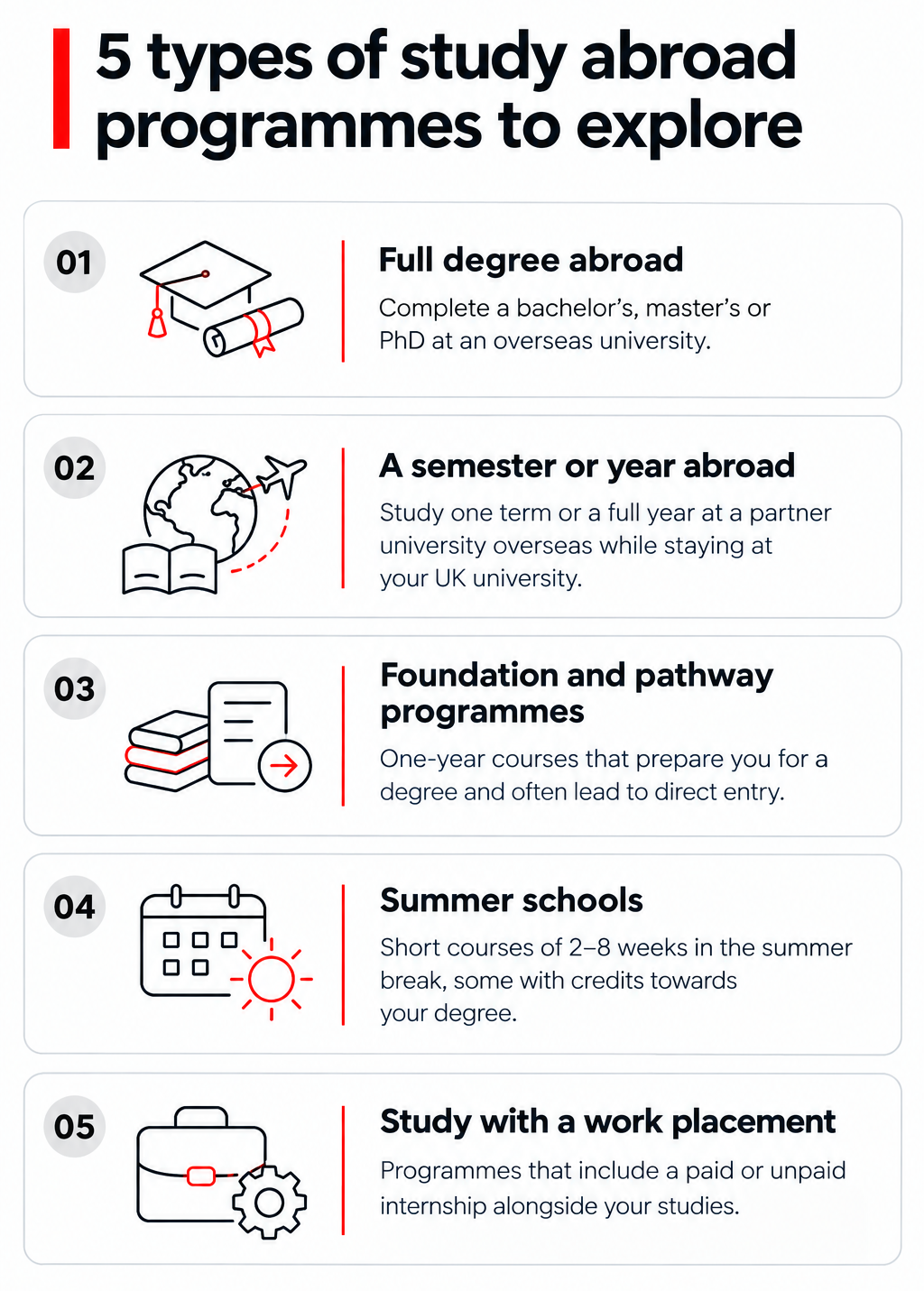
- Full degree abroad: You enrol for a whole bachelor's, master's or PhD at an overseas university. A bachelor's usually takes 3-4 years and a master's 1-2 years. This suits students who plan to build a career or stay on in that country.
- A semester or year abroad as part of a UK degree: You stay registered at your UK university and spend one term or a full year at a partner university overseas. It adds 4-12 months abroad, often without adding time to your degree. This suits students already at a UK university who want international experience.
- Foundation and pathway programmes: These one-year courses prepare you for a degree when your grades or English do not yet meet direct entry. Many lead straight into the first year at a partner university. They suit school leavers and students moving between education systems.
- Summer schools: Short courses of 2-8 weeks run in the summer break by universities abroad. Some carry credits towards your degree. They suit students who want to try studying abroad before committing to a full degree.
- Study with a work placement: Some programmes build in a paid or unpaid internship, such as co-op programmes in Canada or a placement year in Europe. They add 3-12 months and suit students who want work experience alongside their qualification.
How to do a Master’s or MBA abroad
Studying for a postgraduate degree abroad can help you gain specialist knowledge, develop practical skills and improve your career opportunities. Course duration, admission requirements and tuition fees vary by country and university. Most UK master’s degrees take one year to complete, while most US master’s programmes take two years. In Canada, Australia, Germany and Ireland, programmes usually last between one and two years.
Master’s degree duration by country
| Study destination | Typical duration |
|---|---|
| UK | 1 year |
| USA | 2 years |
| Canada | 1–2 years |
| Australia | 1–2 years |
| Germany | 1–2 years |
| Ireland | 1–2 years |
| France | 1–2 years |
| Netherlands | 1–2 years |
| New Zealand | 1–2 years |
| Switzerland | 1.5–2 years |
| Sweden | 1–2 years |
Study a Master’s (MS or MSc) abroad
An MS or MSc (Master of Science) is a postgraduate programme that helps you develop advanced knowledge and specialist skills in a particular subject. Popular study areas include engineering, computer science, data science, business, finance and healthcare. A master’s degree abroad can provide international academic experience and help you explore career opportunities in different countries. Course duration, entry requirements and fees depend on the subject, university and destination.
Master’s programmes by study area
| Study area | Popular programme options | What you can gain |
|---|---|---|
| Engineering | Mechanical Engineering, Civil Engineering, Electrical Engineering | Technical expertise and specialist engineering skills |
| Computer Science and IT | Computer Science, Artificial Intelligence, Cybersecurity | Advanced computing and technology skills |
| Business and Management | International Business, Management, Business Analytics | Business knowledge and management skills |
| Data and Analytics | Data Science, Business Analytics, Data Analytics | Skills in data analysis, modelling and decision-making |
| Finance and Accounting | Finance, Accounting, Financial Management | Specialist financial and analytical knowledge |
| Healthcare | Public Health, Healthcare Management, Biomedical Science | Knowledge and skills for healthcare and related fields |
Study an MBA abroad
An MBA (Master of Business Administration) is a popular postgraduate qualification for students who want to develop business and management skills. Popular destinations include the UK, USA, Germany, Australia and Canada. Depending on the university, admission may require a GMAT or GRE score, an English language test such as IELTS or TOEFL, and around 3–5 years of work experience. Some universities may offer admission without all these requirements. Popular MBA specialisations include finance, marketing, human resources, supply chain management and project management.
Popular MBA specialisations and Top Universities
| MBA specialisation | Top Universities |
|---|---|
| Marketing | IU International University of Applied Sciences (Germany); University of Newcastle (Australia); University of Sunderland (UK); California State University, Los Angeles (USA) |
| Finance | Coventry University (UK); New York Institute of Technology (USA); University of South Australia (Australia) |
| Human Resources | Pace University (USA); University of Bedfordshire (UK); University of Newcastle (Australia); University of Sunderland (UK) |
| Supply Chain Management | Colorado Technical University (USA); Kühne Logistics University (Germany); University of South Dakota (USA) |
| Project Management | Torrens University (Australia); Salem University (USA); University of Bedfordshire (UK) |
Study a PhD abroad
A PhD is a research-based degree for students who want to develop expertise in a specific subject and contribute original research to their field. It is suitable for those interested in academic careers, research roles or specialist professional positions. A PhD usually takes 3–4 years in the UK and Europe, while programmes in the USA often take five years or more because they normally include taught coursework as well as research. Many PhD opportunities are funded through studentships or research assistantships. It is useful to contact potential supervisors early, explore available funding and check the exact programme duration and entry requirements on each university’s website.
PhD duration and study options by destination
| Study destination | Typical duration or programme structure |
|---|---|
| UK | Usually 3–4 years |
| Europe | Usually 3–4 years |
| USA | Often 5 years or more; programmes normally include taught coursework and research |
Note: These are typical durations, not guaranteed completion times. The length of a programme can vary by university, research subject and study arrangement.
How much does it cost to study abroad?
The cost of studying abroad is tuition plus living costs, visa fees and health cover. Each country sets the money you must show for living costs when you apply for your student visa:
| Country | Money to show for living costs | Additional Costs |
|---|---|---|
| UK | £1,529 per month in London or £1,171 per month elsewhere, up to 9 months, held for 28 days in a row | Course fees shown on your CAS; healthcare surcharge £776 a year |
| USA | As shown on your I-20 | Tuition as shown on your I-20 |
| Canada | CAD 23,448 a year (single applicant outside Quebec, from 1 Sept 2026) | First-year tuition and travel |
| Australia | AUD 29,710 a year (main applicant) | Tuition and travel |
| Germany | EUR 11,904 a year in a blocked account (EUR 992 a month) | Semester contribution and any tuition |
| Ireland | Check irishimmigration.ie | Tuition |
Student visa fees, processing times and work rights
| Country | Student visa fee | Processing | Work while studying |
|---|---|---|---|
| UK | £558 (from 8 April 2026), plus £776 a year healthcare surcharge | Usually within 3 weeks of your biometrics appointment (outside the UK). Apply up to 6 months before your course | Up to 20 hours a week in term at degree level; full time in official vacations |
| USA | $185 application fee + $350 SEVIS I-901 fee. A $250 Visa Integrity Fee is in US law; collection varies by post | Interview wait times vary by consulate. Check the State Department wait-time tool | On-campus work up to 20 hours a week in term; off-campus work only through CPT or OPT |
| Canada | CAD 150 + CAD 85 biometrics | Check IRCC's processing-times tool | Up to 24 hours a week off campus in term |
| Australia | AUD 2,500 (from 1 July 2026) | Check the Home Affairs processing-times page | 48 hours per fortnight in term; unlimited in scheduled breaks |
| Germany | EUR 75 national visa | Check your local German mission | 140 full days or 280 half days a year |
| Ireland | Check irishimmigration.ie | Check irishimmigration.ie | 20 hours a week in term; 40 hours in set holiday periods |
- UK dependants: since January 2024, only students on postgraduate research courses or government-sponsored courses of 6 months or more can bring dependants.
- Canada: 2026 cap of 408,000 study permits (155,000 for new arrivals, 253,000 extensions). Master's and doctoral students at public DLIs no longer need a provincial attestation letter from 1 January 2026.
- Australia: the 2026 National Planning Level is 295,000 new overseas student commencements, and every applicant must meet the Genuine Student requirement.
Post-Study Work Opportunities in Abroad
Studying abroad can give you the opportunity to gain international work experience after completing your degree. Several popular study destinations offer post-study work routes that allow eligible international graduates to stay and look for a job or work after graduation. The length of stay and eligibility requirements vary by country, qualification and course. Compare the options below to understand the post-study work opportunities available in each destination.
| Country | Post-study work route | Length |
|---|---|---|
| UK | Graduate visa | 2 years if you apply on or before 31 December 2026; 18 months if you apply on or after 1 January 2027; 3 years for a PhD. Fee: £937, plus £1,035 a year for the healthcare surcharge. |
| USA | Optional Practical Training (OPT) | Up to 12 months, plus a 24-month STEM OPT extension for eligible STEM degrees. |
| Canada | Post-Graduation Work Permit (PGWP) | Up to 3 years, depending on programme length. Field-of-study rules apply to many college programmes. |
| Australia | Temporary Graduate visa (subclass 485), Post-Higher Education Work stream | 2 years for bachelor's and master's by coursework; 3 years for master's by research and PhD. |
| Germany | Residence permit to look for work | Up to 18 months for graduates of German universities. |
| Ireland | Stamp 1G Third Level Graduate Programme | 12 months for Level 8 (honours bachelor's); 24 months for Level 9 and above. |
| France | Job search or business creation residence permit (RECE) | Up to 12 months for eligible graduates with a French master's-level or equivalent qualification. |
| Netherlands | Orientation Year residence permit (Zoekjaar) | Up to 12 months for eligible graduates and researchers. |
| New Zealand | Post-Study Work Visa | Up to 3 years, depending on the qualification and period of study. |
| Switzerland | Short-term residence permit for job search | Up to 6 months for eligible graduates of Swiss higher education institutions. |
| Sweden | Residence permit to look for work or explore starting a business | Up to 12 months after bachelor's or master's studies; 12–18 months after doctoral studies. |
Step-by-Step Guide to Applying to Universities Abroad
Step 1: Shortlist your country, course and universities.
Step 2: Take your English test (IELTS, PTE or TOEFL) and any entrance test such as GMAT or GRE.
Step 3: Apply to universities with your transcripts, SOP, CV and references.
Step 4: Accept an offer. The university issues your CAS (UK), I-20 (USA), letter of acceptance (Canada) or CoE (Australia).
Step 5: Show your funds and apply for your student visa. The visa decision is made by the government, not the university.
Who Can Study Abroad from the UK?
You can apply to universities overseas whether you are a British citizen, a UK resident or an international student currently living in the UK. However, admission requirements and student visa rules depend on your nationality, academic qualifications and chosen destination.
You may be eligible to apply if you are:
- A school leaver with A-levels, Scottish Highers or equivalent qualifications.
- A student completing a UK undergraduate degree and planning to pursue a master's abroad.
- A graduate looking to study an MBA, MSc or PhD overseas.
- An international student living in the UK who wants to continue higher education in another country.
Before applying, check whether your academic qualifications are recognised by your chosen university and whether you meet the destination country's student visa requirements.
Entry Requirements for UK Students Applying Abroad
Universities overseas have different admission requirements depending on the country, course and level of study. Your UK qualifications may be accepted directly, or you may need to complete additional academic or language requirements.
Academic requirements by study level
| Study level | Typical entry requirements |
|---|---|
| Bachelor's degree | A-levels, Scottish Highers, T Levels or equivalent school qualifications. Some universities may require specific subjects and grades. |
| Foundation programme | GCSEs or equivalent qualifications, depending on the university and course. |
| Master's degree | A recognised bachelor's degree, usually with a minimum grade or classification specified by the university. |
| MBA | A recognised undergraduate degree. Some universities also require professional experience, GMAT or GRE scores. |
| PhD | A relevant master's degree or, in some cases, a strong bachelor's degree, along with a research proposal and academic references. |
Other admission requirements
Depending on your chosen university, you may also need:
- A minimum academic score or grade.
- English language proficiency.
- Relevant work experience for selected postgraduate courses.
- A portfolio for creative or design-related programmes.
- An entrance examination or interview.
- A research proposal for PhD applications.
Always check the university's official entry requirements before submitting an application.
English Language and Admission Tests
Many overseas universities require international applicants to demonstrate their English language ability. If you have studied in the UK, some universities may accept your previous education as evidence of English proficiency, but exemptions are not automatic.
Common English language tests
| Test | Purpose |
|---|---|
| IELTS Academic | Measures English language skills for university admission. |
| TOEFL iBT | Tests academic English proficiency. |
| PTE Academic | Computer-based English language test accepted by many universities. |
| Cambridge English qualifications | Some universities accept recognised Cambridge English certificates. |
Other admission tests
| Test | Commonly required for |
|---|---|
| SAT | Undergraduate admissions at some universities, particularly in the USA. |
| ACT | Undergraduate admissions at some US universities. |
| GRE | Selected master's and doctoral programmes. |
| GMAT | MBA and selected business-related postgraduate programmes. |
Test requirements and minimum scores vary by university and course. Check whether your chosen university accepts exemptions based on your previous education.
Scholarships and Funding for UK Students to Study Abroad
Studying overseas can involve tuition fees, accommodation, travel and everyday living expenses. Scholarships and financial assistance can help reduce the cost of an international education. UK students can explore university scholarships, international funding programmes and subject-specific awards. Some scholarships cover full tuition fees, while others provide partial fee reductions or living-cost support.
Types of scholarships and funding
| Funding option | What it offers |
|---|---|
| University scholarships | Financial awards offered directly by overseas universities based on academic performance, subject or other eligibility criteria. |
| Merit-based scholarships | Awards for students with strong academic results or other recognised achievements. |
| Need-based financial aid | Assistance based on a student's financial circumstances, where available. |
| Government-funded scholarships | Funding offered through government or public education programmes in selected countries. |
| Research scholarships | Funding for eligible postgraduate research students, including master's by research and PhD candidates. |
| Erasmus Mundus Joint Master's scholarships | Funding opportunities for eligible students undertaking selected joint master's programmes across European universities. |
Scholarships to explore
- Erasmus Mundus Joint Master's: Offers scholarships for eligible students on selected international joint master's programmes.
- University-specific scholarships: Many universities in the USA, Canada, Australia, Europe and other destinations offer scholarships to international applicants.
- Research funding: Universities and research institutions may offer funded PhD positions, studentships or research assistantships.
Check each scholarship's nationality requirements, academic criteria, funding coverage and application deadlines. Scholarship availability can vary by intake and year.
Student Finance and Loans for Studying Abroad
If you are planning to study overseas from the UK, it is important to understand how your education will be funded. Your eligibility for financial support depends on your usual residence, nationality, course and whether you are undertaking a full degree abroad or an approved study-abroad placement.
Can you get Student Finance England funding to study abroad?
Student Finance England does not generally fund a full degree at an overseas university. However, eligible students enrolled at a UK university may receive financial support for an approved period of study abroad as part of their UK course.
Depending on eligibility and the approved arrangement, support may include:
- Tuition Fee Loans.
- Maintenance Loans.
- Travel grants for eligible study-abroad placements.
- Additional support for certain students with disabilities or other eligible circumstances.
Funding rules differ across England, Scotland, Wales and Northern Ireland. Students should check with the relevant student finance authority and their university before making financial plans.
Other ways to fund an overseas degree
| Funding option | Details |
|---|---|
| Private student loans | Some lenders offer education loans for eligible overseas courses and universities. |
| University scholarships | Scholarships may reduce tuition fees or contribute towards living costs. |
| Government scholarships | Selected countries and public organisations provide funding for international students. |
| Personal savings | Savings can help cover tuition deposits, travel and living expenses. |
| Family sponsorship | Family members may contribute towards tuition and living costs, subject to destination-country financial evidence rules. |
| Graduate or research funding | Eligible postgraduate students may receive studentships, research grants or assistantships. |
Before accepting an offer, calculate the full cost of your course, accommodation, insurance, visa and travel. Also check whether your chosen lender or scholarship provider recognises the overseas university and programme.
Study Abroad Intakes and Application Deadlines
Overseas universities usually offer more than one admission intake each year. The main intake is often in September or autumn, while some universities also accept students in January or during the spring and summer. Applying early gives you more time to prepare your documents, arrange funding, receive an offer and complete your student visa application.
Common study abroad intakes
| Intake | Typical start period | Details |
|---|---|---|
| Autumn or Fall intake | August–October | Main intake in many destinations, including the USA, Canada, UK, Australia and parts of Europe. |
| Spring intake | January–March | Available for selected courses and universities, particularly in the USA and Canada. |
| Summer intake | May–July | Offered by selected universities for specific programmes, foundation courses and short-term study options. |
When should you start your application?
| Time before course starts | What to do |
|---|---|
| 12–18 months | Research countries, courses, universities and funding options. |
| 9–12 months | Prepare for English language or admission tests and shortlist universities. |
| 6–9 months | Submit university and scholarship applications. |
| 3–6 months | Accept your offer, arrange funding and prepare student visa documents. |
| 1–3 months | Complete visa formalities, arrange accommodation and plan your travel. |
Application deadlines vary by university, course and intake. Competitive programmes and scholarship applications may close earlier, so check the relevant university deadlines before applying.
Why Choose Y-Axis Study Abroad Consultant?
Y-Axis is a trusted study overseas consultant with expertise in guiding students to gain an excellent education. Realizing this aspiration is a great way to boost the student's future career. The services offered by Y-Axis to study abroad help students live their dream lives.
Y-Axis Services
Preparing for tests and guiding with the application process: After selecting a suitable university, Y-Axis study visa consultants assist you in arranging the required documents, SOP, CVs, and recommendation letters. Additionally, the team submits your student visa application and documents on your behalf. Y-Axis abroad education consultants offer standardized test coaching services.
*Want to avail of coaching to ace your tests? Let Y-Axis Coaching Services help you!
Visa application and financial aid: Applying for a visa can be time-consuming and puzzling if you are unaware of the timeline, rules, and procedures. Study abroad consultants ensure that the application is error-free and that the procedures comply with the current rules. Leading study abroad consultants also guide you through the financial aid requirements and lessen the expenses.
*Sign up with Y-Axis to know more about study abroad consultancy!
Travel assistance: Studying abroad is a significant decision. If you have never traveled to a foreign country, leading study abroad consultants offer pre-departure services and ease the students' anxiety. Before moving abroad, you must handle accommodation, airport pick-up, foreign exchange, and cultural adaptability.
Our Accreditations |
|||
 |
 |
 |
 |
Looking for Inspiration
Explore what global Indians have to say about Y-Axis in shaping their future
Frequently Asked Questions