

Posted on June 22 2026
What are the eligibility requirements for an Ireland Work Visa?

By , Editor & Director
Updated June 22 2026
To be eligible for an Ireland Work Visa, you must have a confirmed job offer from an Irish employer and obtain an approved employment permit. Most applicants qualify through either the Critical Skills Employment Permit for shortage occupations with a minimum annual salary of €40,904 or the General Employment Permit for eligible skilled roles with a minimum salary of €36,605. UK citizens can work in Ireland without a visa or employment permit under the Common Travel Area, while non-EEA nationals residing in the UK must secure the appropriate employment permit before relocating to Ireland for work.
|
Requirement |
Details |
|
Job Offer |
Confirmed offer from an Irish employer for a minimum of two years |
|
Permit Type |
Critical Skills Employment Permit or General Employment Permit depending on role and salary |
|
CSEP Salary |
€40,904 per year with a relevant degree; €68,911 without a relevant degree |
|
GEP Salary |
€36,605 per year for most roles; €32,691 for healthcare assistants and agri-food workers |
|
Qualifications |
Relevant degree and experience for CSEP; role-specific qualifications for GEP |
|
Language |
No official language test required; employer determines language requirements |
|
Processing Time |
8 to 16 weeks total including employment permit and any visa processing |
*Want to apply for an Ireland Work Visa? Let Y-Axis guide you through every step of the process.
Eligibility Requirements for an Ireland Work Visa
Eligibility for an Ireland Work Visa depends on your occupation, qualifications, salary, and employment permit category. Most non-EEA nationals residing in the UK apply through either the Critical Skills Employment Permit or the General Employment Permit.
To qualify for an Ireland Work Visa, you need:
- A confirmed job offer from an Irish employer for a minimum duration of two years
- A salary meeting the minimum threshold for your permit type — €40,904 for CSEP or €36,605 for GEP
- Relevant qualifications and professional experience suited to your nominated role
- A valid passport with sufficient validity for the duration of your employment permit
- Compliance with Irish immigration requirements for employment permit holders
- A Long Stay D Visa if your nationality requires one to enter Ireland
- For CSEP: a role on the Critical Skills Occupation List or a salary of €68,911 for roles not on the list
- For GEP: employer Labour Market Needs Test confirming the role was advertised locally before being offered internationally
*Want to check your eligibility? Get a free eligibility assessment from Y-Axis today.
Documents Required for an Ireland Work Visa
To apply for an Ireland Work Visa, you must provide documents supporting your job offer, qualifications, identity, and immigration eligibility. If your nationality requires a Long Stay D Visa, you must submit a separate visa application after your employment permit has been approved.
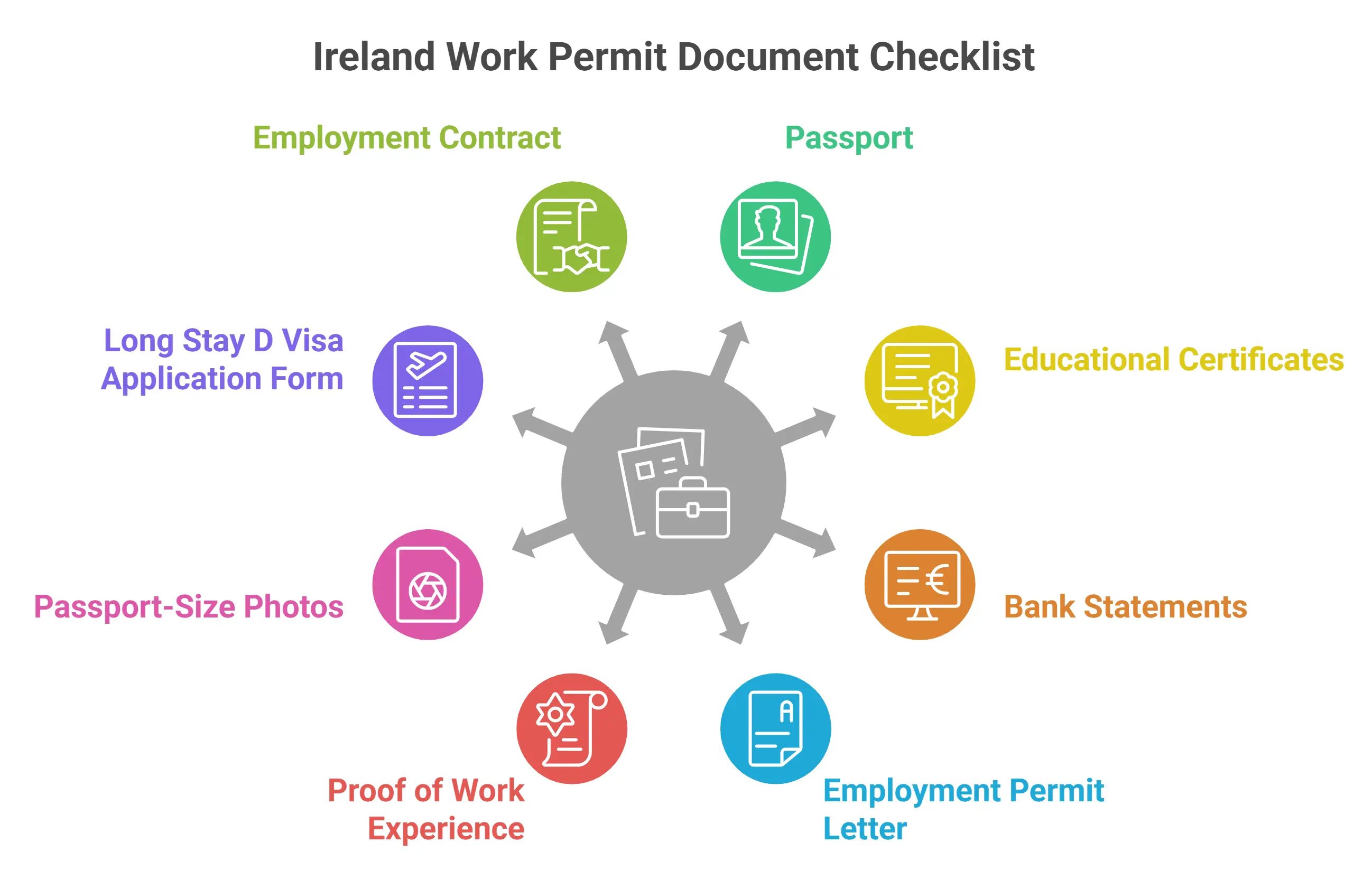
- Valid passport with sufficient validity for your intended stay in Ireland
- Signed employment contract confirming job title, salary, and duration of employment
- Educational certificates, degrees, and professional qualification documents
- Evidence of relevant work experience such as reference letters or payslips
- Bank statements showing proof of sufficient funds to support yourself on arrival
- Passport-size photographs meeting Irish visa specifications
- Employment permit approval letter issued by the relevant Irish authority
- Completed Long Stay D Visa application if your nationality requires entry clearance to Ireland
How to Apply for an Ireland Work Visa from the UK?
The Ireland Work Visa application process from the UK starts with securing a job offer from an Irish employer and obtaining an approved employment permit. Depending on your nationality, you may also need to apply for a Long Stay D Visa before travelling to Ireland. Once the required approvals are in place, you can make arrangements to move to Ireland and begin employment.
Step 1: Secure a confirmed job offer from an Irish employer for a role that meets the salary and eligibility requirements for the Critical Skills Employment Permit or General Employment Permit.
Step 2: Your employer submits the employment permit application on your behalf, including all required supporting documents confirming the role and salary.
Step 3: The employment permit application is processed by the relevant Irish authority, typically taking 4 to 8 weeks.
Step 4: Once your employment permit is approved, check whether your nationality requires a Long Stay D Visa to enter Ireland. If so, gather all required documents and submit your visa application.
Step 5: Pay any applicable visa fees and await your visa decision if a D Visa is required. Visa processing typically takes 4 to 8 weeks.
Step 6: Travel to Ireland once all permits and visas are in order and register your immigration permission with the relevant Irish immigration authority upon arrival.
*Want to apply for an Ireland Work Visa? Get expert guidance from Y-Axis professionals.
FAQs
Do UK citizens need a work permit to work in Ireland?
No. UK citizens can live and work in Ireland without a visa or employment permit under the Common Travel Area agreement. They can enter Ireland using a valid UK passport and start employment immediately. However, non-EEA nationals living in the UK generally require an Irish employment permit and may also need a visa to work in Ireland.
What salary do I need for an Ireland Work Visa from the UK?
The salary requirement depends on the employment permit type. Critical Skills Employment Permits generally require a minimum salary of €40,904 per year, while General Employment Permits require €36,605 per year for most occupations. Lower salary thresholds may apply to certain healthcare, home care, and agri-food positions that qualify under specific permit rules.
What is the Critical Skills Employment Permit and who qualifies?
The Critical Skills Employment Permit is designed for highly skilled professionals in shortage occupations. It generally requires a minimum salary of €40,904 per year and does not require a Labour Market Needs Test. Eligible permit holders can bring their family immediately and may qualify for Stamp 4 permission after 21 months.
What is the General Employment Permit and who qualifies?
The General Employment Permit is available for a broader range of occupations and generally requires a minimum salary of €36,605 per year. Employers must complete a Labour Market Needs Test before sponsoring an overseas worker. Permit holders may apply for family reunification after meeting eligibility requirements and can generally qualify for Stamp 4 after five years.
What jobs are in demand in Ireland for UK-based professionals?
Ireland has strong demand for skilled professionals in IT, software development, engineering, healthcare, pharmaceuticals, financial services, and construction. Many of these occupations appear on Ireland’s Critical Skills Occupations List. UK-based professionals with recognised qualifications and relevant experience are often well positioned to secure opportunities in these high-demand sectors.
How much does an Ireland Work Visa cost from the UK?
Employment permit fees are generally €1,000 for permits valid for more than six months. Applicants who require a Long Stay D Visa may also need to pay €60 for a single-entry visa or €100 for a multiple-entry visa. Additional costs may include document preparation and immigration registration fees.
How long does Ireland Work Visa processing take from the UK?
Employment permit applications are typically processed within 4 to 8 weeks. Applicants who require a Long Stay D Visa should allow an additional 4 to 8 weeks after permit approval. Applying well in advance of your planned start date is recommended.
What is Stamp 4 and how does it benefit professionals working in Ireland?
Stamp 4 is an Irish immigration permission that allows holders to work for any employer without requiring a separate employment permit. Critical Skills Employment Permit holders can generally obtain Stamp 4 after 21 months, while General Employment Permit holders may qualify after five years. It provides greater job flexibility and long-term settlement benefits.
Can the Ireland Work Visa lead to permanent residency and citizenship?
Yes. Individuals who complete five years of continuous legal residence in Ireland on a qualifying employment permit may become eligible for long-term residence or permanent residency. Those who satisfy the residence requirements for naturalisation may also apply for Irish citizenship, which provides the right to live and work across the European Union.
Can I bring my family to Ireland on a Work Visa?
Yes. Critical Skills Employment Permit holders can generally bring their spouse or partner and dependent children to Ireland immediately. Spouses and partners may work without a separate employment permit. General Employment Permit holders can usually apply for family reunification after 12 months, subject to meeting the relevant immigration requirements.
Tags:
Ireland Work Visa
Ireland Work Permit
Ireland Work Visa Requirements
Ireland Immigration
Work in Ireland
Ireland Critical Skills Permit
Ireland General Employment Permit
Ireland Work Visa UK
Ireland PR
Ireland Stamp 4
Share
Y-Axis Services

Get it on your mobile

Get News alerts

Contact Y-Axis
Latest Article
Popular Post
Trending Article

Posted On October 21 2026
What is the Average Salary in the UAE?