

Posted on August 04 2026
Top 10 Countries for Electrical Engineers to Work Abroad: Salary, Demand & PR Opportunities Compared

By , Editor & Director
Updated August 10 2026
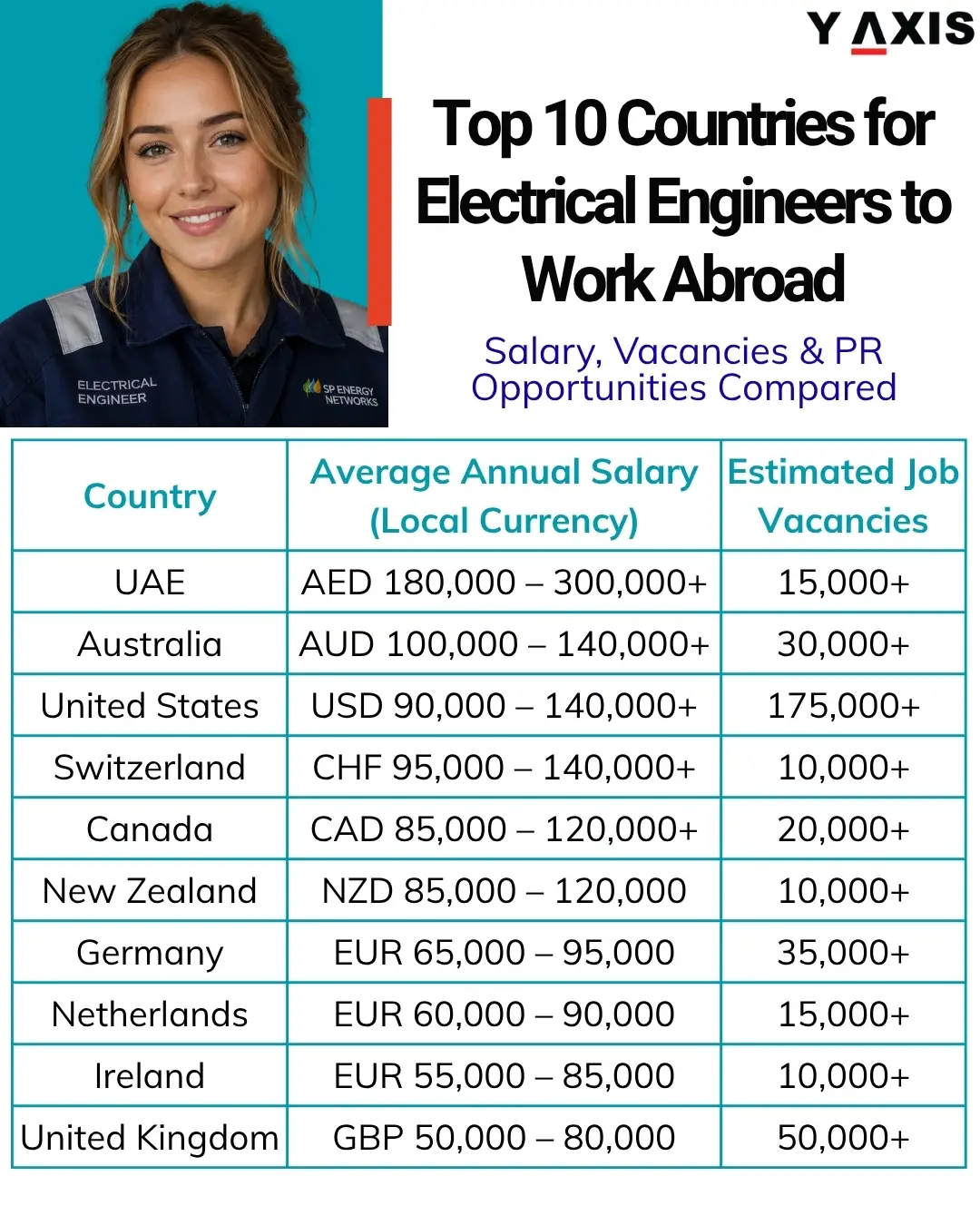
The best countries for Electrical Engineers to work abroad are Canada, Australia, Germany, the United States, Ireland, the Netherlands, the United Kingdom, Switzerland, New Zealand, and the United Arab Emirates. These countries offer competitive salaries, strong demand for Electrical Engineers, work visa options, and permanent residency (PR) pathways.
Global demand for Electrical Engineers continues to grow due to rapid expansion in renewable energy, electricity networks, smart grids, electric vehicle infrastructure, semiconductor manufacturing, AI-powered data centres, and industrial automation. According to the International Energy Agency (IEA), global electricity demand is projected to grow by an average of 3.6% annually through 2027, driving investment in electrical infrastructure and increasing demand for Electrical Engineers worldwide.
*Want to work abroad? Avail Y-Axis Resume Marketing Services to find the right job faster
Why Demand for Electrical Engineers is increasing globally?
Electrical Engineers are in increasing demand worldwide because power systems, digital infrastructure, and advanced manufacturing continue to expand. According to the International Energy Agency (IEA), global data centre electricity consumption is projected to reach around 945 TWh by 2030, increasing investment in power systems, grid capacity, and electrical infrastructure.
- Power grid modernization: Upgrading transmission networks, substations, and smart grids.
- AI-powered data centres: Expanding power distribution, cooling, and backup power systems.
- Semiconductor manufacturing: Building and automating advanced chip production facilities.
- Battery energy storage systems: Integrating large-scale energy storage with electricity grids.
- Industrial automation: Increasing the use of PLC, SCADA, robotics, and control systems.
- Transmission and distribution expansion: Building new power lines, substations, and distribution networks.
How to Choose Right Country for Electrical Engineer Jobs Abroad?
Choosing the right country for Electrical Engineer jobs abroad involves comparing job demand, salaries, work visa options, licensing requirements, and permanent residency pathways. Evaluating these factors can help you select a destination that aligns with your career goals.
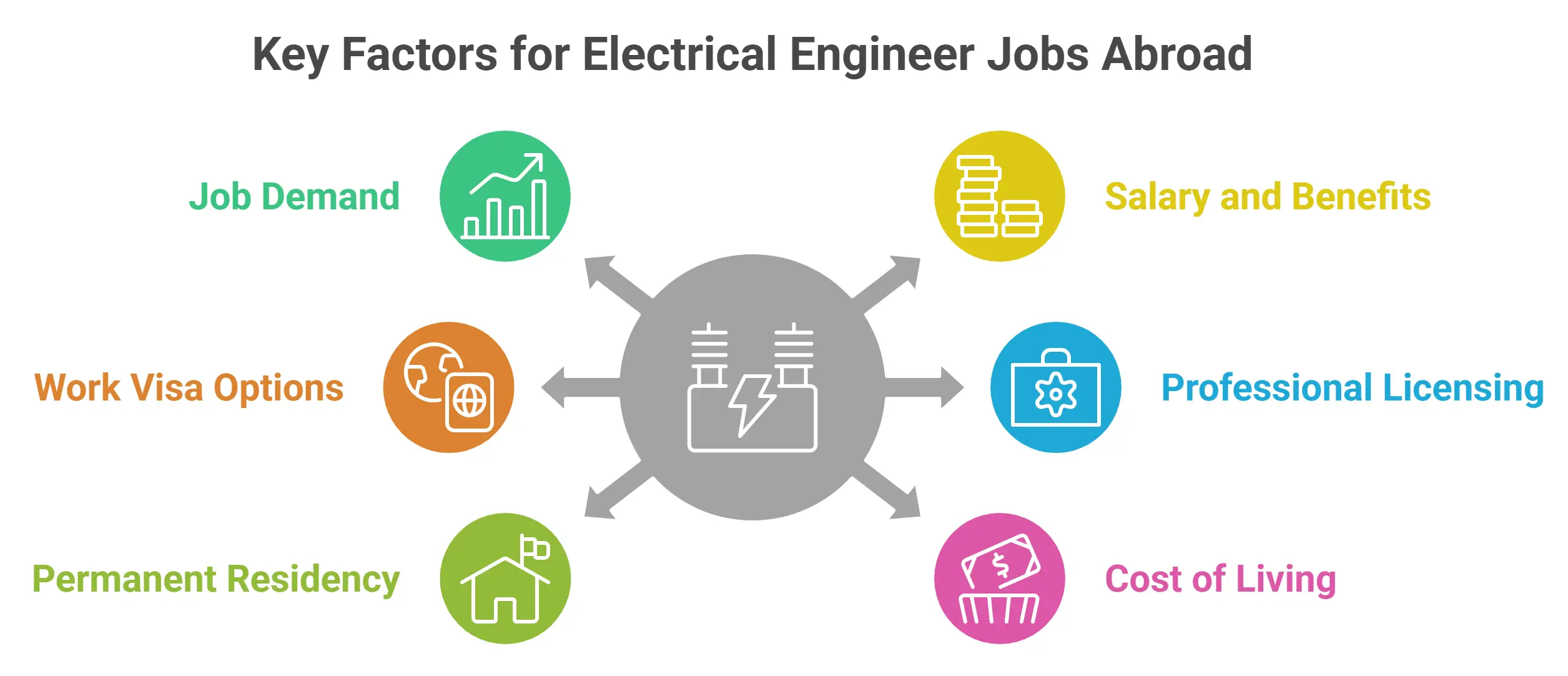
- Job demand: Look for countries with consistent hiring across key industries.
- Salary and benefits: Compare annual salaries, taxes, and employment benefits.
- Work visa options: Review visa requirements, sponsorship, and processing times.
- Professional licensing: Check registration or licensing requirements before applying.
- Permanent residency: Consider countries with clear long-term settlement pathways.
- Cost of living: Compare housing, transport, healthcare, and daily expenses.
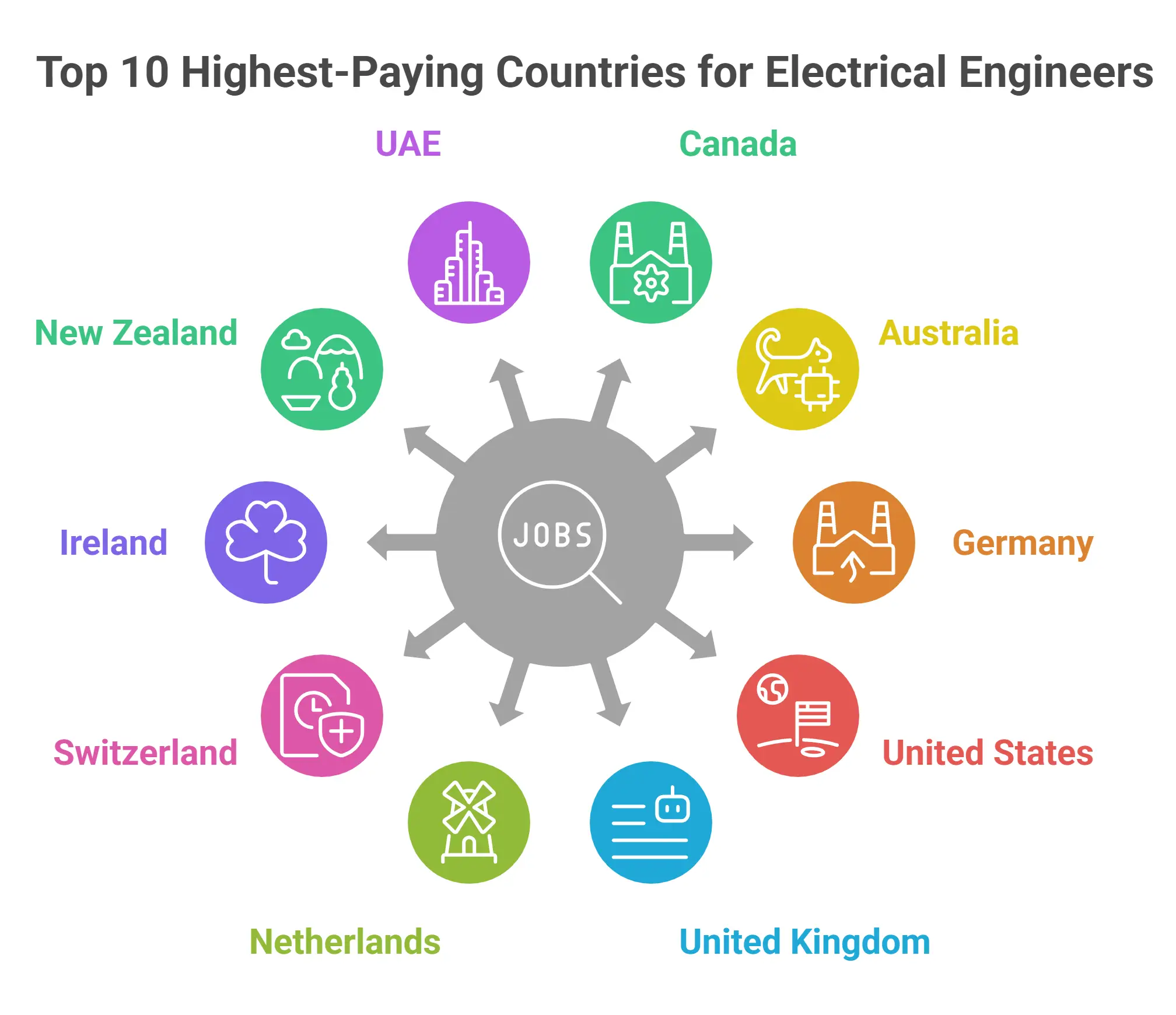
Top 10 Highest-Paying Countries for Electrical Engineers to Work Abroad
Switzerland, the United States, Canada, Australia, Germany, and the Netherlands are among the highest-paying countries for Electrical Engineers, with average annual salaries ranging from £45,000 to over £100,000. Demand remains strong for roles such as Power Systems Engineer, Electrical Design Engineer, Controls Engineer, Automation Engineer, and Grid Engineer across renewable energy, semiconductor manufacturing, utilities, industrial automation, and electrical infrastructure. These industries continue to recruit Electrical Engineers for large-scale power, manufacturing, and infrastructure projects.
|
Country |
Average Annual Salary (Local Currency) |
Estimated Electrical Engineer Job Vacancies |
|
Canada |
CAD 85,000 – 120,000+ |
20,000+ |
|
Australia |
AUD 100,000 – 140,000+ |
30,000+ |
|
Germany |
EUR 65,000 – 95,000 |
35,000+ |
|
United States |
USD 90,000 – 140,000+ |
175,000+ |
|
Ireland |
EUR 55,000 – 85,000 |
10,000+ |
|
Netherlands |
EUR 60,000 – 90,000 |
15,000+ |
|
United Kingdom |
GBP 50,000 – 80,000 |
50,000+ |
|
Switzerland |
CHF 95,000 – 140,000+ |
10,000+ |
|
New Zealand |
NZD 85,000 – 120,000 |
10,000+ |
|
UAE |
AED 180,000 – 300,000+ |
15,000+ |
*Want to work abroad? Avail Y-Axis Resume Marketing Services to find the right job faster.
Best Countries for Electrical Engineers to Work and Settle Abroad
Electrical Engineers can build long-term careers and settle abroad in countries such as Canada, Australia, Germany, the United Kingdom, the Netherlands, New Zealand, and Ireland. These countries offer established immigration pathways that allow eligible Electrical Engineers to transition from work visas to permanent residence. Many also provide access to stable engineering industries, family sponsorship options, public healthcare, and a clear route to citizenship after meeting residency requirements.
Electrical Engineer Jobs in Canada
Canada has strong demand for Electrical Engineers across power generation, renewable energy, utilities, manufacturing, mining, transportation, and electrical infrastructure. Employers recruit for roles such as Power Systems Engineer, Electrical Design Engineer, Controls Engineer, Protection and Control Engineer, Automation Engineer, and Electrical Project Engineer.
Electrical Engineers can work in Canada through employer-sponsored work permits and apply for permanent residence through Express Entry and Provincial Nominee Programs (PNPs). Canada's expansion of electricity transmission networks, clean energy projects, battery manufacturing, and critical mineral processing continues to create new opportunities for Electrical Engineers across the country.
|
Factor |
Details |
|
Electrical Engineer Job Market & Job Opportunities for the Next Decade |
Canada is expected to create more than 15,000 Electrical Engineer jobs over the next decade, driven by electricity grid modernization, clean energy, electric vehicle manufacturing, battery production, industrial automation, and infrastructure projects. |
|
Workforce Expansion & Growing Industries |
Canada is investing over CAD 180 billion through the Investing in Canada Infrastructure Program to expand electricity transmission, renewable energy, battery manufacturing, electric vehicle production, and industrial automation, driving demand for Electrical Engineers. |
|
Top Companies Hiring Electrical Engineers |
Hydro-Québec, Ontario Power Generation, Siemens Canada, Schneider Electric Canada, ABB Canada, GE Vernova Canada, Bombardier, and Tesla recruit Electrical Engineers for power systems, manufacturing, automation, transportation, and infrastructure projects. |
|
Top Cities with Electrical Engineer Jobs |
Toronto, Vancouver, Calgary, Montreal, Ottawa, Edmonton, and Quebec City offer Electrical Engineer jobs across renewable energy, utilities, manufacturing, transportation, semiconductor, and technology industries. |
|
In-Demand Electrical Engineer Roles & Skills |
Common roles include Power Systems Engineer, Electrical Design Engineer, Automation Engineer, Control Systems Engineer, Protection and Control Engineer, Electronics Engineer, and Renewable Energy Engineer. Key skills include power systems, electrical design, PLC, SCADA, automation, and protection systems. |
|
Work Visa Options for Electrical Engineers |
Electrical Engineers can apply for employer-sponsored work permits, LMIA-based work permits, or the Global Talent Stream for qualifying roles. |
|
Fast-Track Hiring Options |
The Global Talent Stream (GTS) enables eligible employers to recruit Electrical Engineers through faster work permit processing. |
|
PR / Long-Term Residence Options |
Electrical Engineers can apply for permanent residence through Express Entry, including the Federal Skilled Worker Program (FSWP) and Provincial Nominee Programs (PNPs). |
|
Family Sponsorship & Dependents |
Spouses and dependent children can accompany Electrical Engineers through Canada's work permit and permanent residence pathways. |
|
Benefits for Family Members |
Spouses can apply for work authorization, children can attend public schools, and families can access provincial healthcare under applicable Canadian immigration programmes. |
*Want to Work in Canada? Let Y-Axis guide you through application process.
Electrical Engineer Jobs in Australia
Australia offers excellent job opportunities for Electrical Engineers as the country expands renewable energy, electricity transmission networks, battery energy storage systems, and major mining and infrastructure projects. Employers recruit for roles including High Voltage Engineer, Power Systems Engineer, Electrical Design Engineer, Protection and Control Engineer, Automation Engineer, and Electrical Project Engineer.
Electrical Engineers can work in Australia through employer-sponsored visas and skilled migration pathways, including the Subclass 189, 190, 491, 482, and 186 visas. According to the Australian Energy Market Operator (AEMO), around 6,000 km of new transmission lines will be needed by 2050 to support Australia's energy transition, creating long-term demand for Electrical Engineers.
|
Factor |
Details |
|
Electrical Engineer Job Market & Job Opportunities Over the Next Decade |
Australia is expected to create more than 30,000 Electrical Engineer jobs over the next decade, driven by renewable energy, electricity network upgrades, mining electrification, industrial automation, and major infrastructure projects. |
|
Workforce Expansion & Growing Industries |
Australia is investing more than AUD 22.7 billion through the Future Made in Australia initiative to expand renewable energy, clean manufacturing, battery storage, electricity networks, and industrial technologies, driving demand for Electrical Engineers. |
|
Top Companies Hiring Electrical Engineers |
Schneider Electric, Siemens Australia, Tesla, BHP, Rio Tinto, Woodside Energy, AGL Energy, Origin Energy, and major electricity network operators recruit Electrical Engineers across energy, mining, automation, and infrastructure projects. |
|
Top Cities with Electrical Engineer Jobs |
Sydney, Melbourne, Brisbane, Perth, Adelaide, and Canberra offer Electrical Engineer jobs across renewable energy, utilities, mining, manufacturing, defence, and technology industries. |
|
In-Demand Electrical Engineer Roles & Skills |
Common roles include Power Systems Engineer, Electrical Design Engineer, Renewable Energy Engineer, Control Systems Engineer, Automation Engineer, Grid Connection Engineer, and Protection Engineer. Key skills include power systems, electrical design, PLC, SCADA, protection systems, and renewable energy integration. |
|
Work Visa Options |
Electrical Engineers can apply through the Skilled Independent Visa (Subclass 189), Skilled Nominated Visa (Subclass 190), Skilled Work Regional Visa (Subclass 491), Skills in Demand Visa (Subclass 482), and Employer Nomination Scheme Visa (Subclass 186). |
|
Fast-Track Hiring Options |
Employer-sponsored pathways, including the Skills in Demand Visa (Subclass 482), provide faster recruitment for Electrical Engineers in energy, infrastructure, mining, and technology sectors. |
|
PR / Long-Term Residence Options |
Electrical Engineers can apply for permanent residence through the Skilled Independent Visa (Subclass 189), Skilled Nominated Visa (Subclass 190), and Employer Nomination Scheme Visa (Subclass 186). |
|
Family Sponsorship & Dependents |
Spouses and dependent children can be included in skilled migration and employer-sponsored visa applications. |
|
Benefits for Family Members |
Spouses may receive work rights, children can attend Australian schools, and families may access healthcare through Medicare, depending on the visa category. |
*Planning to Work in Australia? Let Y-Axis guide you through every step of the process.
Electrical Engineer Jobs in Germany
Germany is one of Europe's leading destinations for Electrical Engineers, driven by advanced manufacturing, Industry 4.0, semiconductor production, electric vehicle manufacturing, and industrial automation. Employers recruit for roles including Automation Engineer, PLC Engineer, Electrical Design Engineer, Controls Engineer, Power Systems Engineer, and Electrical Project Engineer.
Electrical Engineers can work in Germany through the EU Blue Card and the Skilled Immigration Act, with pathways to permanent residence. Germany's semiconductor industry is expected to grow by nearly 10% annually through 2030, while continued investment in electricity grid expansion and industrial electrification is creating long-term opportunities for Electrical Engineers.
|
Factor |
Details |
|
Electrical Engineer Job Market & Job Opportunities for the Next Decade |
Germany is expected to create more than 35,000 Electrical Engineer jobs over the next decade, driven by electric vehicle manufacturing, renewable energy, industrial automation, semiconductor production, and electricity grid modernization. |
|
Workforce Expansion & Growing Industries |
Germany is investing more than €500 billion in infrastructure and climate transformation projects by 2030, expanding renewable energy, electricity networks, digital infrastructure, semiconductor manufacturing, and industrial modernization, driving demand for Electrical Engineers. |
|
Top Companies Hiring Electrical Engineers |
Siemens, BMW Group, Volkswagen Group, Bosch, Infineon Technologies, BASF, ABB Germany, and Mercedes-Benz Group recruit Electrical Engineers for automotive, automation, semiconductor, energy, and industrial projects. |
|
Top Cities with Electrical Engineer Jobs |
Munich, Stuttgart, Berlin, Frankfurt, Hamburg, Cologne, and Düsseldorf offer Electrical Engineer jobs across automotive, semiconductor, renewable energy, manufacturing, and technology industries. |
|
In-Demand Electrical Engineer Roles & Skills |
Common roles include Power Systems Engineer, Automation Engineer, Embedded Systems Engineer, Electrical Design Engineer, Control Systems Engineer, and Electronics Engineer. Key skills include industrial automation, power electronics, embedded systems, robotics, PLC, renewable energy systems, and electrical design. |
|
Work Visa Options for Electrical Engineers |
Electrical Engineers can apply through the EU Blue Card, German Skilled Worker Visa, Opportunity Card (Chancenkarte), and employer-sponsored work permits. |
|
Fast-Track Hiring Options |
Germany's Accelerated Skilled Worker Procedure helps employers recruit international Electrical Engineers more quickly for shortage occupations. |
|
PR / Long-Term Residence Options |
Electrical Engineers can apply for permanent residence after meeting Germany's residence, employment, and integration requirements. |
|
Family Sponsorship & Dependents |
Spouses and dependent children can accompany Electrical Engineers through Germany's residence permit pathways. |
|
Benefits for Family Members |
Spouses can work, children can attend public schools, and families can access Germany's statutory healthcare system, subject to residence permit conditions. |
Electrical Engineer Jobs in the United States
The United States offers some of the world's highest-paying jobs for Electrical Engineers across AI data centres, semiconductor manufacturing, aerospace, defence, power generation, telecommunications, and advanced manufacturing. Employers recruit for roles including Power Systems Engineer, Electrical Design Engineer, Controls Engineer, Hardware Engineer, Embedded Systems Engineer, and Electrical Project Engineer.
Electrical Engineers can work in the United States through employer-sponsored visas, including the H-1B and EB-2 or EB-3 employment-based immigration pathways. According to the U.S. Bureau of Labour Statistics, employment of Electrical Engineers is projected to grow through 2034, while rising investment in AI infrastructure, semiconductor manufacturing, and electricity networks continues to create long-term demand across the country.
|
Factor |
Details |
|
Electrical Engineer Job Market & Job Opportunities for the Next Decade |
The United States is expected to create more than 175,000 Electrical Engineer jobs over the next decade, driven by semiconductor manufacturing, AI infrastructure, aerospace, defence, renewable energy, and advanced manufacturing. |
|
Investment in Electrical Engineering & Growing Industries |
The US is investing more than USD 9.6 trillion in infrastructure, clean energy, semiconductor manufacturing, advanced manufacturing, and technology, driving demand for Electrical Engineers in chip production, power systems, automation, electric vehicles, and industrial technologies. |
|
Top Employers Hiring Electrical Engineers |
Tesla, GE Vernova, Intel, NVIDIA, Lockheed Martin, Boeing, Microsoft, Apple, and Texas Instruments recruit Electrical Engineers for semiconductor, aerospace, energy, defence, automation, and advanced manufacturing projects. |
|
Top Cities with Electrical Engineer Jobs |
San Jose, Austin, Boston, Seattle, Houston, Dallas, and New York offer Electrical Engineer jobs across semiconductor, aerospace, technology, manufacturing, energy, and research industries. |
|
In-Demand Electrical Engineer Roles |
Common roles include Electrical Engineer, Electronics Engineer, Power Systems Engineer, Hardware Engineer, Semiconductor Engineer, Control Systems Engineer, Embedded Systems Engineer, and Renewable Energy Engineer. |
|
Work Visa Options |
Electrical Engineers can apply through the H-1B visa, O-1 visa, and employment-based immigration pathways, including EB-2 and EB-3, where applicable. |
|
Fast-Track Hiring Options |
Employer sponsorship is widely available for Electrical Engineers working in semiconductor manufacturing, AI infrastructure, renewable energy, aerospace, defence, and advanced manufacturing. |
|
PR / Long-Term Residence Options |
Electrical Engineers can apply for a US Green Card through employment-based immigration pathways, including the EB-2 and EB-3 categories. |
|
Family Sponsorship & Dependents |
Spouses and dependent children can accompany Electrical Engineers through applicable US work visa and employment-based immigration pathways. |
|
Benefits for Family Members |
Depending on the visa category, spouses may qualify for work authorization, children can attend US schools, and families can access employer-sponsored or private healthcare plans. |
*Want to Work in United States? Let Y-Axis guide you through every step of the process.
Electrical Engineer Jobs in Ireland
Electrical Engineer jobs in Ireland are growing across semiconductor manufacturing, pharmaceutical production, medical device manufacturing, hyper scale data centres, renewable energy, and electricity infrastructure. Employers recruit for roles including Automation Engineer, Electrical Design Engineer, Controls Engineer, Commissioning Engineer, Power Systems Engineer, and Electrical Project Engineer.
Electrical Engineers are listed on Ireland's Critical Skills Occupations List and can work through the Critical Skills Employment Permit, which provides a pathway to long-term residence. Expansion of semiconductor manufacturing, digital infrastructure, and clean energy projects is expected to support long-term demand for Electrical Engineers across Ireland.
|
Factor |
Details |
|
Electrical Engineer Job Market & Job Opportunities for the Next Decade |
Ireland is expected to create more than 10,000 Electrical Engineer jobs over the next decade, driven by semiconductor manufacturing, hyperscale data centres, pharmaceutical facilities, medical device production, renewable energy, and electrical infrastructure projects. |
|
Workforce Expansion & Growing Industries |
Ireland is investing €3.5 billion in electricity infrastructure by 2030, while semiconductor manufacturing, data centres, pharmaceutical facilities, and renewable energy projects are increasing demand for Electrical Engineers in power distribution, automation, controls, and facility systems. |
|
Top Companies Hiring Electrical Engineers |
Intel Ireland, Apple, Google, Microsoft, Meta, Pfizer, Johnson & Johnson, Boston Scientific, Schneider Electric, and Eaton hire Electrical Engineers for semiconductor, data centre, pharmaceutical, medical device, and automation projects. |
|
Top Cities with Electrical Engineer Jobs |
Dublin, Cork, Galway, Limerick, Waterford, and Kildare offer Electrical Engineer roles across technology, semiconductor manufacturing, data centres, pharmaceuticals, medical devices, and engineering projects. |
|
In-Demand Electrical Engineer Roles & Skills |
Common roles include Electrical Design Engineer, Building Services Electrical Engineer, Data Centre Electrical Engineer, Facilities Electrical Engineer, Automation Engineer, Controls Engineer, Commissioning Engineer, and Power Systems Engineer. Key skills include power distribution, MEP design, PLC, SCADA, automation, commissioning, and control systems. |
|
Work Visa Options |
Electrical Engineers can apply through the Critical Skills Employment Permit and General Employment Permit routes. Electrical Engineers are included on Ireland's Critical Skills Occupations List. |
|
Fast-Track Hiring Options |
The Critical Skills Employment Permit provides a faster immigration route for Electrical Engineers in shortage occupations and supports a pathway towards long-term residence. |
|
PR / Long-Term Residence Options |
Electrical Engineers with a Critical Skills Employment Permit can apply for Stamp 4 permission after two years, allowing them to live and work in Ireland without an employment permit. |
|
Family Sponsorship & Dependents |
Spouses and dependent children can accompany Electrical Engineers through Ireland's employment permit and residence pathways. |
|
Benefits for Family Members |
Spouses can work, children can access education, and families can use healthcare services based on their residence status. |
Electrical Engineer Jobs in the Netherlands
The Netherlands is a global leader in semiconductor equipment and high-tech engineering, creating strong demand for Electrical Engineers across smart energy systems, offshore wind, industrial automation, and electrical infrastructure. Electrical Engineers design and develop power electronics, motion control systems, high-voltage networks, precision equipment, and electrical infrastructure for advanced technology industries.
Employers recruit for roles including Electrical Design Engineer, Power Electronics Engineer, Automation Engineer, Controls Engineer, High Voltage Engineer, and Electrical Project Engineer. Electrical Engineers can work in the Netherlands through the Highly Skilled Migrant programme and the EU Blue Card. Growth in semiconductor technology, offshore wind capacity, and electricity grid expansion is expected to support long-term demand for Electrical Engineers across the Netherlands.
|
Factor |
Details |
|
Electrical Engineer Job Market & Job Opportunities for the Next Decade |
The Netherlands is expected to create more than 15,000 Electrical Engineer jobs over the next decade, driven by semiconductor equipment, offshore wind, smart electricity grids, industrial automation, and advanced manufacturing. |
|
Workforce Expansion & Growing Industries |
The Netherlands is investing through the €20 billion National Growth Fund to expand semiconductor technology, renewable energy, electricity networks, digital infrastructure, and advanced manufacturing, driving demand for Electrical Engineers. |
|
Top Companies Hiring Electrical Engineers |
ASML, Philips, Shell Netherlands, Siemens Netherlands, ABB Netherlands, VDL Group, and TenneT recruit Electrical Engineers for semiconductor, power systems, automation, renewable energy, and industrial projects. |
|
Top Cities with Electrical Engineer Jobs |
Amsterdam, Eindhoven, Rotterdam, The Hague, Utrecht, and Delft offer Electrical Engineer jobs across semiconductor technology, renewable energy, manufacturing, research, and engineering industries. |
|
In-Demand Electrical Engineer Roles & Skills |
Common roles include Semiconductor Engineer, Power Systems Engineer, Electrical Design Engineer, Automation Engineer, Control Systems Engineer, and Embedded Systems Engineer. Key skills include power electronics, embedded systems, PLC, automation, electrical design, semiconductor technology, and renewable energy systems. |
|
Work Visa Options |
Electrical Engineers can apply through the Highly Skilled Migrant programme, EU Blue Card, and employer-sponsored residence permits. |
|
Fast-Track Hiring Options |
The Highly Skilled Migrant programme enables recognised employers to recruit international Electrical Engineers through a streamlined immigration process. |
|
PR / Long-Term Residence Options |
Electrical Engineers can apply for permanent residence or EU long-term residence after meeting the Netherlands' residence, employment, and integration requirements. |
|
Family Sponsorship & Dependents |
Spouses and dependent children can accompany Electrical Engineers through the Netherlands' residence permit pathways. |
|
Benefits for Family Members |
Spouses can work, children can attend Dutch schools, and families can access the Dutch healthcare system, subject to residence permit requirements. |
Electrical Engineer Jobs in the United Kingdom
The United Kingdom is modernising its electricity network and expanding offshore wind, nuclear power, smart energy systems, and transport electrification to deliver its Clean Power 2030 and Net Zero ambitions, creating strong demand for Electrical Engineers. Employers recruit for roles including Power Systems Engineer, Electrical Design Engineer, Protection and Control Engineer, High Voltage Engineer, Automation Engineer, and Electrical Project Engineer.
Electrical Engineers design, install, commission, and maintain power generation systems, substations, electricity networks, and industrial control systems. Electrical Engineers can work in the UK through the Skilled Worker visa. Expansion of National Grid infrastructure and low-carbon energy projects is expected to support long-term demand for Electrical Engineers across the UK.
|
Factor |
Details |
|
Electrical Engineer Job Market & Job Opportunities for the Next Decade |
The UK is expected to create more than 50,000 Electrical Engineer jobs over the next decade, driven by offshore wind, electricity network upgrades, rail electrification, renewable energy, and industrial automation. |
|
Workforce Expansion & Growing Industries |
The UK is investing in Clean Power 2030, electricity grid modernization, offshore wind, nuclear power, transport electrification, and digital infrastructure, driving demand for Electrical Engineers across power systems, automation, and energy technologies. |
|
Top Companies Hiring Electrical Engineers |
National Grid, Siemens UK, Rolls-Royce, BAE Systems, Schneider Electric UK, ABB UK, EDF Energy, and SSE recruit Electrical Engineers for energy, defence, aerospace, automation, and infrastructure projects. |
|
Top Cities with Electrical Engineer Jobs |
London, Manchester, Birmingham, Bristol, Glasgow, Edinburgh, Leeds, and Cambridge offer Electrical Engineer jobs across energy, manufacturing, technology, infrastructure, and research industries. |
|
In-Demand Electrical Engineer Roles & Skills |
Common roles include Power Systems Engineer, Electrical Design Engineer, Control Systems Engineer, Renewable Energy Engineer, Automation Engineer, and Electronics Engineer. Key skills include power systems, electrical design, PLC, SCADA, control systems, renewable energy integration, and electrical safety standards. |
|
Work Visa Options |
Electrical Engineers can apply through the Skilled Worker Visa, Global Talent Visa, Scale-up Worker Visa, and other employer-sponsored UK work visa routes. |
|
Fast-Track Hiring Options |
Approved UK employers can recruit Electrical Engineers through the Skilled Worker Visa, with priority processing available for eligible applications. |
|
PR / Long-Term Residence Options |
Electrical Engineers can apply for Indefinite Leave to Remain (ILR) after meeting the qualifying residence requirements under the relevant visa route. |
|
Family Sponsorship & Dependents |
Spouses and dependent children can accompany Electrical Engineers through the UK's work visa pathways. |
|
Benefits for Family Members |
Spouses can work, children can attend public schools, and families can access NHS healthcare, subject to visa conditions. |
Electrical Engineer Jobs in Switzerland
Switzerland is recognised for its high-value engineering industry, offering some of the world's highest-paying jobs for Electrical Engineers across precision engineering, industrial automation, robotics, medical technology, power systems, and energy technologies. Electrical Engineers design, develop, and optimise advanced electrical equipment, automation systems, power electronics, high-voltage networks, and precision technologies for globally recognised engineering companies.
Employers recruit for roles including Electrical Design Engineer, Power Electronics Engineer, Automation Engineer, Controls Engineer, Power Systems Engineer, and Robotics Engineer. Electrical Engineers can work in Switzerland through employer-sponsored work permits. Industrial automation, electrification, robotics, and next-generation energy technologies are expected to sustain long-term demand for Electrical Engineers across Switzerland.
|
Factor |
Details |
|
Electrical Engineer Job Market & Job Opportunities for the Next Decade |
Switzerland is expected to create more than 10,000 Electrical Engineer jobs over the next decade, driven by precision engineering, robotics, industrial automation, medical technology, and advanced energy systems. |
|
Workforce Expansion & Growing Industries |
Switzerland is investing around CHF 50 billion in innovation, clean energy, and advanced manufacturing, driving demand for Electrical Engineers in robotics, power electronics, automation, energy systems, and high-value manufacturing. |
|
Top Companies Hiring Electrical Engineers |
ABB, Siemens Switzerland, Roche, Novartis, Stadler Rail, Hitachi Energy Switzerland, and Logitech recruit Electrical Engineers for automation, electronics, railway, energy, and industrial projects. |
|
Top Cities with Electrical Engineer Jobs |
Zurich, Geneva, Basel, Bern, Lausanne, and Zug offer Electrical Engineer jobs across automation, electronics, energy, manufacturing, research, and technology industries. |
|
In-Demand Electrical Engineer Roles & Skills |
Common roles include Electronics Engineer, Automation Engineer, Power Systems Engineer, Control Systems Engineer, Embedded Systems Engineer, and Electrical Design Engineer. Key skills include robotics, automation, power electronics, embedded systems, electrical design, and energy management. |
|
Work Visa Options |
Electrical Engineers can apply through employer-sponsored L Permit and B Permit, while EU/EFTA nationals benefit from free movement arrangements. |
|
Fast-Track Hiring Options |
Swiss employers can recruit highly specialised Electrical Engineers through employer-sponsored skilled worker permits, particularly for engineering and technology roles facing talent shortages. |
|
PR / Long-Term Residence Options |
Electrical Engineers can apply for a C Permit (Permanent Residence) after meeting Switzerland's residence, employment, and integration requirements. |
|
Family Sponsorship & Dependents |
Spouses and dependent children can accompany Electrical Engineers through Switzerland's residence permit pathways. |
|
Benefits for Family Members |
Spouses can work, children can attend public schools, and families can access Switzerland's mandatory health insurance system, subject to residence permit requirements. |
Electrical Engineer Jobs in New Zealand
Electrical Engineers play a key role in New Zealand's renewable electricity generation, power transmission, electricity distribution, transport infrastructure, and industrial automation. Employers recruit for roles including Power Systems Engineer, Electrical Design Engineer, Protection and Control Engineer, High Voltage Engineer, Automation Engineer, and Electrical Project Engineer.
Electrical Engineers design, install, and maintain substations, high-voltage networks, renewable energy systems, and industrial control systems. Electrical Engineers can work in New Zealand through the Accredited Employer Work Visa (AEWV), while the Green List provides a pathway to residence. New Zealand's electricity demand is projected to increase by around 50% by 2050, driving continued expansion of renewable energy and electricity networks.
|
Factor |
Details |
|
Electrical Engineer Job Market & Job Opportunities for the Next Decade |
New Zealand is expected to create more than 10,000 Electrical Engineer jobs over the next decade, driven by renewable energy expansion, electricity network upgrades, electrification projects, and infrastructure development. |
|
Workforce Expansion & Growing Industries |
New Zealand's infrastructure investment in transport, energy, water systems, and housing is increasing demand for Electrical Engineers working on power networks, renewable energy systems, automation, and electrification projects. |
|
Top Companies Hiring Electrical Engineers |
Transpower, Meridian Energy, Contact Energy, Genesis Energy, Vector, Fisher & Paykel, Beca, and Downer Group recruit Electrical Engineers for energy, infrastructure, manufacturing, and engineering projects. |
|
Top Cities with Electrical Engineer Jobs |
Auckland, Wellington, Christchurch, Hamilton, and Tauranga offer Electrical Engineer jobs across utilities, renewable energy, infrastructure, manufacturing, and engineering consultancies. |
|
In-Demand Electrical Engineer Roles & Skills |
Common roles include Power Systems Engineer, Renewable Energy Engineer, Electrical Design Engineer, Control Systems Engineer, Automation Engineer, and Grid Engineer. Key skills include power systems, electrical design, SCADA, PLC automation, renewable energy systems, and electricity network planning. |
|
Work Visa Options |
Electrical Engineers can apply through the Accredited Employer Work Visa (AEWV), Skilled Migrant Category Resident Visa, and employer-sponsored work pathways. |
|
Fast-Track Hiring Options |
The Accredited Employer Work Visa (AEWV) allows approved New Zealand employers to recruit international Electrical Engineers through a streamlined work visa process. |
|
PR / Long-Term Residence Options |
Electrical Engineers can apply for residence through the Skilled Migrant Category and other skilled residence pathways after meeting immigration requirements. |
|
Family Sponsorship & Dependents |
Spouses and dependent children can accompany Electrical Engineers through New Zealand's work and residence visa pathways. |
|
Benefits for Family Members |
Spouses can work, children can attend schools, and families can access healthcare services based on their visa or residence status. |
Electrical Engineer Jobs in the UAE
The UAE continues to recruit Electrical Engineers to support major infrastructure developments, industrial expansion, power and water utilities, MEP construction, and clean energy projects. Electrical Engineers design, install, commission, test, and maintain electrical systems for commercial buildings, substations, utility networks, industrial facilities, airports, metro networks, and data centres.
Employers recruit Electrical Engineers for MEP design, utilities, substations, testing and commissioning, industrial facilities, and major infrastructure projects. Electrical Engineers can work in the UAE through employer-sponsored work visas, while the UAE Golden Visa provides a long-term residence pathway for eligible applicants. The UAE's Operation 300bn strategy is expected to accelerate industrial growth and support long-term demand for Electrical Engineers.
|
Factor |
Details |
|
Electrical Engineer Job Market & Job Opportunities for the Next Decade |
The UAE is expected to create more than 15,000 Electrical Engineer jobs over the next decade, driven by power and water projects, renewable energy, MEP construction, industrial facilities, transport networks, data centres, and major infrastructure developments. |
|
Workforce Expansion & Growing Industries |
The UAE is investing AED 300 billion through Operation 300bn to expand industrial development, clean energy, advanced manufacturing, and infrastructure, increasing demand for Electrical Engineers in power systems, utilities, automation, and energy projects. |
|
Top Companies Hiring Electrical Engineers |
DEWA, ADNOC, Masdar, Emirates Global Aluminium, Siemens UAE, Schneider Electric UAE, ABB UAE, Etihad Rail, and major engineering contractors recruit Electrical Engineers for utilities, energy, MEP, industrial, and infrastructure projects. |
|
Top Cities with Electrical Engineer Jobs |
Dubai, Abu Dhabi, Sharjah, Ras Al Khaimah, and Al Ain offer Electrical Engineer jobs across construction, utilities, renewable energy, oil and gas, manufacturing, transport, and infrastructure sectors. |
|
In-Demand Electrical Engineer Roles & Skills |
Common roles include MEP Electrical Engineer, Electrical Design Engineer, Power Systems Engineer, Substation Engineer, Testing & Commissioning Engineer, Control Systems Engineer, and Automation Engineer. Key skills include power distribution, AutoCAD, ETAP, PLC, SCADA, electrical design, testing, commissioning, and protection systems. |
|
Work Visa Options |
Electrical Engineers can work in the UAE through employer-sponsored residence visas, the Green Visa for skilled professionals, and the Golden Visa for long-term residence under skilled professional categories. |
|
Fast-Track Hiring Options |
Engineering, construction, energy, and utility companies can directly sponsor Electrical Engineers for UAE work permits based on project requirements. |
|
PR / Long-Term Residence Options |
Experienced Electrical Engineers can apply for the UAE Golden Visa, which provides a long-term residence option of up to 10 years for eligible skilled professionals. |
|
Family Sponsorship & Dependents |
Electrical Engineers with UAE residence visas can sponsor eligible family members, including spouses and children. |
|
Benefits for Family Members |
Family members can access education, healthcare, and residence benefits through the sponsor's UAE visa status. |
Job Outlook for Electrical Engineers over the Next Decade
The demand for Electrical Engineers is expected to grow strongly over the next decade, driven by renewable energy expansion, electric vehicle infrastructure, semiconductor manufacturing, automation, and advanced electrical systems. Employment of Electrical and Electronics Engineers is projected to grow 7% by 2034, reflecting continued demand for electrical expertise in modern industries.
Worldwide, growth in power grids, battery storage, artificial intelligence data centres, robotics, smart technologies, and industrial electrification is creating opportunities across energy, manufacturing, technology, transportation, and infrastructure sectors. Electrical Engineers with skills in power systems, automation, PLC, SCADA, embedded systems, and renewable energy integration will remain highly valued in global markets.
*Want to work abroad? Avail Y-Axis Resume Marketing Services to find the right job faster
FAQs
Which countries are best for Electrical Engineers to work abroad?
Australia, Canada, Germany, the UK, the United States, Ireland, Switzerland, the Netherlands, New Zealand, and the UAE are popular destinations for Electrical Engineers. These countries offer opportunities in power generation, renewable energy, electrical infrastructure, automation, semiconductor manufacturing, oil and gas, and industrial projects. The best destination depends on salary expectations, engineering specialisation, visa options, and long-term career goals.
What is the salary of an Electrical Engineer abroad?
Electrical Engineer salaries vary based on country, experience, industry, and specialisation. Experienced engineers can earn competitive salaries in countries such as Switzerland, the United States, Australia, and the UAE. For example, Electrical Engineers may earn around AUD 80,000–140,000 in Australia, CAD 70,000–120,000 in Canada, €45,000–90,000 in Germany, and £35,000–75,000 in the UK.
Why are Electrical Engineers in demand worldwide?
Electrical Engineers are needed to support the global shift towards renewable energy, electric vehicles, smart grids, automation, and advanced manufacturing. Demand is increasing for engineers who can design power systems, manage electricity networks, develop control systems, integrate renewable energy sources, and support industries such as semiconductor manufacturing, data centres, and industrial automation.
Which Electrical Engineer jobs are most in demand abroad?
The most in-demand roles include Power Systems Engineer, Electrical Design Engineer, Electrical Project Engineer, Automation Engineer, Control Systems Engineer, Renewable Energy Engineer, Semiconductor Engineer, Embedded Systems Engineer, and Testing and Commissioning Engineer. Demand varies by country, with energy, infrastructure, manufacturing, and technology sectors offering major opportunities.
Which industries hire Electrical Engineers overseas?
Electrical Engineers are hired by power utilities, renewable energy companies, semiconductor manufacturers, automotive companies, aerospace organisations, construction firms, oil and gas companies, data centre operators, and industrial automation companies. These industries require engineers for electrical design, equipment testing, power distribution, automation systems, control technologies, and infrastructure projects.
What skills improve Electrical Engineer job opportunities abroad?
Employers look for technical skills in power systems, electrical design, PLC, SCADA, ETAP, AutoCAD, protection systems, control systems, commissioning, renewable energy integration, and industrial automation. Knowledge of project management, safety standards, and industry-specific engineering software can also improve job opportunities with international employers.
What qualifications are required to work as an Electrical Engineer abroad?
Most countries require a bachelor’s degree in Electrical Engineering or a related field, relevant professional experience, and technical knowledge. Some countries may require engineering assessments or registration for certain roles. Employers also consider experience with electrical design, power systems, automation, commissioning, and industry-specific technologies.
Do Electrical Engineers need professional registration to work abroad?
Registration requirements depend on the country and job role. Australia may require Engineers Australia assessment, Canada may require provincial engineering licensing for regulated positions, and other countries may have local registration requirements. Many private-sector engineering roles focus on qualifications, experience, and technical skills rather than mandatory registration.
How much experience is required for Electrical Engineer jobs abroad?
Experience requirements depend on the employer and role level. Many overseas employers prefer candidates with 2–5 years of experience in areas such as power systems, electrical design, automation, commissioning, renewable energy, or industrial projects. Senior roles usually require specialised experience in engineering design, project delivery, or technical leadership.
Can UK Electrical Engineers work abroad?
Yes, UK Electrical Engineers can apply for international opportunities in countries such as Australia, Canada, Germany, Ireland, and New Zealand. Their UK qualifications and industry experience can support applications, but candidates must meet the destination country's visa requirements, employer criteria, and any professional registration requirements.
Which visa options are available for Electrical Engineers abroad?
Visa options depend on the destination country. Common routes include Australia's skilled migration visas, Canada's Express Entry and employer-sponsored permits, Germany's EU Blue Card, the UK's Skilled Worker visa, Ireland's Critical Skills Employment Permit, and employer-sponsored work visas in other countries.
Which countries offer permanent residence pathways for Electrical Engineers?
Canada, Australia, New Zealand, Germany, and Ireland offer structured permanent residence pathways for eligible Electrical Engineers. These routes may include skilled migration programmes, employer sponsorship, or long-term residence options. Requirements usually depend on qualifications, work experience, language ability, salary level, and immigration criteria.
Can Electrical Engineers move abroad with their family?
Many countries allow Electrical Engineers to include spouses and dependent children through eligible work visa and residence pathways. Depending on the country, family members may receive dependent visas, spouse work rights, education access for children, and healthcare benefits after relocation.
Which Electrical Engineering specialisations have the best career opportunities abroad?
Power systems, renewable energy, automation, robotics, semiconductor engineering, embedded systems, power electronics, and electrical design offer strong career opportunities. These specialisations are growing due to investment in clean energy, electric vehicles, smart grids, industrial automation, and advanced technology manufacturing.
Are renewable energy jobs available for Electrical Engineers abroad?
Yes, Electrical Engineers are required for solar power plants, wind farms, battery storage systems, grid connection projects, and energy management solutions. Countries expanding renewable energy capacity need engineers for electrical design, system integration, testing, commissioning, and maintenance of clean energy infrastructure.
What certifications help Electrical Engineers get jobs abroad?
Certifications in PLC, SCADA, ETAP, AutoCAD, project management, renewable energy systems, and electrical safety standards can strengthen an Electrical Engineer’s profile. Certifications are especially valuable for engineers targeting automation, utilities, renewable energy, and industrial engineering roles.
Can fresh Electrical Engineers get jobs abroad?
Fresh graduates can explore overseas opportunities through graduate programmes, engineering trainee roles, and entry-level positions. However, employers often prefer candidates with internships, academic projects, software knowledge, and practical exposure to electrical systems, automation, or engineering tools.
How can Electrical Engineers find jobs abroad?
Electrical Engineers can find overseas roles through company career websites, LinkedIn, international job portals, engineering recruitment agencies, and skilled migration programmes. A strong CV highlighting engineering projects, technical skills, software knowledge, and industry experience can improve chances of securing international opportunities.
What is the future scope of Electrical Engineers abroad?
The future outlook for Electrical Engineers remains positive as countries invest in renewable energy, smart grids, electric vehicles, automation, semiconductor manufacturing, robotics, and digital infrastructure. Engineers with skills in power systems, automation, renewable energy, and advanced electrical technologies will continue to find opportunities across global markets.
Is Electrical Engineering a good career for working abroad?
Yes, Electrical Engineering is a strong international career option because industries worldwide require engineers for energy transition, infrastructure development, automation, manufacturing, and advanced technology projects. Countries facing engineering shortages continue to recruit Electrical Engineers with relevant qualifications and technical expertise.
Tags:
Electrical Engineers
Best Countries for Electrical Engineers
Electrical Engineer Salary
Electrical Engineer Jobs
Electrical Engineer Jobs Abroad
Countries Hiring Electrical Engineers
Electrical Engineer Work Visa
Electrical Engineer PR
Share
Y-Axis Services

Get it on your mobile

Get News alerts

Contact Y-Axis
Latest Article
Popular Post
Trending Article
Posted On September 18 2026
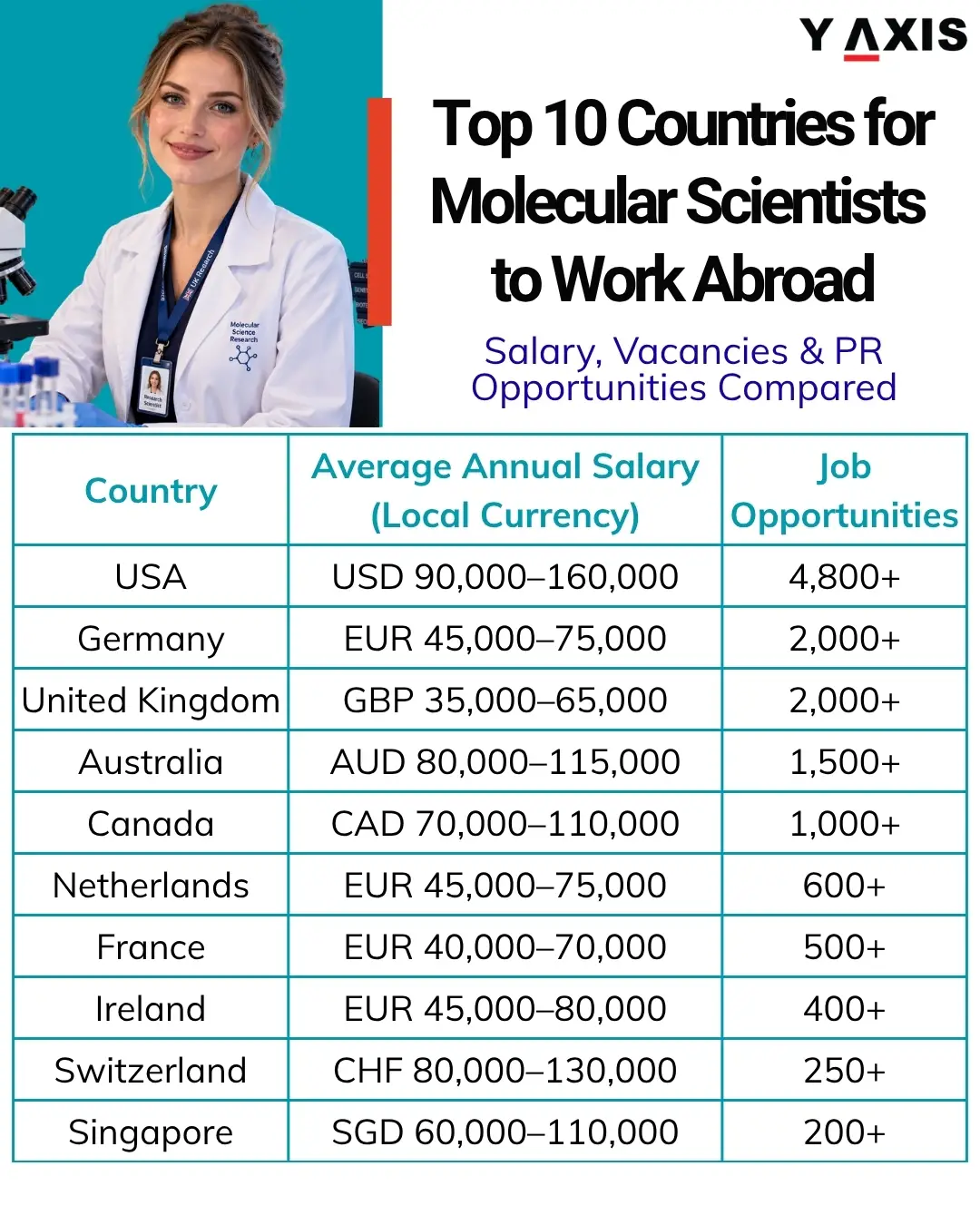
Top 10 Countries for Molecular Scientists to Work Abroad: Salary, Demand & PR Opportunities Compared