

Posted on October 20 2026
What Are the Different Types of UK Visas to Immigrate?

By , Editor & Director
Updated October 22 2026
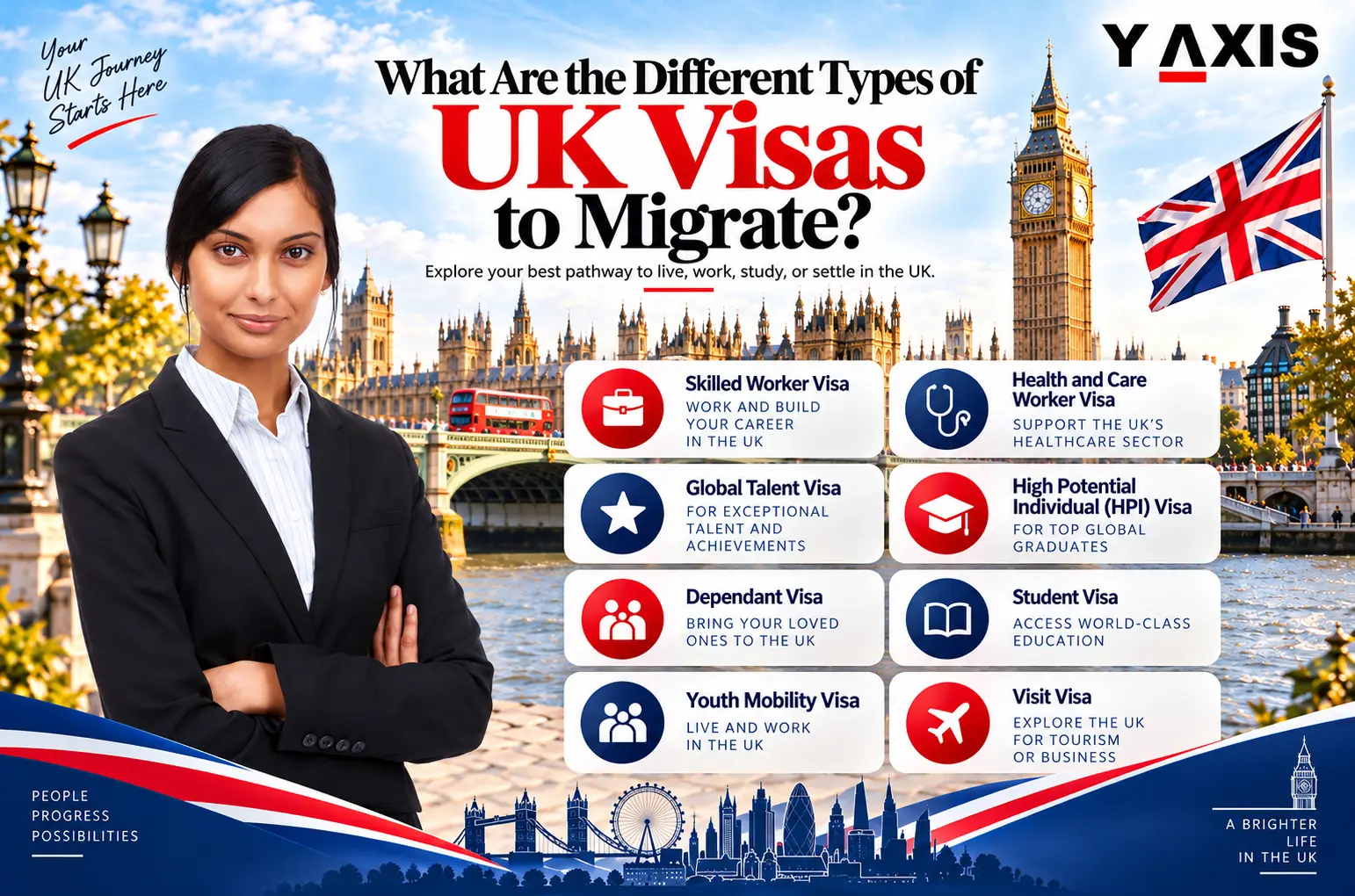
The main types of UK visas for immigration include work, student, family, business and post-study routes. The Skilled Worker visa is for people with a job offer from a UK employer, while the Student visa allows international students to study at approved institutions. The Graduate visa lets international graduates stay in the UK after completing their studies, and the Innovator Founder visa is for entrepreneurs starting an innovative business.
The Global Talent visa is designed for people with recognised talent or potential in their field, while the Family visa allows people to join a partner or relative in the UK. Some visa routes can lead to indefinite leave to remain (ILR), which allows people to settle permanently in the UK.
*Want to migrate to UK? Book a free consultation with Y-Axis today.
Types of UK Visas for Immigration
The UK offers different visa types for people planning to move for work, study, business or to join family members. The right visa depends on your circumstances, such as having a job offer from a UK employer, admission to an approved educational institution, recognised talent in your field or a family member living in the UK. Some work, business and family visa routes can lead to indefinite leave to remain (ILR), which allows permanent settlement in the UK, while a Student visa is generally temporary.
|
UK Visa Type |
Who Is Eligible? |
Main Purpose |
|
People who meet the settlement requirements for their immigration route |
To live permanently in the UK |
|
|
People with a qualifying job offer from an approved UK employer |
To work in the UK |
|
|
Health and Care Worker visa |
Doctors, nurses and other health professionals in qualifying roles |
To work in eligible health and care jobs |
|
Scale-up Worker visa |
People with a qualifying job offer from an approved scale-up employer |
To work for a qualifying UK business |
|
International students accepted onto an eligible course at an approved institution |
To study in the UK |
|
|
International graduates who meet the route's requirements |
To stay in the UK after completing their studies |
|
|
Leaders or potential leaders in eligible fields |
To work in research, academia, arts or digital technology |
|
|
High Potential Individual visa |
Graduates of eligible overseas universities |
To live and work in the UK without a job offer |
|
Entrepreneurs with an innovative business idea endorsed under the route |
To establish an innovative business in the UK |
|
|
People joining a qualifying partner, parent or child in the UK |
To live with family in the UK |
|
|
UK Ancestry visa |
Eligible Commonwealth citizens with a UK-born grandparent |
To live and work in the UK |
|
Youth Mobility Scheme visa |
Young adults from participating countries who meet the scheme's requirements |
To live and work in the UK temporarily |
UK Visa Eligibility Requirements
UK visa eligibility depends on the visa type. The Skilled Worker visa requires a job offer from an approved UK employer, while the Student visa requires admission to an approved institution. The Global Talent visa may require an endorsement or qualifying prize, and the Innovator Founder visa requires an endorsed business idea. Family visas depend on your relationship with someone in the UK. Applicants may also need a valid passport, proof of funds and English language evidence.
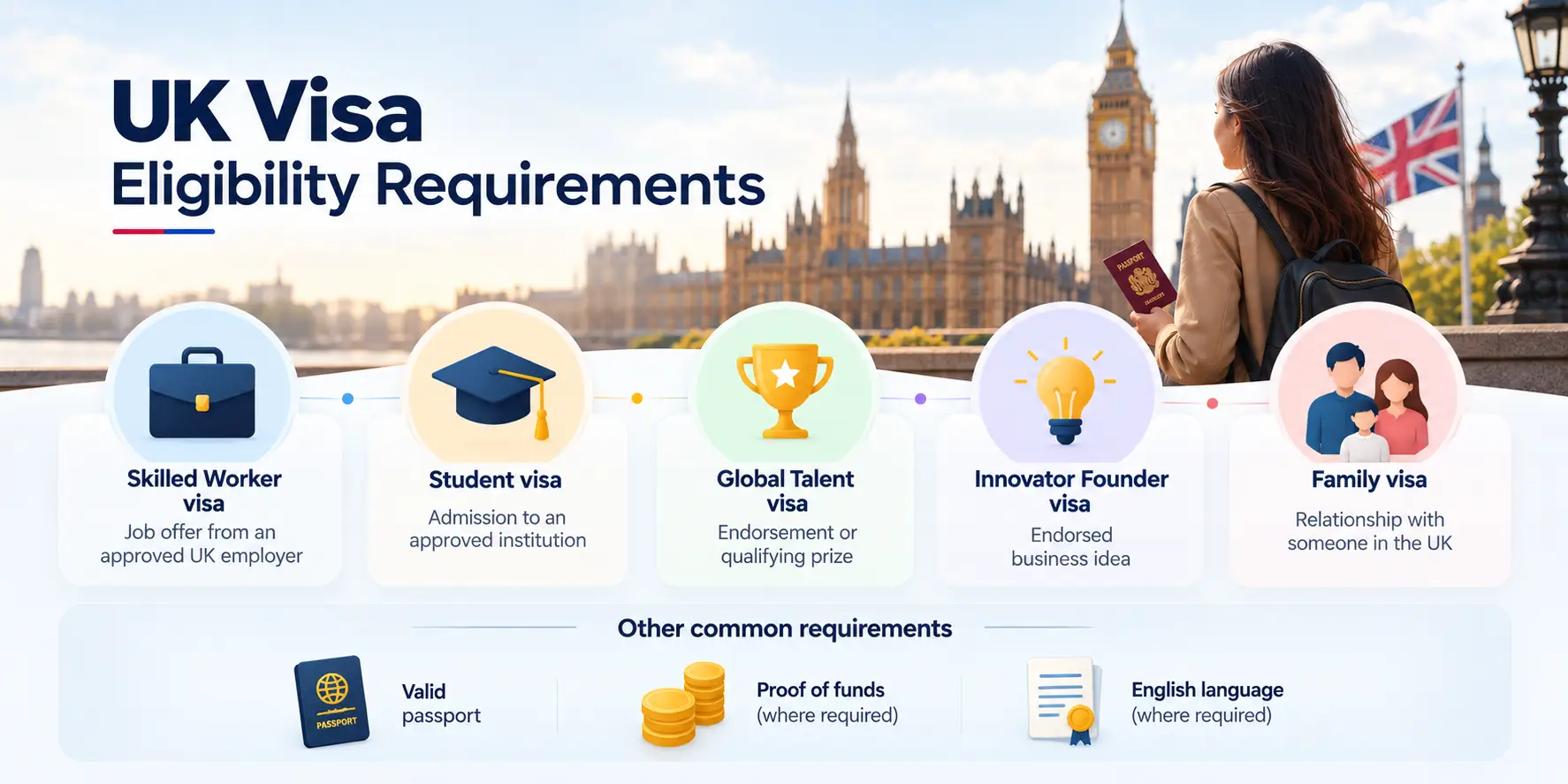
- Job offer: The Skilled Worker visa requires a job offer from a UK employer approved by the Home Office.
- Student admission: The Student visa requires an offer for an eligible course from a licensed student sponsor.
- English language: Applicants must demonstrate English proficiency for visa types that require it.
- Proof of funds: Some applicants must show they have enough money to cover tuition fees or living costs.
- Business endorsement: Innovator Founder applicants need an endorsement for their business idea.
- Talent recognition: Global Talent applicants must qualify through an endorsement or an eligible prestigious prize.
- Family relationship: Family visa applicants must meet the relationship requirements for joining a partner, parent or child in the UK.
- Permanent settlement: ILR applicants must meet the residence period and other requirements for their immigration route.
*Not sure which UK visa suits you? Get free eligibility assessment from Y-Axis today.
How to Apply for a UK Visa?
To apply for a UK visa, choose the right visa route, check its requirements, gather the necessary documents and apply online through GOV.UK. Depending on the route, you may need sponsorship or an endorsement, pay the applicable fees and verify your identity.
Step 1: Choose the right visa route
Select a visa based on your purpose, such as work, study, business, talent or joining family.
Step 2: Secure the required sponsorship or approval
Depending on your visa route, obtain a Certificate of Sponsorship from an employer, a Confirmation of Acceptance for Studies (CAS) from an education provider or an endorsement from an approved body.
Step 3: Prepare your documents
Gather your passport, proof of funds, English language evidence and other supporting documents required for your visa category.
Step 4: Submit your online application
Complete the relevant application form on GOV.UK and pay the visa fee and Immigration Health Surcharge, if applicable.
Step 5: Verify your identity
Follow the instructions to verify your identity through the UK Immigration: ID Check app or attend a biometrics appointment to provide your fingerprints and photograph, if required.
Step 6: Wait for a decision
UK Visas and Immigration (UKVI) will assess your application. Processing times vary by visa type and application location.
Step 7: Access your eVisa
Once your application is approved, follow the instructions to access your eVisa and check your immigration status before travelling to the UK.
*Want to apply for UK Visa? Book a free consultation with Y-Axis today.
UK Visa Fees
The UK Student visa costs £558, while the Skilled Worker visa costs £819 for up to three years when applying from outside the UK. Most applicants must also pay the Immigration Health Surcharge, which is £1,035 per year for most work visa applicants and £776 per year for students. Applicants for the Health and Care Worker visa are exempt from the Immigration Health Surcharge.
|
UK visa type |
Application fee |
Immigration Health Surcharge (IHS) |
|
Skilled Worker visa |
£819–£1,865 |
£1,035 per year |
|
Health and Care Worker visa |
£324–£628 |
Exempt |
|
Student visa |
£558 |
£776 per year |
|
Graduate visa |
£937 |
£1,035 per year |
|
Global Talent visa |
£766 |
£1,035 per year |
|
High Potential Individual visa |
£880 |
£1,035 per year |
|
Innovator Founder visa |
£1,357 (outside the UK) |
£1,035 per year |
|
Family visa |
£2,064 (outside the UK) |
Usually £1,035 per year for adults |
|
Youth Mobility Scheme visa |
£340 |
£776 per year |
|
UK Ancestry visa |
£726 |
£1,035 per year |
|
Scale-up visa |
£937 |
£1,035 per year |
UK Visa Processing Time
Most UK visa applications made from outside the UK receive a decision within 3 weeks for work and study visas and 12 weeks for family visas. Applications made from inside the UK generally take 8 weeks for work and study visas, although some routes have shorter or longer processing times.
|
UK visa type |
Outside the UK |
Inside the UK |
|
Skilled Worker visa |
3 weeks |
8 weeks |
|
Student visa |
3 weeks |
8 weeks |
|
Graduate visa |
Not applicable |
8 weeks |
|
Global Talent visa |
3 weeks |
8 weeks |
|
Innovator Founder visa |
3 weeks |
8 weeks |
|
Family visa (partner or spouse) |
12 weeks |
8 weeks |
*Planning to migrate to UK? Get expert guidance from Y-Axis professionals.
FAQs
How many types of UK visas are there?
The UK has several visa categories covering work, study, family, business, talent, visits and temporary stays. Major immigration routes include the Skilled Worker, Student, Graduate, Global Talent, High Potential Individual, Innovator Founder, Family, Youth Mobility Scheme and UK Ancestry visas. The right route depends on your purpose and circumstances.
Which UK visa is easiest to get?
There is no single easiest UK visa because each route has different requirements. The Student visa requires admission to an eligible course, while the Skilled Worker visa requires a qualifying job offer from an approved sponsor. Choose the route that matches your circumstances and meets its requirements.
Which UK visas can lead to permanent residency?
The Skilled Worker, Health and Care Worker, Scale-up, Global Talent, Innovator Founder and certain Family visa routes can lead to indefinite leave to remain (ILR), which allows you to settle permanently in the UK. Qualifying periods vary by route, so check GOV.UK for current rules, as settlement reforms are under review.
Can I move to the UK without a job offer?
Yes. Options include the Global Talent, High Potential Individual, Student, Youth Mobility Scheme and Innovator Founder visas. Each route has specific conditions, such as recognised talent, a degree from an eligible university, admission to a UK institution, qualifying nationality or an endorsed business idea.
How much does a UK visa cost?
The Student visa application fee is £558, while the standard Skilled Worker visa fee ranges from £819 to £1,865 depending on visa length and whether you apply inside or outside the UK. Most adult applicants also pay the Immigration Health Surcharge, usually £1,035 per year, or £776 per year for students. Health and Care Worker visa holders are exempt.
How long does it take to get a UK visa?
Many work and study applications made outside the UK receive a decision within three weeks, while most made inside the UK take around eight weeks. Partner and spouse visa applications usually take up to 12 weeks from outside the UK. Times vary by route and location, so apply well before you plan to travel.
What are the requirements for a UK Skilled Worker visa?
Applicants generally need a job offer from a Home Office-approved sponsor, a Certificate of Sponsorship, an eligible occupation and a salary that meets the applicable threshold. They must also meet the English language requirement and provide the required supporting documents.
Do I need an English test for a UK visa?
It depends on the route. New Skilled Worker, Scale-up and High Potential Individual applicants generally need English at CEFR B2 level. Some applicants can meet the requirement through an accepted qualification or a nationality-based exemption rather than a test.
Can I bring my family to the UK on a visa?
Some routes allow you to bring a partner and dependent children, but the rules vary. Skilled Worker, Global Talent and Innovator Founder visa holders may be able to bring dependants, subject to the applicable conditions. Student visa holders can bring dependants only in specified circumstances.
Can I switch from a Student visa to another UK visa?
Yes. Depending on their circumstances, students may be able to switch to a Skilled Worker, Global Talent or Innovator Founder visa. Students who complete an eligible course can also apply for a Graduate visa. You must meet the rules for the new route and apply before your current permission expires.
Tags:
UK Visas
UK Immigration
UK Work Visa
UK Study Visa
UK Family Visa
UK Business Visa
UK Graduate Visa
UK Global Talent Visa
UK Skilled Worker Visa
UK Permanent Residency
Share
Y-Axis Services

Get it on your mobile

Get News alerts

Contact Y-Axis
Latest Article
Popular Post
Trending Article

Posted On October 21 2026
What is the Average Salary in the UAE?