

Don't know what to do ?
Get Free Counseling
Last Updated: October 23, 2026
Germany Job Visa for UK Citizens: Types, Requirements, Fees & Application
UK citizens need a valid residence permit to work in Germany. If you have a recognised qualification and a qualifying job offer, you may be eligible for an EU Blue Card, which in 2026 generally requires an annual gross salary of at least €50,700, or €45,934.20 for eligible shortage occupations and other qualifying cases.
Eligible Blue Card holders may qualify for a settlement permit after 27 months, or 21 months with B1-level German. If you do not have a job offer, the Opportunity Card (Chancenkarte) may allow you to stay in Germany for up to one year to look for work, provided you meet the eligibility and financial requirements.
Why Seek a Germany Job Visa?
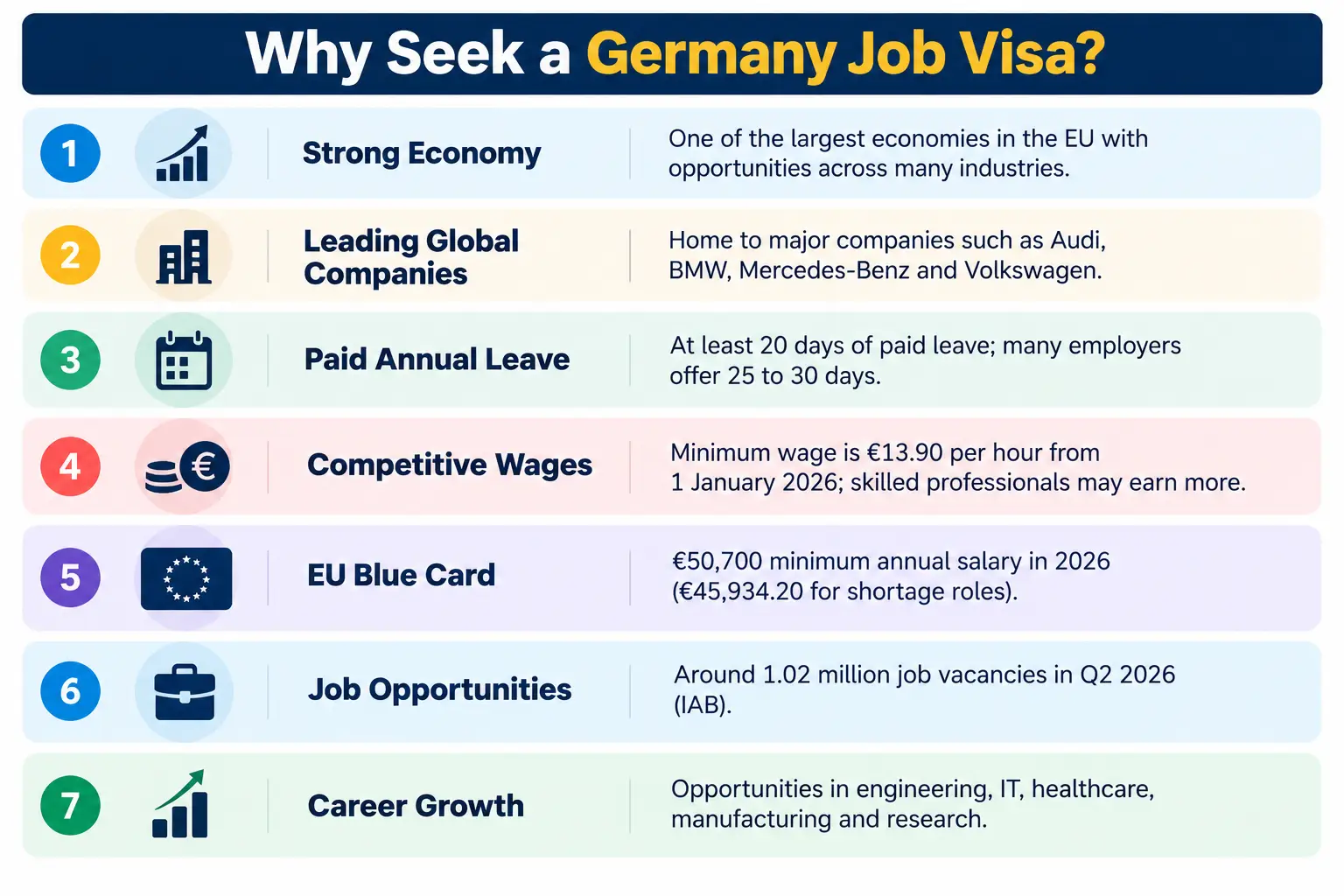
- Strong Economy: Germany is one of the largest economies in the European Union and offers job opportunities across many industries.
- Leading Global Companies: Major companies such as Audi, BMW, Mercedes-Benz and Volkswagen are based in Germany.
- Paid Annual Leave: Employees are legally entitled to at least 20 days of paid annual leave when working a five-day week. Many employers offer 25 to 30 days.
- Competitive Wages: Germany's minimum wage is €13.90 per hour from 1 January 2026. Skilled professionals may earn considerably more, depending on their role and experience.
- EU Blue Card: In 2026, the minimum annual salary is €50,700 for standard occupations and €45,934.20 for shortage occupations, as well as certain eligible recent graduates and IT specialists. Applicants must also meet the other Blue Card requirements.
- Job Opportunities: Germany had approximately 1.02 million job vacancies in the second quarter of 2026, according to the Institute for Employment Research (IAB).
- Career Growth: Germany offers opportunities in fields such as engineering, IT, healthcare, manufacturing and research.
Note: Salary thresholds and job vacancy figures can change. Check the latest official requirements before applying for a German work visa or EU Blue Card.
What is a Germany Work Visa?
The Germany Employment Visa allows non-EU citizens, including UK nationals, to live and work in Germany if they have a valid job offer. This long-term visa is designed for skilled professionals with qualifications recognised in Germany. Depending on your job and salary, it may lead to permanent residence or the EU Blue Card.
For those without a job offer, the Germany Opportunity Card allows skilled professionals to enter Germany and search for work through a points-based system.
*Read More…
3 Million Jobs in Germany over the Next Decade
Types of Germany Work Visas
- Standard Employment Visa: For skilled workers with a qualifying job offer from a German employer.
- EU Blue Card: For qualified professionals who meet the required qualifications and minimum salary threshold.
- IT Specialist Visa: For eligible IT professionals who may qualify through their work experience without a university degree.
- Opportunity Card (Chancenkarte): Allows eligible applicants to stay in Germany for up to 1 year to look for a job. Applicants must meet the qualification and financial requirements and, where applicable, the points-based criteria. You can work part-time for up to 20 hours per week while searching for a job.
German Employment Visa Benefits for UK Citizens
EU Blue Card
- Live and work in Germany if you meet the eligibility requirements.
- Travel within the Schengen area for short stays, subject to applicable rules.
- Access social security and healthcare benefits if eligible.
- Apply for a settlement permit after 27 months, or after 21 months with B1-level German, provided you meet the other requirements.
- Your spouse may be eligible to work in Germany under family reunification rules.
Germany Opportunity Card (Chancenkarte)
- Stay in Germany for up to 1 year to look for suitable work.
- Apply without a job offer, if you meet the eligibility and financial requirements.
- Work part-time for up to 20 hours per week while searching for a job.
- Try out a job for up to 2 weeks per employer, subject to the applicable rules.
- Explore job opportunities in Germany before securing qualifying employment.
The 21-month route requires B1 German, while the 27-month route generally requires A1 German and both require other conditions to be met.
Eligibility Criteria for Germany Work Visa
- A valid job offer from a German employer
- Academic or vocational qualifications recognised in Germany
- Minimum salary threshold (e.g., €43,800 for EU Blue Card; exceptions for shortage occupations)
- Health insurance (private or public, meeting EU standards)
- Clean criminal record
- German language skills may be required for certain occupations
Requirements for Germany Work Visa
The table below has details of the list of documents required for a Germany Work visa:
| Document | Description |
|---|---|
| Valid Passport | Must have at least 2 blank pages |
| Job Offer/Employment Contract | Must specify salary, role, and employer details |
| Academic Degree | Recognised by German authorities (check via ANABIN) |
| CV & Motivation Letter | Highlighting qualifications and job relevance |
| Health Insurance | Must cover initial stay (and beyond if needed) |
| Proof of Funds | If required for your situation |
| Visa Application Form | Completed and signed |
| Biometric Photos | Passport-sized, Schengen format |
Step-by-Step Application Process for a German Work Visa
Step 1: Get a job offer from a German employer, if required for your visa category.
Step 2: Check whether your qualifications need to be recognised, using Anabin or the relevant recognition authority.
Step 3: Check the application process for your nationality. UK citizens can generally enter Germany visa-free and apply for a work-related residence permit at the local Foreigners’ Office (Ausländerbehörde), provided they meet the relevant requirements.
Step 4: Gather the required documents and complete the relevant application.
Step 5: Submit your application and attend an appointment or interview if required.
Step 6: Wait for a decision. Processing times vary by application type and location.
Step 7: After arriving in Germany, register your address if required.
Step 8: Apply for the relevant residence permit at the local Foreigners’ Office, if you have not already done so.
*Also Read…
Fast-Track Hiring Options in Germany for Skilled Professionals
Germany Employment Visa Processing Time
| Factor | Processing time |
|---|---|
| Average Processing Time | 6 to 12 weeks |
| EU Blue Card Processing | Often faster with higher salary |
Germany Work Visa Processing Fee
| Factor | Processing fee |
|---|---|
| Visa Application Fee | €75 |
| Residence Permit (post-arrival) | Up to €100 |
The national visa fee is usually €75. The fee for an EU Blue Card residence permit is €100, so replace the previous €100–€120 range with up to €100. Fees may vary by permit type and application.
Job Portals & Employer Resources
Germany offers a wide range of employment opportunities for international professionals, especially in sectors facing critical skill shortages. To support job seekers, official and regional platforms provide access to thousands of verified openings across industries.
Key Resources to Explore:
- Make-it-in-Germany Job Portal: A central platform designed for international candidates seeking employment in Germany.
- Federal Employment Agency Jobbörse: Germany’s largest government-run job exchange listing openings from verified employers nationwide.
High-Demand Sectors for Foreign Professionals:
- Information Technology & Software Development
- Engineering (Civil, Mechanical, Electrical)
- Nursing & Healthcare Services
- Skilled Trades (Electricians, Plumbers, Metalworkers)
- Construction & Logistics
Recognition of Qualifications
If you are applying for a Germany Employment Visa, it is essential that your educational or professional qualifications are recognised in Germany. This ensures that your academic background aligns with the requirements for the job you’ve been offered.
Here’s how to verify and validate your qualifications:
- Check Recognition Status: Use the official ANABIN database to see if your degree or institution is recognised in Germany.
- ZAB Evaluation (if required): If your qualification is not listed or needs further assessment, you may need to request an official Statement of Comparability from ZAB (Central Office for Foreign Education).
- Healthcare and Regulated Professions: If you are applying for roles in regulated sectors such as healthcare, education, or legal professions, formal licensing or professional approval may be required. You may need to go through additional recognition or adaptation procedures.
Can a Germany Employment Visa Lead to Permanent Residency?
Yes, a German employment visa can lead to permanent residency (a settlement permit), depending on your visa type and whether you meet the eligibility requirements.
- EU Blue Card holders: May qualify for a settlement permit after 27 months, or 21 months with B1-level German.
- Other skilled workers: May qualify after 3 years of holding the relevant residence permit, subject to additional requirements.
- Other eligible residents: Generally, may qualify after 5 years, depending on their residence status and individual circumstances.
- Requirements: You may need to pay pension insurance contributions, demonstrate sufficient German language skills, and meet other legal and integration requirements.
*Also Read…
Visa Sponsorship Jobs in Germany for Skilled Professionals
How Y-Axis Can Help You?
- We help identify the best strategy to boost your chances in getting a German job visa.
- We advise you on how to do the step-by-step filling of essential documents.
- If you are looking for a PR in Germany, we can help you grab the best job that helps boost your PR chances.
- We help you fill out all application forms.
- Review all your work visa-related documents before submission.
- Get yourself evaluated instantly for free with the Y-Axis immigration points calculator here.
Our Accreditations |
|||
 |
 |
 |
 |
Don't know what to do ?
Get Free Counseling
Frequently Asked Questions

