

Different countries offer Digital Nomad Visas with varying validity periods, income requirements, family rules, tax considerations and renewal options. For UK remote workers, eligibility depends on factors such as employment status, income, intended length of stay and whether family members will accompany them.
Digital-Nomad
Don't know what to do?
Get Free Counselling
Last Updated: September 23, 2026
Digital Nomad Visa UK: Countries, Requirements & How to Apply
A Digital Nomad Visa allows eligible remote workers, freelancers and business owners to live temporarily in another country while continuing to work remotely for an overseas employer, business or clients. Each country sets its own Digital Nomad Visa requirements, including income, employment, insurance and documentation rules.
For UK citizens, Digital Nomad Visas provide an option to live and work remotely in countries that offer dedicated digital nomad or remote-work visa and residence routes. The requirements, visa duration, family eligibility and tax rules vary by destination.
-
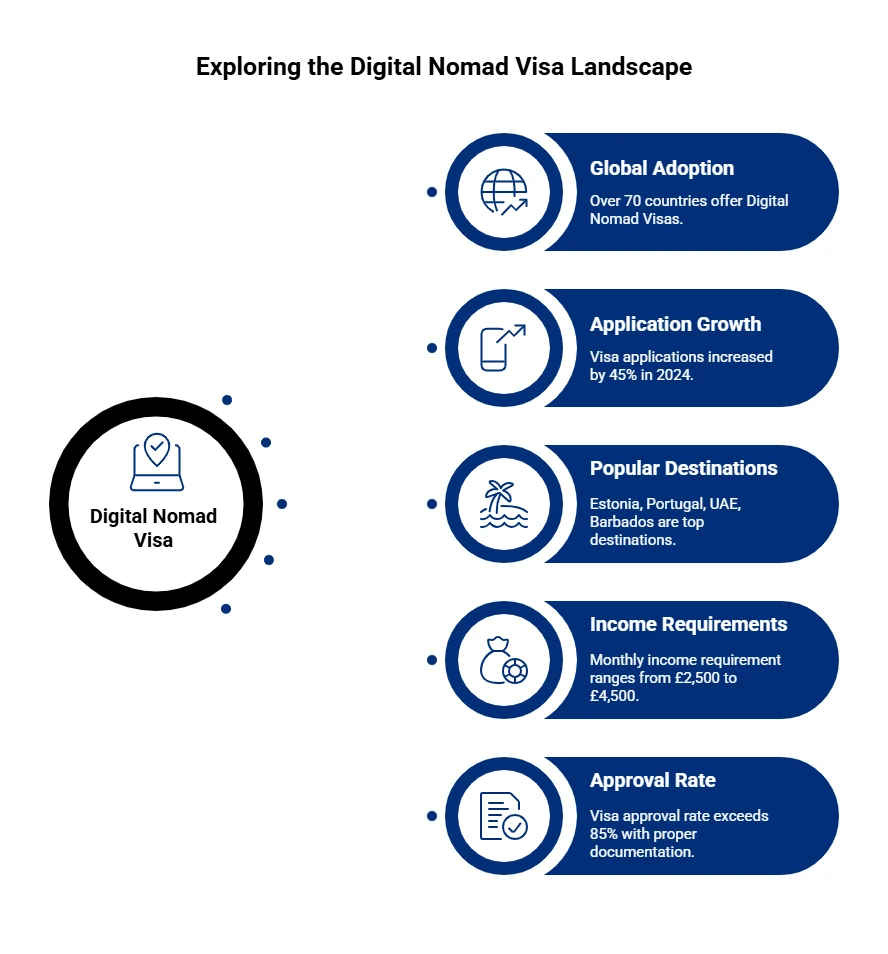
Digital Nomad Visas are available to eligible remote workers, freelancers and business owners who meet the requirements of the destination country.
-
Popular destinations for UK applicants include Estonia, Portugal, Spain, the UAE and Barbados, subject to each country's eligibility requirements, although eligibility and visa conditions vary by country.
-
Digital Nomad Visa requirements commonly include proof of remote employment or self-employment, minimum income, health insurance, accommodation and a valid passport.
-
Income thresholds, visa duration, family eligibility, fees and renewal rules vary by destination.
What Is a Digital Nomad Visa? A Guide for UK Remote Workers
A Digital Nomad Visa is a visa or residence permit that allows eligible remote workers to live in a foreign country while working remotely for an employer, business or clients based outside the destination country. Depending on the programme, it may be available to employees, freelancers, self-employed professionals and business owners.
For UK citizens, these visas can provide a legal route to live and work remotely in countries that offer dedicated digital nomad or remote-work programmes. Visa validity, income requirements, family eligibility, tax rules and renewal options vary by country.
*Looking for assistance to apply for work abroad? Y-Axis is here to support you with the process.
Digital Nomad Visa Requirements: Who Is Eligible?
People who may be eligible for a Digital Nomad Visa include:
- Freelancers working with international clients
- Workers employed by companies outside their country of residence
- Business owners running international businesses
- Content creators, consultants and online teachers
- Remote workers who can demonstrate qualifying employment, freelance work or business activity outside the host country
Benefits of a Digital Nomad Visa
The benefits of a Digital Nomad Visa are given below.
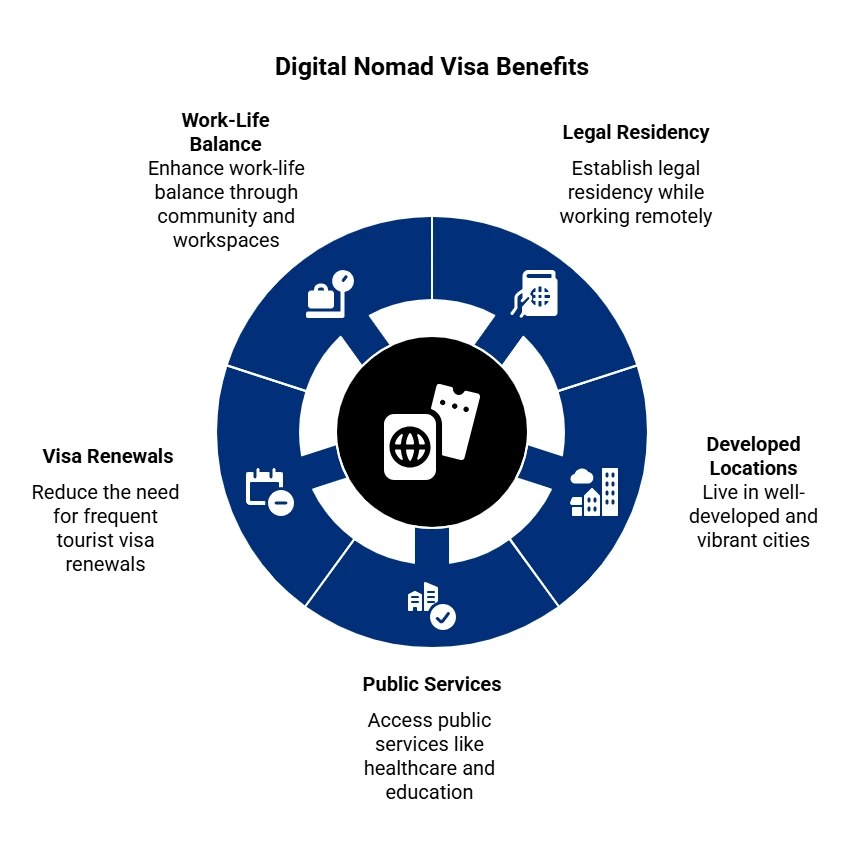
- Establish legal residency in another country while keeping a remote job.
- Get the chance to live in well-developed places.
- Be able to use public services, banks, and local phone or data plans.
- Cut down on tourist visa renewals.
- Promote work-life balance through local groups and shared workspaces.
*Want guidance to apply for overseas immigration? Let Y-Axis support you with the process.
Types of Digital Nomad Visas Available to UK Citizens
Countries provide nomad visas that differ a lot. The various types of Digital Nomad Visa are:
- Single-year nomad visas (for example, Estonia, UAE).
- Visas that can be renewed yearly for many countries.
- Visas for families that allow dependents.
- Visa or residence routes designed for remote workers, including Portugal's D8 visa for digital nomads and remote workers.
1. Single-Year Digital Nomad Visas
Single-year Digital Nomad Visas allow remote workers to live legally in a foreign country for up to 12 months, usually without long-term renewal options. These visas are designed for individuals who want to experience living abroad without committing to permanent relocation.
Key Features
- Valid for up to 12 months
- Limited or no renewal options
- Income must be earned outside the host country
- No local employment permitted
Best For
This applies to:
- Single-Year Digital Nomad Visas
- Renewable Digital Nomad Visas
- Family Digital Nomad Visas
- Tiered/Residency-Linked Visas
Countries Offering Single-Year Digital Nomad Visas
- Estonia
- United Arab Emirates (UAE)
- Barbados
2. Renewable Digital Nomad Visas
Renewable Digital Nomad Visas allow remote workers to stay for an initial period (usually 1 year) and renew or extend the visa annually or for multiple years, provided income and compliance requirements are met.
Key Features
- Initial validity of 12–24 months
- Renewable for several years
- Legal residence with access to banking, housing, and healthcare
- Foreign income requirement applies
Best For
Remote workers and freelancers planning medium- to long-term stays abroad.
Countries Offering Renewable Digital Nomad Visas
- Portugal
- Spain
- Greece
- Croatia
3. Digital Nomad Visas for Families
Many countries now offer Digital Nomad Visas that allow dependents, enabling spouses and children to accompany the primary applicant. These visas make it easier for families from the UK to relocate together while continuing remote work.
Key Features
- Spouse and dependent children allowed
- Family reunification or dependent visa options
- Legal residence for the entire family
Common Benefits
- Access to local education systems
- Eligibility for healthcare services
- Ability to rent property and open bank accounts
Best For
UK families planning international relocation without disrupting careers or education.
4. Tiered or Residency-Linked Digital Nomad Visas
Some countries offer tiered Digital Nomad Visa models, where remote workers can later transition to more permanent immigration routes. These visas are ideal for professionals looking beyond temporary stays.
Transition Options May Include
- Long-term residence permits
- Permanent Residency (PR)
- Business, startup, or self-employment visas
Best For
Professionals seeking settlement opportunities, business expansion, or EU residency benefits.
Digital Nomad Visa Countries for UK Remote Workers
Estonia Digital Nomad Visa
Type: Digital Nomad Visa
Key Highlights
- Valid for up to 12 months
- Minimum monthly gross income of €4,500 required, evidenced by 6 months of bank statements
- Open to remote employees, freelancers, and business owners
- Work must be for employers or clients registered outside Estonia
- Local employment in Estonia is not permitted
- Visa holders may travel within the Schengen Area subject to applicable Schengen rules.
Ideal For
UK professionals seeking a short-term EU digital nomad experience with advanced digital infrastructure and e-governance systems.
Portugal Digital Nomad Visa (D8)
Type: Temporary Stay or Residence Visa for Remote Work
Key Highlights
Two application routes available:
- Temporary Stay Visa: Valid for up to 1 year
- Residency Visa: Leads to a 2-year residence permit, renewable for a further 3 years
- Processing time: Processing times can vary depending on the application route, workload and completeness of the application. Applicants should check the latest information from the relevant Portuguese authorities before applying.
- Allows spouse and dependent children
- Legal access to banking, healthcare, and housing
- Potential tax planning benefits under Portugal’s regime
Ideal For
UK remote workers, freelancers and entrepreneurs seeking a longer-term European base and a residence route for remote work.
Pathway to Permanent Residency & Citizenship
Permanent residence may be obtained by holders who have satisfied the salary and residency conditions for 5 years. Portuguese citizenship eligibility is subject to the nationality law and the applicant's individual circumstances. Applicants should check the latest requirements with the Portuguese authorities before relying on a specific residence period.
UAE Virtual Work Residency Visa
Type: Single-Year Renewable Digital Nomad Visa
Key Highlights
- Valid for 1 year and available for renewal through re-application.
- Applicants must work remotely for an employer or business outside the UAE.
- A minimum monthly income of USD 3,500 (or equivalent in another currency) is required.
- Applicants must provide proof of remote employment and meet the UAE's applicable visa and residence requirements.
Suitable For
UK remote workers who meet the UAE Virtual Work Residency requirements and want to reside in the UAE while continuing qualifying remote work for an overseas employer or business.
Barbados Welcome Stamp
Type: Single-Year Digital Nomad Visa
Key Highlights
- Validity: One year, renewable (renewal fee attracts 25% discount)
- Annual minimum income: USD $50,000 from sources other than Barbados
- Application fee: USD $2,000 (individual) or USD $3,000 (family package)
- Approval time frame: 7 working days
- No income tax payable on foreign income
- Dependents included: Family includes spouse and children
- Programme confirmed to be operational up until 31st December, 2026
Ideal For
UK remote workers looking for a short-term, lifestyle-focused digital nomad experience in a low-tax environment.
Spain Digital Nomad Visa
Visa Type: Renewable Residency-Tied Digital Nomad Visa
Main Features
- Minimum financial means for the main applicant: €2,442 per month in 2026
- The amount is based on 200% of Spain's 2026 Minimum Interprofessional Salary (SMI) of €1,221.
- Additional financial means are required for accompanying family members.
- Applicants may apply through the appropriate Spanish immigration or consular route. The validity and renewal conditions depend on the route used and the applicant's circumstances.
- Self-employed applicants may work for Spanish clients, provided the work for Spanish companies does not exceed 20% of their total professional activity.
- Tax treatment depends on the applicant's circumstances and current Spanish tax rules. Applicants should obtain independent tax advice before relying on a specific tax rate or regime.
- Spouse, children, parents and eligible dependent adult family members may be able to join, subject to the applicable requirements.
- Processing times vary depending on the application route, authority, workload and completeness of the application. Applicants should check the applicable Spanish authority for the latest processing information.
- Permanent residency application after 5 years
Good Fit for
UK freelancers and remote workers considering a longer-term stay in Spain, subject to the Digital Nomad Visa's eligibility, residence and tax requirements.
Pathway to Permanent Residency
Eligible applicants may be able to apply for long-term residence after meeting the applicable residence and legal requirements.
Digital Nomad Visa Requirements: Eligibility Criteria
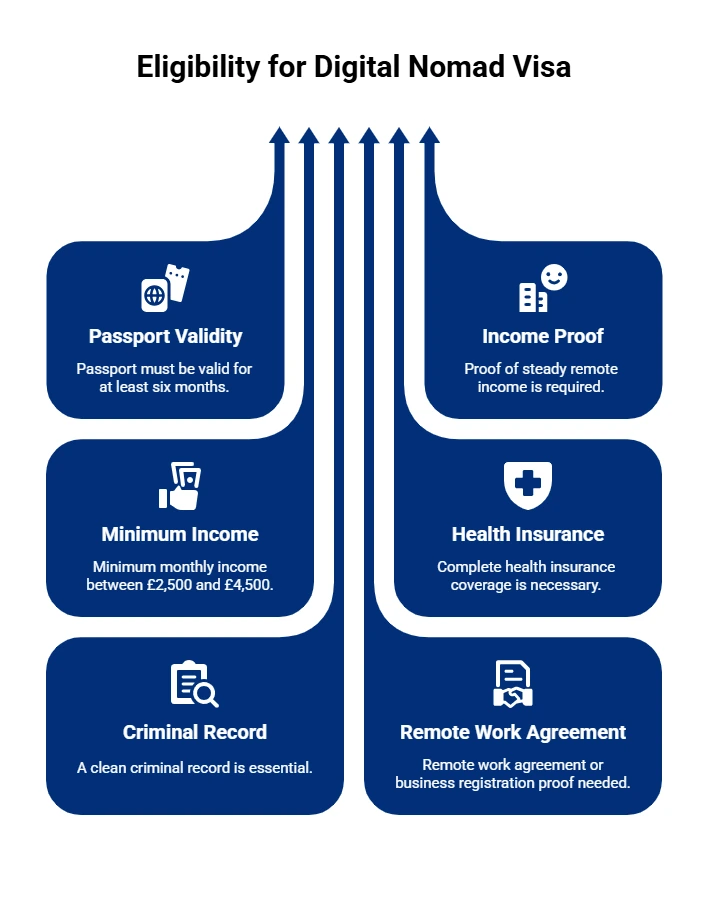
Digital nomad visa requirements vary by country, but applicants are commonly required to:
- Be employed remotely, work as a freelancer, or run a business for clients or an employer outside the host country
- Meet a minimum monthly income (varies by country)
- Hold valid health/travel insurance
- Provide proof of clean criminal record
- Show accommodation details and passport validity of 6+ months
Documents Required for a Digital Nomad Visa
Digital nomad visa documents vary by country, but applicants are commonly asked to provide:
| Document | Description |
|---|---|
| Valid Passport | Must be valid for at least 6 months |
| Employment Proof | Remote job contract or proof of freelance income |
| Bank Statements | Showing stable income (e.g., €2,400–€4,000+/mo) |
| Health/Travel Insurance | Coverage for entire duration of stay |
| Accommodation Proof | Rental agreement or booking confirmation |
| Police Clearance Certificate | Recent background check (usually within 6 months) |
How to Apply for a Digital Nomad Visa?
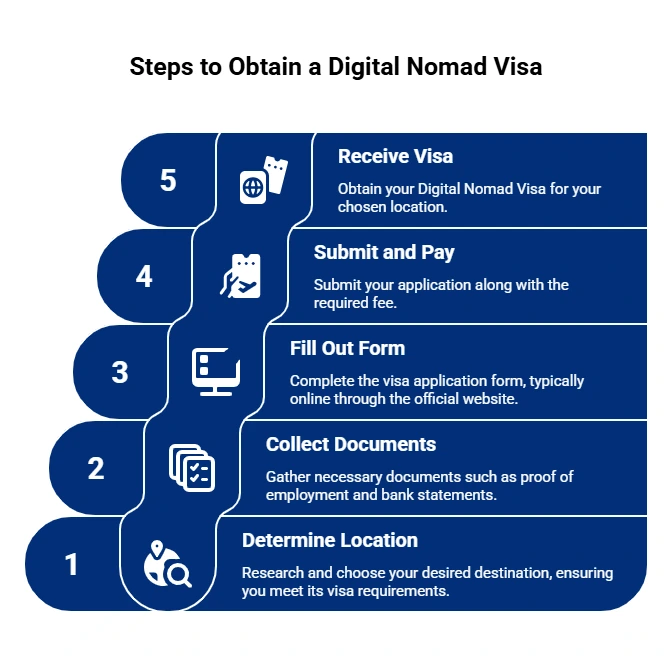
How to apply for a Digital Nomad Visa depends on the destination country, but the process generally includes the following steps:
Step 1: Choose your destination based on visa rules and eligibility.
Step 2: Fill out the visa application (typically online).
Step 3: Upload required documents and income proof.
Step 4: Pay the visa fee as outlined by the host country.
Step 5: Attend biometrics or interview, if needed.
Step 6: Receive your visa decision (processing time varies).
Step 7: Enter the country and register locally, if applicable.
Popular Digital Nomad Destinations & Income Criteria
| Country | Income Requirement (govt-verified) | Visa Duration |
|---|---|---|
| Spain | €2,442/month for the main applicant (2026); +€916/month for first family member | Up to 1 year via consulate, renewable up to 5 years / up to 3 years if applying from inside Spain |
| Portugal (D8) | €3,680/month (4× Portugal's 2026 minimum wage of €920) | Temporary Stay Visa: up to 1 year. Residence Visa: 2-year permit, renewable for 3 more years |
| Estonia | €4,500 gross/month, evidenced over 6 months | Up to 12 months, single entry, not renewable in-country |
| Greece | €3,500/month net income (+20% for a spouse, +15% per child) | Initial visa up to 12 months, extendable to a 2-year residence permit (2 years total) |
| Costa Rica | $3,000/month individual, $4,000/month with dependents | Up to 1 year, renewable once (2 years total) |
Note: Income thresholds are approximate and subject to change. Always check with the host country’s immigration authority.
Digital Nomad Visa Costs and Fees
Detailed information about the costs and fees for Digital Nomad Visa is given below.
| Cost Category | Estimated Range (in GBP) |
|---|---|
| Visa Application Fee | £200 – £2,000 |
| Health Insurance | £50 – £150 per month |
| Police Clearance Certificate | £20 – £100 |
| Document Translation/Notarisation | £30 – £200 per document |
| Income Proof (not a fee) | Typically £2,500 – £4,500/month |
| Renewal or Extension Fees | £150 – £1,000 |
Processing Times for Digital Nomad Visas
Detailed information about the processing times for Digital Nomad Visa is given below.
| Region / Country Type | Standard Processing Time |
|---|---|
| Fast-track countries | 5 to 15 working days |
| Average processing countries | 3 to 6 weeks |
| High-volume applications | 6 to 12 weeks |
| With Priority or Express Service | 3 to 7 working days |
| With Incomplete or Additional Checks | Up to 3 months or more |
Validity and Renewals for a Digital Nomad Visa
- Digital Nomad Visa validity varies by country. Some programmes are issued for several months, while others allow stays of one year or longer and may provide renewal or residence options.
- Some programmes allow renewal or extension, while others have fixed validity periods or separate residence routes.
- Most programs need a renewal application before the visa expires.
- Conditions can include ongoing proof of income and insurance renewal.
Visa Extensions, Taxes & Residency Rules for a Digital Nomad Visa
- Visa Extensions: Some countries allow extensions or renewals, while others require a new application or provide a separate residence route.
- Tax Rules: Tax residency and reporting obligations depend on the destination country, residence status, time spent in the country, income source and applicable tax treaties.
- Residency: Holding a Digital Nomad Visa does not automatically make an applicant a tax resident or permanent resident.
Taxes and Legal Obligations for Digital Nomads
Digital nomads may need to:
- Declare income or meet local tax obligations where required.
- Determine whether they become tax residents under the destination country's rules.
- Consider applicable tax treaties between countries.
- Maintain required tax records and file returns where applicable.
- Follow the immigration and employment conditions attached to their Digital Nomad Visa.
- For UK citizens: UK tax residents remain liable to HMRC for tax on worldwide income regardless of where they work. Spending more than 183 days in a host country may trigger local tax residency. Check HMRC's Statutory Residence Test (SRT) and the relevant double taxation agreement before applying for a digital nomad visa.
Nomads may need to consider the following, which varies depending on their host country:
- Declare all income or pay taxes on income earned in that country.
- There is no universal Digital Nomad Visa rule that makes 183 days the applicable tax-residency threshold in every destination.
- Use tax treaties between their home and host countries.
- Keep up with personal tax returns based on their tax residence.
- Nomad visas can offer easier legal ways for remote workers to operate.
Can You Bring Dependants on a Digital Nomad Visa?
Some Digital Nomad Visa programmes allow eligible dependants to accompany the primary applicant, subject to additional requirements.
- Proof of the familial relationship (for example, a marriage certificate or a birth certificate) must be submitted.
- Evidence of sufficient income to support each dependent is necessary.
- The host country may provide educational opportunities or limited work permits.
- Separate charges for each dependent may be levied.
- Due to difference in eligibility criteria, checking the host country's specific regulations is important.
Common Reasons for Visa Rejection
Applications might be rejected for these reasons:
- The documents are not complete or don't match each other.
- There is not enough proof of a steady remote pay or contracts.
- The applicant lacks current health insurance.
- There are unexplained breaks in their travel or job history.
- The applicant has past visa violations or a criminal record.
Providing complete, accurate and consistent documentation can help demonstrate that you meet the visa requirements. However, the final decision is made by the relevant immigration authority.
Life as a Digital Nomad – What to Expect
Living abroad as a digital nomad involves more than working remotely. Depending on the destination, visa holders may need to arrange accommodation, health insurance, banking, telecommunications and local registration. Popular destinations for UK remote workers include Lisbon, Porto, Barcelona, Valencia, Tallinn and Dubai.
A valid Digital Nomad Visa may allow eligible applicants to:
- Live abroad legally while continuing qualifying remote work
- Stay for the period permitted by the visa or residence permit
- Access local services according to the destination country's rules
- Build professional connections through coworking and remote-work communities
- Explore longer-term residence options where the immigration rules provide them
How Can Y-Axis Help With Digital Nomad Visa Applications?
Y-Axis provides Digital Nomad Visa assistance for eligible remote workers, freelancers and business owners. Our team can help you understand country-specific requirements, prepare supporting documents and navigate the application process.
Our services include:
- Evaluate your eligibility based on your profile and preferred destination
- Assist with preparing supporting documents and income evidence
- Provide country-specific Digital Nomad Visa application guidance
- Help with visa application tracking and required formalities
- Support eligible family members accompanying the main applicant
- Provide guidance on the next steps after the visa decision
Not sure which Digital Nomad Visa you may qualify for? Contact Y-Axis for an eligibility assessment.
Frequently Asked Questions