
Posted on October 16 2026
How Can I Get Permanent Residency in Germany?

By , Editor & Director
Updated October 16 2026
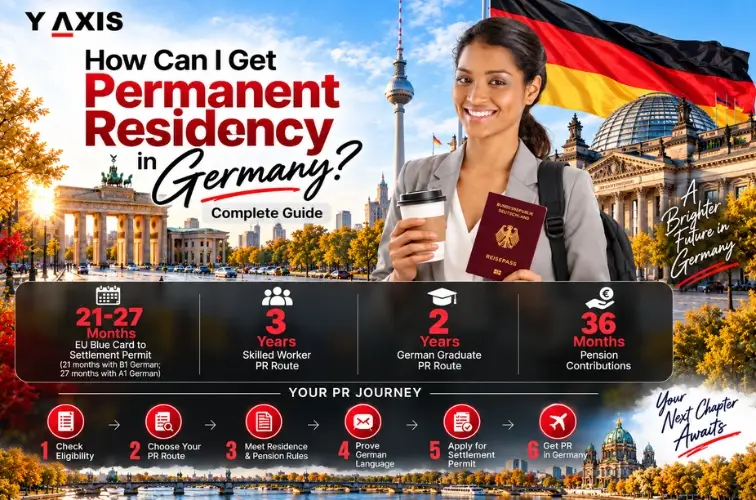
To get permanent residency in Germany, you must apply for a settlement permit (Niederlassungserlaubnis) after meeting the residence and eligibility requirements for your visa category. Most applicants qualify after five years of legal residence, while skilled workers with a qualifying residence permit can apply after three years. EU Blue Card holders can qualify after 21 months with B1 German or 27 months with A1 German. Applicants must also meet the requirements for pension contributions, sufficient income, German language skills and adequate housing. Once approved, you can live and work in Germany indefinitely.
*Want to apply for Germany PR? Let Y-Axis guide you through the application process.
Pathways to Permanent Residency in Germany
There are five main pathways to permanent residency in Germany, including the standard settlement permit, EU Blue Card, skilled worker route, German graduate route and self-employment route. Each pathway has different residence periods and eligibility requirements, depending on your residence permit, employment history, German language skills and financial situation.
- Standard Settlement Permit: For residents who have lived legally in Germany for five years and meet the income, pension contribution, language and housing requirements.
- EU Blue Card: For eligible holders who have completed 21 months of qualifying employment with B1 German or 27 months with A1 German.
- Skilled Workers: For workers with a qualifying German skilled-worker residence permit who meet the three-year residence requirement and other eligibility conditions.
- German University Graduates: For graduates who have completed two years of qualified employment in Germany and 24 months of pension contributions.
- Self-Employed Individuals: For business owners who have operated a successful business for three years and can demonstrate a secure livelihood.
Requirements for Permanent Residency in Germany
To qualify for permanent residency in Germany, you generally need sufficient income, the required pension contributions, B1-level German language skills, suitable accommodation and valid health insurance. You also need to demonstrate knowledge of German laws and society and meet the residence requirements for your permit category.
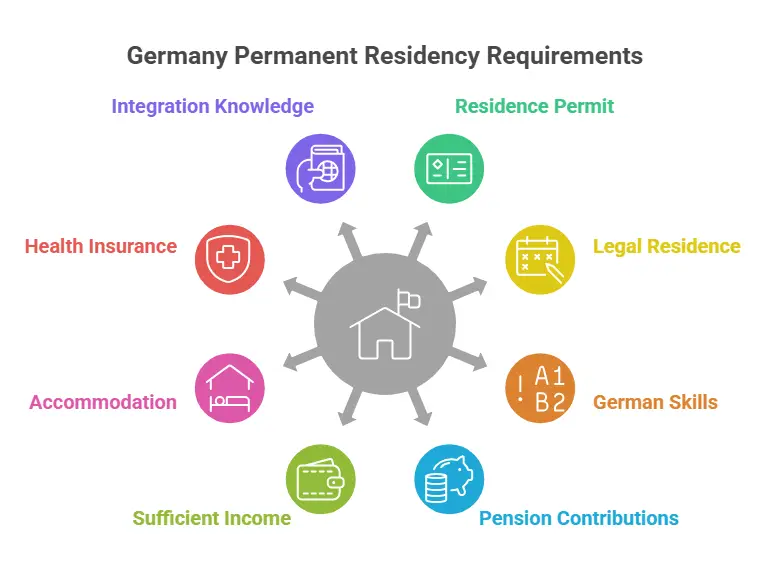
- Residence Permit: Hold a German residence permit that qualifies for permanent residency.
- Legal Residence: Complete five years of legal residence in Germany.
- German Language Skills: Demonstrate B1-level German proficiency.
- Pension Contributions: Complete 60 months of contributions to Germany’s statutory pension insurance.
- Sufficient Income: Earn enough to cover your living expenses and those of your dependants without relying on certain public benefits.
- Accommodation: Provide proof of adequate housing for yourself and your family.
- Health Insurance: Maintain valid health insurance coverage in Germany.
- Integration Knowledge: Demonstrate knowledge of German laws and society, usually through the Living in Germany test or an accepted exemption.
*Need help with Germany PR requirements? Book a free consultation with Y-Axis today.
How to Apply for Permanent Residency in Germany?
To apply for permanent residency in Germany, submit your settlement permit application to the local immigration authority (Ausländerbehörde) responsible for your registered address.
Step 1: Check Your Eligibility
Confirm that you meet the residence, income, pension contribution and German language requirements for your permit category.
Step 2: Prepare the Required Documents
Gather your passport, residence permit, employment contract, payslips, pension contribution record, German language certificate, health insurance proof and rental agreement.
Step 3: Book an Appointment
Contact your local immigration authority (Ausländerbehörde) or use its online service to book an appointment.
Step 4: Submit Your Application
Complete the settlement permit application and submit it with the required documents.
Step 5: Attend Your Appointment and Pay the Fee
Present your original documents, provide any additional information requested and pay the application fee.
Step 6: Receive Your Settlement Permit
Once your application is approved, you will receive your German settlement permit (Niederlassungserlaubnis).
*Want to apply for Germany PR? Book a free consultation with Y-Axis today.
Cost of Permanent Residency in Germany
The cost of permanent residency in Germany is €113 for a standard settlement permit. Applicants in other categories may pay different fees, and additional expenses may apply for language tests, document translations and certification.
|
Applicant Category |
Application Fee |
|
Standard settlement permit |
€113 |
|
Highly qualified applicants |
€147 |
|
Self-employed applicants |
€124 |
Germany Permanent Residency Processing Time
The processing time for permanent residency in Germany is typically 6 to 8 weeks, although it can take longer depending on the workload of the local immigration office and whether your application includes all the required documents. After approval, producing your electronic residence permit card may take an additional 4 to 6 weeks.
How Y-Axis Can Help You?
Y-Axis provides guidance to help you prepare for your Germany permanent residency application.
- Eligibility Guidance: Understand the available permanent residence routes and their requirements.
- Document Assistance: Get guidance on preparing and organising the required documents.
- Application Support: Receive assistance with completing application forms and reviewing documents before submission.
- German Language Coaching: Prepare for the German language requirements through language coaching.
- Career Guidance: Get support with identifying job opportunities in Germany that match your qualifications and experience.
- Immigration Counselling: Understand the application process, residence requirements and next steps.
*Want to settle in Germany permanently? Book a free consultation with Y-Axis today.
FAQs
What are the requirements for permanent residency in Germany?
To get permanent residency in Germany, most applicants need five years of legal residence, 60 months of pension contributions, B1-level German, sufficient income, health insurance and adequate accommodation. Requirements and qualifying periods differ for skilled workers, EU Blue Card holders and certain other applicant categories.
How many years do I need to live in Germany to get permanent residency?
The standard route requires five years of qualifying residence and generally 60 months of pension contributions. Skilled workers can usually qualify after three years, while EU Blue Card holders can qualify after 21 months with B1 German or 27 months with A1 German.
Can UK citizens get permanent residency in Germany?
Yes. UK citizens can apply for a German settlement permit after moving to Germany and meeting the requirements for their residence category. British citizens covered by the EU–UK Withdrawal Agreement may have separate residence rights if they were already living in Germany before the end of the Brexit transition period.
What level of German do I need for permanent residency?
Most applicants need B1-level German and basic knowledge of German law and society. EU Blue Card holders can qualify with A1 German after 27 months of qualifying employment or with B1 German after 21 months.
Can I get permanent residency in Germany after two years?
Yes. Skilled workers who completed a university degree or recognised vocational training in Germany can generally apply after two years with a qualifying skilled-worker residence permit and 24 months of pension contributions. They must also meet the other settlement permit requirements.
How much does permanent residency in Germany cost?
The standard settlement permit fee is €113. The fee is €147 for certain highly qualified workers and €124 for self-employed applicants. Additional charges may apply for the electronic residence permit card.
How long does it take to get permanent residency in Germany?
Processing times depend on the local immigration office and whether your documents are complete. In Hamburg, official guidance states that the electronic residence permit card typically takes two to four weeks after processing begins. Other cities may have different timelines.
Can I get permanent residency in Germany with an EU Blue Card?
Yes. EU Blue Card holders can generally qualify after 21 months of qualifying employment with B1 German or 27 months with A1 German. You must also meet the pension contribution, income, accommodation and other requirements.
What documents are required for permanent residency in Germany?
You generally need a valid passport, residence permit, proof of income, pension contribution records, health insurance evidence, German language certificate and proof of adequate accommodation. Your local immigration office may request an employment contract, payslips or a certificate confirming knowledge of German law and society.
Can I apply for German citizenship after getting permanent residency?
Yes. You can apply for German citizenship after meeting the naturalisation requirements, which generally include five years of legal residence, B1 German, financial self-sufficiency and a citizenship test or an accepted exemption. Permanent residency does not automatically grant citizenship.
Tags:
Germany Permanent Residency
Germany PR Eligibility
Germany Settlement Permit Requirements
Germany Permanent Residence Application
Germany PR Application Process
Germany PR Fees
Germany PR Processing Time
EU Blue Card to Permanent Residency Germany
Share
Y-Axis Services

Get it on your mobile

Get News alerts

Contact Y-Axis
Latest Article
Popular Post
Trending Article

Posted On November 24 2026
What is the Average Salary in Portugal?