

Posted on October 26 2026
Europe vs. UK for Hospitality Professionals: Which Country Should You Choose?

By , Editor & Director
Updated November 11 2026
Europe and the UK are popular destinations for hospitality professionals seeking competitive salaries, international career growth and long-term settlement opportunities. The UK offers jobs in luxury hotels, fine dining, restaurant groups and hotel management, with strong demand for experienced chefs and managers, while Europe has strong opportunities in luxury resorts, boutique hotels, fine dining and tourism-led hospitality across several countries.
The UK and Europe differ in hospitality salaries, visa sponsorship, experience requirements, language requirements, cost of living and permanent residency pathways, and the right choice depends on your role level, hospitality specialisation and experience.
*Want to work abroad? Let Y-Axis help you through application process.
Europe vs. UK for Hospitality Professionals: Quick Comparison
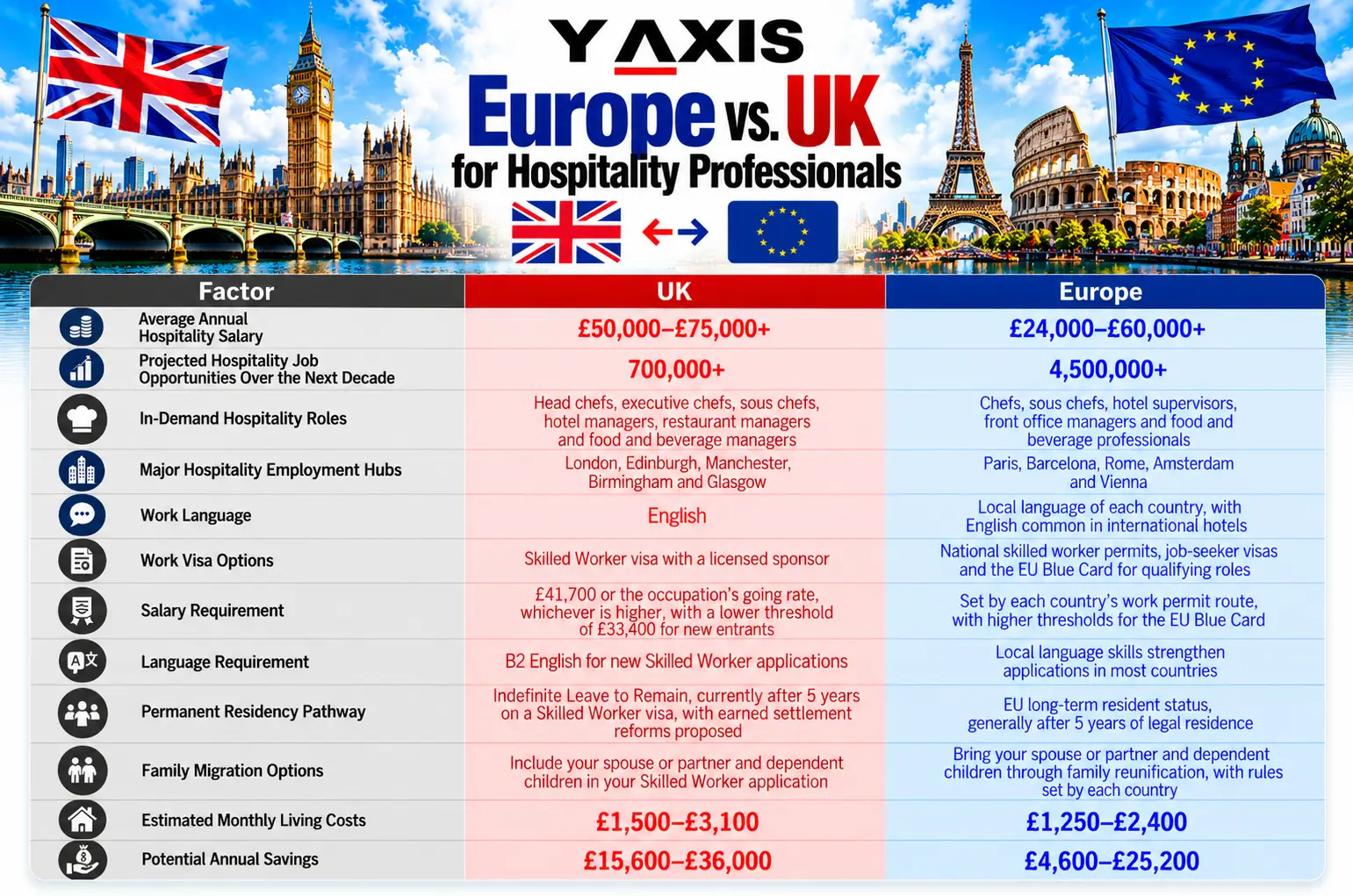
The UK offers English-speaking workplaces and employer-sponsored Skilled Worker visas, while Europe provides hospitality opportunities across luxury hotels, resorts and fine dining, with local language skills creating additional opportunities. The two destinations differ in salaries, visa routes, language requirements and permanent residency pathways.
|
Factor |
UK |
Europe |
|
Average Annual Hospitality Salary |
£50,000–£75,000+ |
€28,000–€70,000+ |
|
Projected Hospitality Job Opportunities Over the Next Decade |
700,000+ |
4,500,000+ |
|
In-Demand Hospitality Roles |
Head chefs, executive chefs, sous chefs, hotel managers, restaurant managers and food and beverage managers |
Chefs, sous chefs, hotel supervisors, front office managers and food and beverage professionals |
|
Major Hospitality Employment Hubs |
London, Edinburgh, Manchester, Birmingham and Glasgow |
Paris, Barcelona, Rome, Amsterdam and Vienna |
|
Work Language |
English |
Local language of each country, with English common in international hotels |
|
Work Visa Options |
Skilled Worker visa with a licensed sponsor |
National skilled worker permits, job-seeker visas and the EU Blue Card for qualifying roles |
|
Salary Requirement |
£41,700 or the occupation’s going rate, whichever is higher, with a lower threshold of £33,400 for new entrants |
Set by each country’s work permit route, with higher thresholds for the EU Blue Card |
|
Language Requirement |
B2 English for new Skilled Worker applications |
Local language skills strengthen applications in most countries |
|
Permanent Residency Pathway |
Indefinite Leave to Remain, currently after 5 years on a Skilled Worker visa, with earned settlement reforms proposed |
EU long-term resident status, generally after 5 years of legal residence |
|
Family Migration Options |
Include your spouse or partner and dependent children in your Skilled Worker application |
Bring your spouse or partner and dependent children through family reunification, with rules set by each country |
| Estimated Monthly Living Costs | £1,500–£3,100 | €1,450–€2,800 |
Europe vs. UK for Hospitality Professionals: Which Country Offers Better Opportunities?
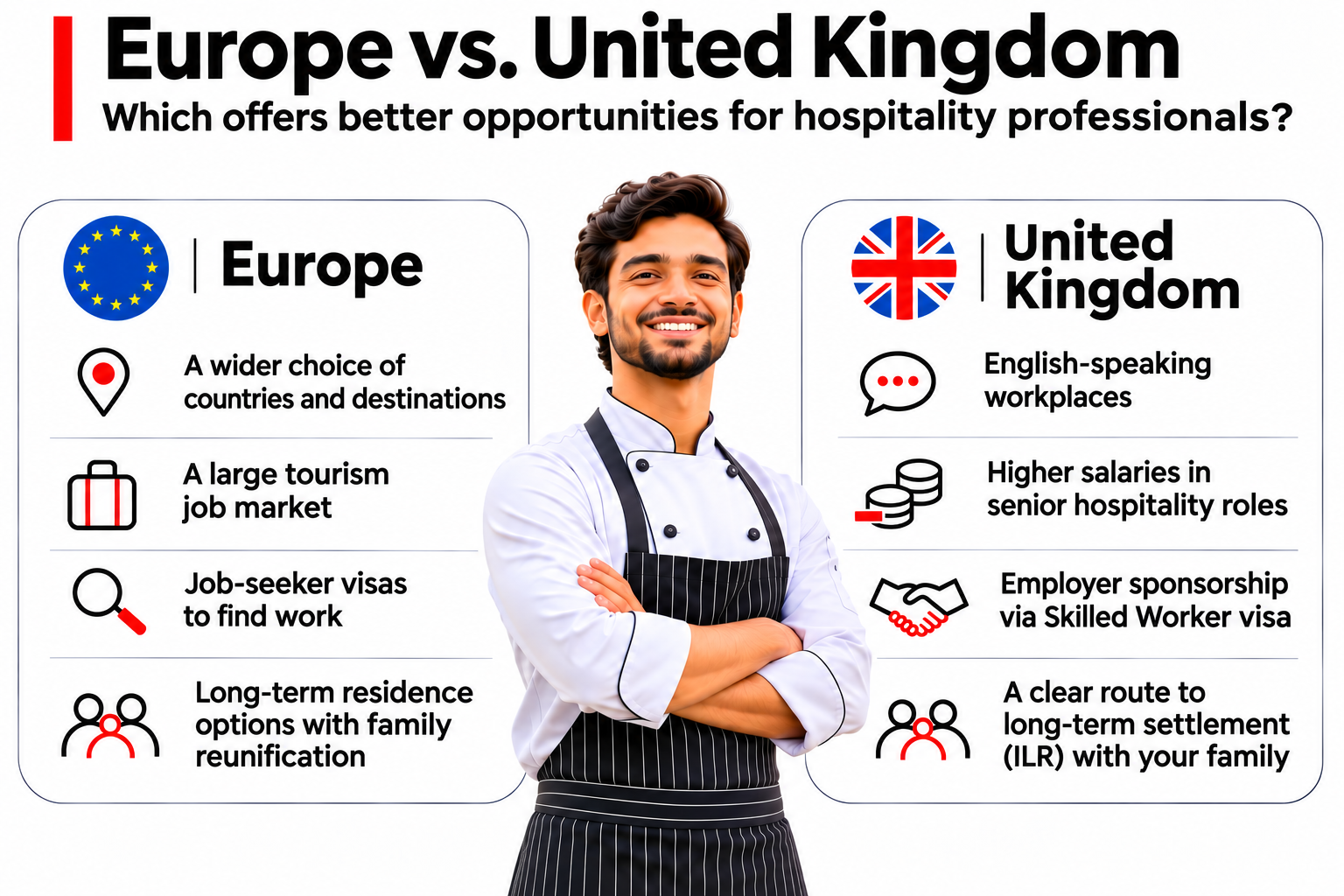
The UK offers better opportunities for hospitality professionals who want English-speaking workplaces, strong salaries in senior roles and employer-sponsored routes to settle long term. Europe offers a wider choice of countries, a large tourism job market and the chance to build international experience.
The UK may be a better choice if you want:
- English-speaking hospitality workplaces
- Strong salaries for head chefs, executive chefs and hotel managers
- Jobs in luxury hotels, fine dining and leading restaurant groups
- Employer sponsorship through the Skilled Worker visa for eligible roles
- A clear route to settle through Indefinite Leave to Remain
- Your spouse or partner and children included in your visa application
Want to work in the UK? Get expert guidance from Y-Axis professionals.
Europe may be a better choice if you want:
- A choice of countries and destinations, from Paris and Barcelona to luxury resorts
- A large tourism job market, with 4.5 million new EU travel and tourism jobs projected over the next decade
- Job-seeker visas that let you look for work without a job offer
- The chance to learn a new language and build international experience
- Long-term residence options in many countries after 2 to 5 years of legal stay
- Family reunification for your spouse and children
Europe vs. UK for Hospitality Professionals: Salary, Living Costs and Savings
The UK offers hospitality professionals strong salaries in senior chef and hotel management roles, particularly in London and major cities, with solid savings potential outside the most expensive areas. Europe provides hospitality careers across luxury resorts, boutique hotels and fine dining, with living costs that vary widely by country. The UK applies income tax and National Insurance to most employees, while European countries apply income tax and social security contributions at different rates. Actual savings depend on salary, income tax, housing costs and everyday expenses in each country.
|
Factor |
UK |
Europe |
|
Annual Salary for Senior Hospitality Roles (Before Tax) |
£42,000–£75,000 |
€28,000–€70,000 |
|
Monthly Gross Salary |
£3,500–£6,250 |
€2,300–€5,800 |
|
Estimated Monthly Take-Home Pay |
£2,800–£4,500 |
€1,900–€3,900 |
|
Monthly Rent for a 1-Bedroom City-Centre Apartment |
£1,000–£2,250 |
€1,000–€2,000 |
|
Monthly Grocery Costs |
£250–£350 |
€250–€400 |
|
Monthly Public Transport Costs |
£50–£200 |
€50–€100 |
|
Monthly Utilities, Internet and Mobile |
£200–£300 |
€150–€300 |
|
Estimated Total Monthly Living Costs |
£1,500–£3,100 |
€1,450–€2,800 |
|
Potential Monthly Savings |
£1,300–£3,000 |
€450–€2,450 |
|
Potential Annual Savings |
£15,600–£36,000 |
€5,400–€29,400 |
|
Lower-Cost Cities for Hospitality Professionals |
Manchester, Birmingham and Glasgow |
Vienna, Prague and Athens |
|
Higher-Cost Hospitality Cities |
London and Edinburgh |
Paris and Amsterdam |
|
Retirement Benefits |
Workplace pension with a minimum 3% employer contribution |
State pension contributions through social insurance, with rates set by each country |
*Plan Your Hospitality Career Abroad? Book a Free Consultation with Y-Axis Today.
FAQs
Which is better for hospitality professionals, the UK or Europe?
The UK suits professionals who want English-speaking workplaces, strong salaries in senior roles and a route to settle long term through employer sponsorship. Europe suits those who want a wider choice of countries, a large tourism job market and international experience. The right choice depends on your role, qualifications, salary expectations and whether you prefer working in English or learning a new language.
Can hospitality professionals get visa sponsorship in the UK?
Yes, through the Skilled Worker visa when a licensed sponsor offers a role that meets the skill level and salary requirements. Since the July 2025 changes, the skill threshold is degree level (RQF Level 6), so eligibility depends on the specific role and its occupation code. Professionals already on a Skilled Worker visa can continue to be sponsored, including when changing employer.
Which hospitality roles can get UK visa sponsorship?
Eligibility depends on the occupation code, and each role must meet the degree-level skill requirement. Hotel receptionists, waiters and kitchen porters do not qualify. One law firm source states that the chef occupation code is closed to new sponsorship since July 2025, while existing sponsored chefs can continue. Check your role on the GOV.UK eligible occupations list before applying.
What is the minimum salary for a UK Skilled Worker visa in hospitality?
The general threshold is £41,700 a year or the occupation’s going rate, whichever is higher. Lower thresholds, such as £33,400, apply to new entrants and some other groups, and pay must be at least £17.13 an hour. Only guaranteed basic pay counts, so bonuses and overtime do not count towards the threshold.
What English level do I need for a UK Skilled Worker visa?
New Skilled Worker applicants need English at B2 level, which has applied since January 2026. You can prove it with an approved English language test, a degree taught in English or nationality of a majority English-speaking country. B2 is higher than the previous B1 requirement, so building your English early strengthens your application.
How much can hospitality professionals earn and save in the UK vs Europe?
UK senior hospitality roles typically pay £42,000 to £75,000 before tax, with potential monthly savings of £1,300 to £3,000 in lower-cost cities. Europe typically pays €28,000 to €70,000, with potential monthly savings of €450 to €2,450. Savings depend on country, city, housing costs and tax, so compare take-home pay and rent rather than salary alone.
Can I get permanent residency through a hospitality job?
Skilled Worker visa holders can currently apply for Indefinite Leave to Remain after 5 years if they meet the salary, English and residence requirements. The government has proposed earned settlement reforms that could lengthen this period, so check the latest rules on GOV.UK before planning. Many European countries offer long-term residence after about 2 to 5 years of legal stay.
Can I work in Europe without a job offer?
Some European countries offer job-seeker visas that let you stay and look for work without a job offer. Requirements differ by country and usually include proof of qualifications, work experience and funds to support yourself. Other countries require a job offer before you apply for a work permit, so check the rules of each country you are considering.
Can I bring my family to the UK or Europe?
Yes. Skilled Worker visa holders can include a spouse or partner and dependent children in their application. European countries also allow family reunification, with rules, income requirements and waiting periods set by each country. Include dependant visa fees and healthcare costs in your budget.
Which UK hospitality employers sponsor visas?
The Home Office publishes a register of licensed sponsors, and more than 10,000 are in accommodation and food services. Hotel groups, luxury resorts and multi-site restaurant groups are the most likely sponsors. Search the register, apply directly to licensed employers and confirm they can sponsor your specific role before you accept an offer.
Tags:
Hospitality Jobs UK
Hospitality Jobs in Europe
Europe vs UK
Hospitality Visa Sponsorship
UK Skilled Worker Visa
Chef Jobs UK
Hotel Manager Jobs
Hospitality Salaries
Hospitality Career Opportunities
UK Permanent Residency (PR)
Share
Y-Axis Services

Get it on your mobile

Get News alerts

Contact Y-Axis
Latest Article
Popular Post
Trending Article

Posted On November 18 2026
How Can I Get Permanent Residency in Italy?