

Posted on October 28 2026
Australia vs. Europe for STEM Professionals: Which Country Should You Choose?

By , Editor & Director
Updated November 11 2026
Australia and Europe offer STEM professionals career opportunities in software engineering, artificial intelligence, data science, renewable energy and biotechnology. Australia has strong demand for engineers, IT specialists and scientists, while Germany, the Netherlands, Ireland and Sweden have established technology, advanced manufacturing and research sectors.
Australia has skilled migration pathways, including the Skills in Demand visa (subclass 482), Skilled Independent visa (subclass 189) and Skilled Nominated visa (subclass 190). Many European countries also offer work visa options, such as the Germany Opportunity Card, Ireland Critical Skills Employment Permit and Netherlands Highly Skilled Migrant visa, alongside the EU Blue Card. Job opportunities, salaries, visa options, living costs and PR pathways vary between Australia and Europe, so choosing the right destination can help you advance your STEM career and achieve your long-term goals.
*Want to work abroad? Let Y-Axis help you through application process.
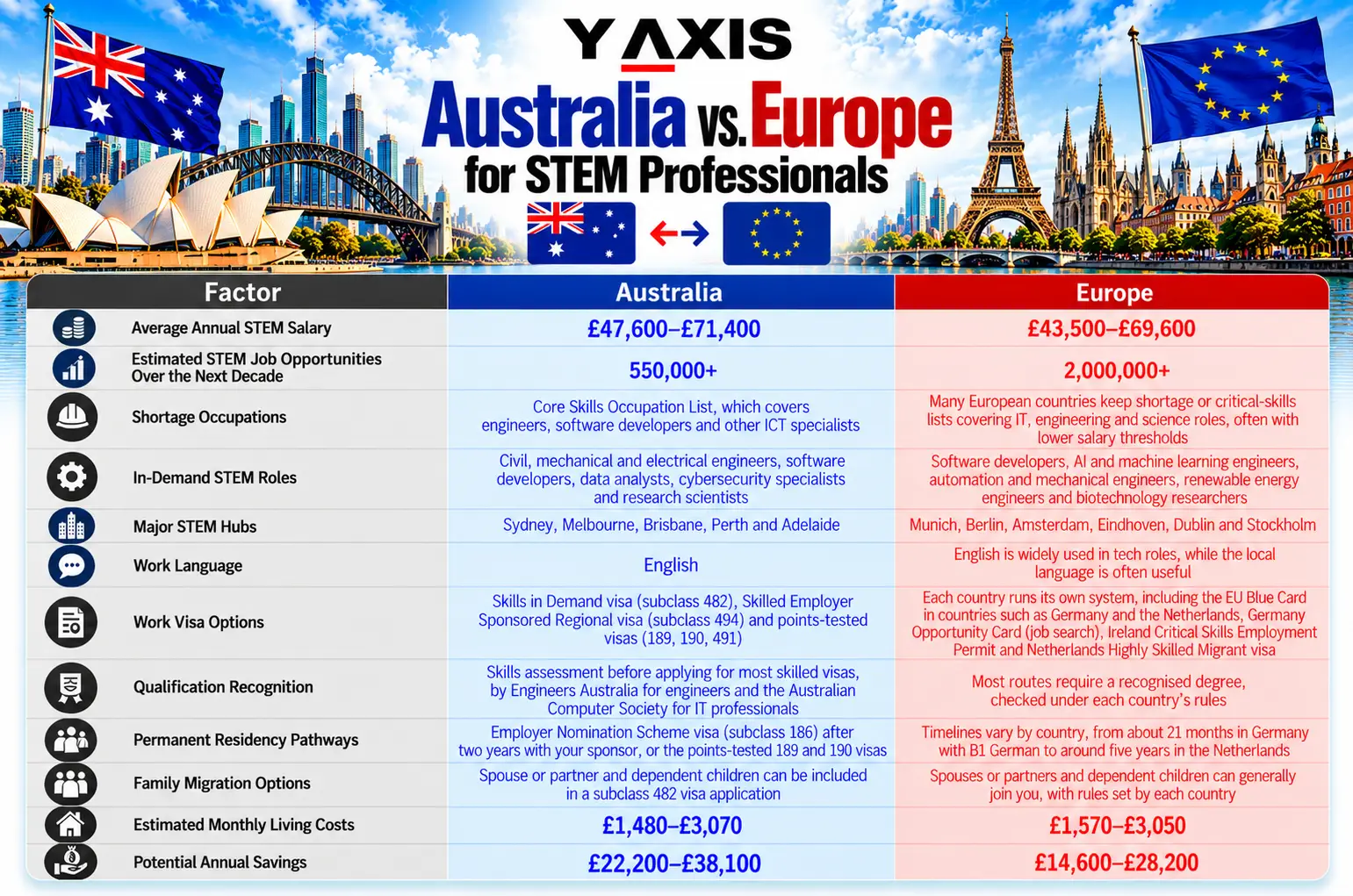
Australia vs. Europe for STEM Professionals: Quick Comparison
|
Factor |
Australia |
Europe |
|
Average Annual STEM Salary |
AUD 90,000-135,000 |
€50,000-80,000 |
|
Estimated STEM Job Opportunities Over the Next Decade |
550,000+ |
2,000,000+ |
|
Shortage Occupations |
Core Skills Occupation List, which covers engineers, software developers and other ICT specialists |
Many European countries keep shortage or critical-skills lists covering IT, engineering and science roles, often with lower salary thresholds |
|
In-Demand STEM Roles |
Civil, mechanical and electrical engineers, software developers, data analysts, cybersecurity specialists and research scientists |
Software developers, AI and machine learning engineers, automation and mechanical engineers, renewable energy engineers and biotechnology researchers |
|
Major STEM Hubs |
Sydney, Melbourne, Brisbane, Perth and Adelaide |
Munich, Berlin, Amsterdam, Eindhoven, Dublin and Stockholm |
|
Work Language |
English |
English is widely used in tech roles, while the local language is often useful |
|
Work Visa Options |
Skills in Demand visa (subclass 482), Skilled Employer Sponsored Regional visa (subclass 494) and points-tested visas (189, 190, 491) |
Each country runs its own system, including the EU Blue Card in countries such as Germany and the Netherlands, Germany Opportunity Card (job search), Ireland Critical Skills Employment Permit and Netherlands Highly Skilled Migrant visa |
|
Qualification Recognition |
Skills assessment before applying for most skilled visas, by Engineers Australia for engineers and the Australian Computer Society for IT professionals |
Most routes require a recognised degree, checked under each country’s rules |
|
Permanent Residency Pathways |
Employer Nomination Scheme visa (subclass 186) after two years with your sponsor, or the points-tested 189 and 190 visas |
Timelines vary by country, from about 21 months in Germany with B1 German to around five years in the Netherlands |
|
Estimated Monthly Living Costs |
AUD 2,800-5,800 |
€1,800-3,500 |
|
Family Migration Options |
Spouse or partner and dependent children can be included in a subclass 482 visa application |
Spouses or partners and dependent children can generally join you, with rules set by each country |
Australia vs Europe: Which Offers Better Opportunities for STEM Professionals?
Australia appeals to STEM professionals seeking English-speaking workplaces, career opportunities in engineering, IT and infrastructure, and skilled migration pathways to permanent residency. Europe offers a wider choice of countries, with technology hubs, advanced manufacturing, renewable energy and research centres across Germany, the Netherlands, Ireland and Sweden. The best fit depends on your specialisation, work experience and long-term plans.
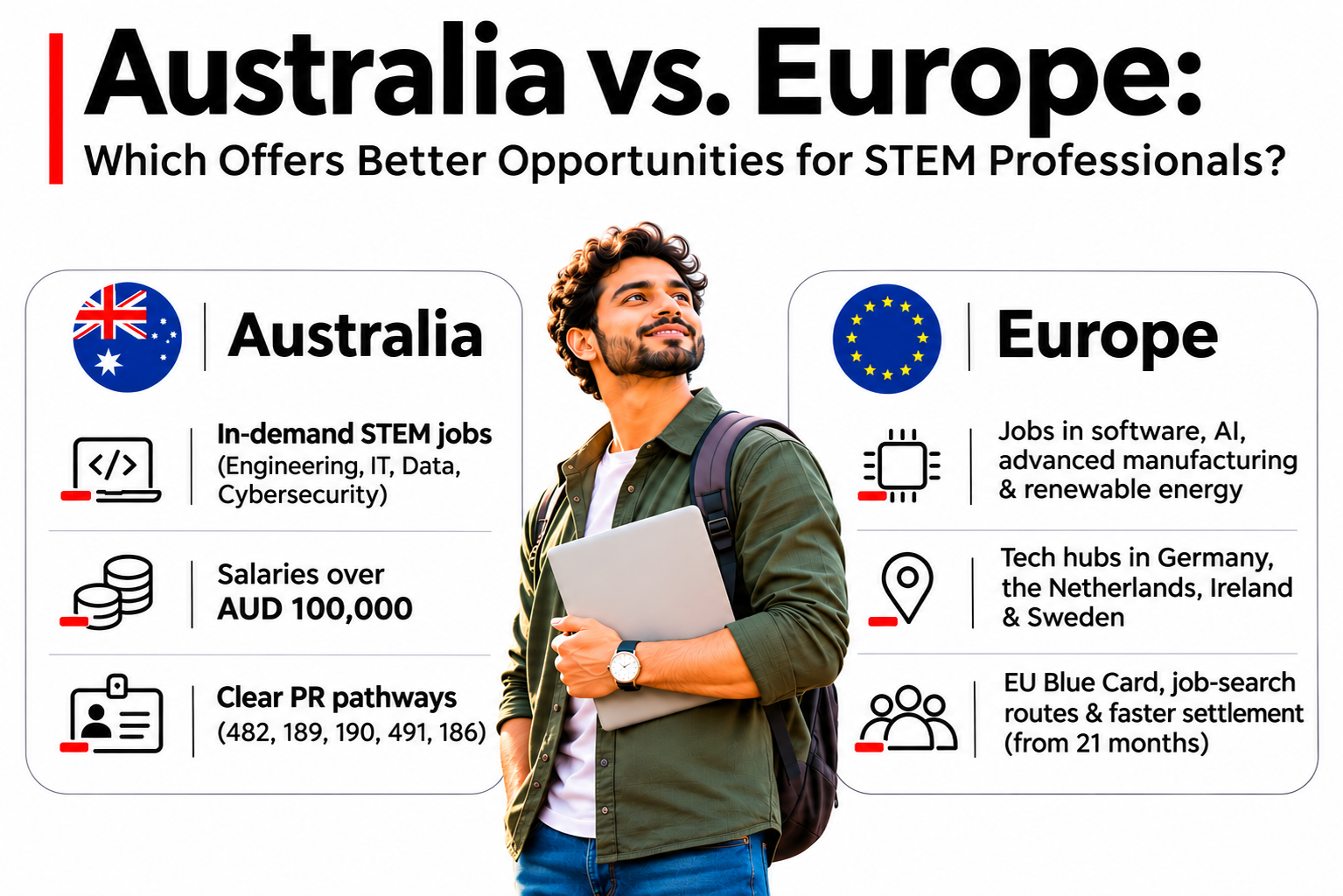
Australia is a strong choice if you want:
- Jobs in engineering, software development, data and cybersecurity
- English-speaking workplaces across STEM industries
- Employer sponsorship through the Skills in Demand visa (subclass 482)
- A sponsor-free route through the Skilled Independent visa (subclass 189)
- Extra points through state and regional nomination
- Permanent residence via the Employer Nomination Scheme visa (subclass 186) after two years
*Planning to work in Australia? Get expert guidance from Y-Axis professionals.
Europe is a strong choice if you want:
- Jobs in software, AI, industrial automation, advanced manufacturing and renewable energy
- Technology hubs and research centres in Germany, the Netherlands, Ireland and Sweden
- Lower EU Blue Card salary threshold for many STEM jobs in Germany
- Job-search routes without a job offer, such as the Germany Opportunity Card and the Sweden job-seeker permit
- Fast-track settlement with local language skills in Germany and Switzerland
- Spouse work rights and fast family reunification
Australia vs Europe: Salary, Living Costs and Savings for STEM Professionals
Australia offers STEM professionals higher gross salaries and a larger share of pay after tax, while Germany, the Netherlands, Ireland and Sweden generally offer lower living costs alongside strong technology, engineering and research sectors. Income tax, rent, pension contributions and everyday expenses all influence how much you can save in each destination while advancing your STEM career.
|
Factor |
Australia |
Europe |
|
Average Annual STEM Salary (Before Tax) |
AUD 90,000-135,000 |
€50,000-80,000 |
|
Monthly Gross Salary |
AUD 7,500-11,250 |
€4,200-6,700 |
|
Estimated Monthly Take-Home Pay |
AUD 5,900-8,400 |
€2,700-4,000 |
|
Monthly Rent for a 1-Bedroom City-Centre Apartment |
AUD 1,600-4,100 |
€700-2,400 |
|
Monthly Grocery Costs |
AUD 350-700 |
€250-400 |
|
Monthly Public Transport Costs |
AUD 120-220 |
€63-100 |
|
Monthly Utilities, Internet and Mobile |
AUD 300-400 |
€250-400 |
|
Estimated Total Monthly Living Costs |
AUD 2,400-5,400 |
€1,300-3,500 |
|
Potential Monthly Savings |
AUD 3,500-6,000 |
€1,400-2,700 |
|
Potential Annual Savings |
AUD 42,000-72,000 |
€16,800-32,400 |
|
Lower-Cost Cities |
Adelaide, Brisbane and Perth |
Leipzig and Dresden |
|
Higher-Cost Cities |
Sydney and Melbourne |
Munich, Amsterdam, Stockholm and Dublin |
|
Retirement Benefits |
12% employer superannuation contribution |
State pension contributions vary, for example 9.3% each in Germany |
*Plan Your STEM Career Abroad? Book a Free Consultation with Y-Axis Today.
FAQs
Is Australia or Europe better for STEM professionals?
It depends on your specialisation, experience and settlement goals. Australia offers English-speaking workplaces and points-tested routes to permanent residency, while Europe offers a wider choice of countries, technology hubs and country-specific work visas.
Is there more demand for STEM professionals in Australia or Europe?
Both have strong demand. Science & Technology Australia estimates about 550,000 additional roles requiring a STEM degree by 2035, and the European Commission estimates a need for 2 million additional science and engineering professionals.
What is the average salary for STEM professionals in Australia and Europe?
Typical gross salaries are AUD 90,000-135,000 in Australia and €50,000-80,000 in Europe. Australian residents are estimated to keep about 75-79% after tax at these levels, against about 62-65% for mid-level engineers in Germany.
How many points do you need for Australia PR?
The pass mark for the 189, 190 and 491 visas is 65 points, and higher scores improve your chances of an invitation. State nomination adds 5 points (190 visa) and regional nomination adds 15 (491 visa).
What work visas are available for STEM professionals in Australia?
Options include the Skills in Demand visa (subclass 482), Skilled Independent visa (189), Skilled Nominated visa (190) and Skilled Work Regional visa (491). Skills in Demand holders can move to permanent residence through the Employer Nomination Scheme visa (186) after two years with their sponsor.
What is the EU Blue Card for STEM professionals?
It is a work and residence permit for highly qualified non-EU workers. It covers 25 EU member states, excluding Denmark and Ireland, and each country sets its own salary threshold. Germany’s current thresholds are €50,700 for general occupations and €45,934.20 for shortage occupations.
Can STEM professionals move to Europe without a job offer?
Yes, through job-search routes such as the Germany Opportunity Card. Sweden also offers a permit of three to nine months for people with an advanced-level degree who want to look for work or explore starting a business.
How long does it take to get permanent residency in Australia and Germany?
In Australia, the employer route takes two years with your sponsor before you can move to the 186 visa. In Germany, EU Blue Card holders can apply for a settlement permit after 21 months with B1 German or 27 months with A1 German.
How do living costs in Australia compare with Europe for STEM professionals?
It depends on the city. A single person spends about AUD 3,800-5,800 a month in Sydney, against about €1,800-2,200 in Leipzig and roughly €3,500 in Amsterdam.
Can STEM professionals bring family to Australia or Europe?
Yes. In Australia, you can include your spouse or partner and dependent children in a subclass 482 visa application. In Europe, EU Blue Card holders benefit from fast-tracked family reunification, and family members can access the labour market, with rules varying by country and permit.
Tags:
Australia vs Europe
STEM Jobs in Australia
STEM Jobs in Europe
Best Country for STEM Professionals
STEM Salaries Abroad
Australia PR Points System
Skills in Demand Visa
EU Blue Card
Germany Opportunity Card
Work Visas for STEM Professionals
Share
Y-Axis Services

Get it on your mobile

Get News alerts

Contact Y-Axis
Latest Article
Popular Post
Trending Article

Posted On November 18 2026
How Can I Get Permanent Residency in Italy?