


Editors Pick
Latest Article

Australia vs. Germany for Engineering Professionals: Which Country Should You Choose?
Australia vs. Germany for Engineering Professionals: Which Country Should You Choose?
Australia and Germany are popular destinations for engineering professionals seeking competitive salaries, international career growth and long-term settlement opportunities. Australia offers jobs in civil, mining, mechanical and electrical engineering, while Germany has strong opportunities in automotive manufacturing, industrial automation and renewable energy.
Australia and Germany differ in engineering salaries, qualification recognition, language requirements, work visa options, cost of living and permanent residency pathways, and the right choice depends on your engineering specialisation and experience.
*Want to work abroad? Let Y-Axis help you through application process.
Australia vs Germany for Engineering Professionals: Quick Comparison
Australia offers English-speaking workplaces and employer-sponsored visas, while Germany provides engineering opportunities across major industries, with German language skills creating additional opportunities. The two countries differ in salaries, qualification recognition, living costs and permanent residency pathways.
|
Factor |
Australia |
Germany |
|
Average Annual Engineering Salary |
AUD 90,000–AUD 150,000+ |
€45,000–€90,000+ |
|
Projected Engineering Job Opportunities Over the Next Decade |
150,000+ |
200,000+ |
|
Shortage Occupations |
Civil, electrical, mechanical and mining engineers appear on the Occupation Shortage List |
Engineers qualify as a shortage occupation, with a lower EU Blue Card salary threshold |
|
In-Demand Engineering Roles |
Civil, mining, mechanical, electrical, structural and project engineers |
Mechanical, electrical, automotive, industrial automation, civil and renewable energy engineers |
|
Major Engineering Employment Hubs |
Sydney, Melbourne, Brisbane, Perth and Adelaide |
Munich, Stuttgart, Berlin, Hamburg and Frankfurt |
|
Work Language |
English |
German widely used, with English common in international firms |
|
Work Visa Options |
Skills in Demand visa (subclass 482), Skilled Employer Sponsored Regional visa (subclass 494) and points-tested skilled visas (189, 190, 491) |
EU Blue Card and Opportunity Card |
|
Qualification Recognition |
Skills assessment by Engineers Australia |
Recognised university degree required for the EU Blue Card |
|
Permanent Residency and Settlement Pathways |
Employer Nomination Scheme visa (subclass 186), Skilled Independent visa (subclass 189) and Skilled Nominated visa (subclass 190) |
Settlement permit after 21 months with B1 German, 27 months with A1 German or 33 months without German |
|
Estimated Monthly Living Costs |
AUD 3,500–AUD 5,000 |
€1,800–€2,500 |
|
Family Migration Options |
Include your spouse or partner and dependent children in a subclass 482 visa application |
Bring your spouse or partner and dependent children with an EU Blue Card |
Australia vs Germany: Which Country Offers Better Opportunities for Engineering Professionals?
Australia offers better opportunities for engineers who want English-speaking workplaces, competitive salaries and employer-sponsored routes to permanent residency. Germany offers opportunities across major industrial sectors, access to Europe’s largest industrial job market and a fast-track settlement permit.
Australia may be a better choice if you want:
- English-speaking engineering workplaces
- High earning potential in civil, mining, electrical, mechanical engineering and IT
- Engineering careers across major infrastructure, renewable energy and defence projects
- Employer sponsorship through the Skills in Demand visa (subclass 482)
- Direct pathway to Australian PR through subclass 186, 189 or 190 visas
- Benefit from employer superannuation contributions
*Want to work in Australia? Get expert guidance from Y-Axis professionals.
Germany may be a better choice if you want:
- Access to one of Europe’s largest industrial job markets
- A lower EU Blue Card salary threshold for engineers
- Jobs in construction, automotive, industrial automation, renewable energy and IT engineering
- Opportunity Card to search for engineering jobs without a job offer
- Fast-track settlement with German language skills
- Family reunification for your spouse and children
*Want to work in Germany? Get expert guidance from Y-Axis professionals.
Australia vs Germany: Salary, Living Costs and Savings for Engineering Professionals
Australia offers engineers attractive salaries and strong savings potential, particularly in mining, infrastructure and electrical engineering. Germany provides rewarding career opportunities in automotive manufacturing, mechanical engineering and industrial automation, alongside lower living costs. Australia applies a 2% Medicare levy to most residents, while Germany requires mandatory social insurance contributions. Actual savings depend on salary, income tax, housing costs and everyday expenses in each country.
|
Factor |
Australia |
Germany |
|
Annual Engineering Salary (Before Tax) |
AUD 90,000–AUD 150,000 |
€45,000–€90,000 |
|
Monthly Gross Salary |
AUD 7,500–AUD 12,500 |
€3,750–€7,500 |
|
Estimated Monthly Take-Home Pay |
AUD 5,900–AUD 9,200 |
€2,400–€4,300 |
|
Monthly Rent for a 1-Bedroom City-Centre Apartment |
AUD 1,700–AUD 3,100 |
€600–€1,800 |
|
Monthly Grocery Costs |
AUD 550–AUD 700 |
€250–€350 |
|
Monthly Public Transport Costs |
AUD 120–AUD 225 |
€63–€120 |
|
Monthly Utilities, Internet and Mobile |
AUD 250–AUD 350 |
€200–€400 |
|
Estimated Total Monthly Living Costs |
AUD 2,600–AUD 4,400 |
€1,100–€2,700 |
|
Potential Monthly Savings |
AUD 3,300–AUD 6,600 |
€1,300–€3,200 |
|
Potential Annual Savings |
AUD 39,600–AUD 79,200 |
€15,600–€38,400 |
|
Lower-Cost Cities for Engineers |
Adelaide, Perth and Brisbane |
Leipzig and Dresden |
|
Higher-Cost Engineering Cities |
Sydney and Melbourne |
Munich and Frankfurt |
|
Retirement Benefits |
12% employer superannuation contribution |
State pension insurance (9.3% each from employer and employee) |
*Plan Your Engineering Career Abroad? Book a Free Consultation with Y-Axis Today.
FAQs
Is Australia or Germany better for engineers?
Both countries offer strong engineering careers, and the better choice depends on your discipline, language skills and visa pathway. Australia suits engineers who value English-speaking workplaces, high-paying salaries and employer-sponsored routes to permanent residency. Germany suits engineers drawn to one of Europe’s largest industrial job markets and a settlement pathway that shortens with German language skills.
Which country pays engineers more, Australia or Germany?
Australia generally offers high-paying salaries, with engineers typically earning AUD 90,000 to AUD 150,000 or more, against €45,000 to €90,000 or more in Germany. Pay varies by discipline and city, and take-home pay reflects income tax, Australia’s 2% Medicare levy and Germany’s social insurance contributions.
Can engineers move to Australia from the UK?
Yes. Engineers can move through employer sponsorship on the Skills in Demand visa (subclass 482) or points-tested skilled visas such as the 189 and 190, subject to each visa’s requirements. An Engineers Australia skills assessment is often the first step, and applicants who meet the requirements of the permanent subclass 186 visa can build a long-term future in Australia.
Can engineers move to Germany from the UK?
Yes. Engineers with a recognised university degree and a qualifying job offer can apply for the EU Blue Card, with a reduced salary threshold (currently €45,934.20) for eligible shortage occupations and the standard threshold for other roles. Engineers who meet the points requirements can also use the Opportunity Card to enter Germany and search for work without a job offer.
Can engineers work in Germany without speaking German?
Yes. Engineers can apply for the EU Blue Card without German, and international employers in automotive, manufacturing and energy hire English-speaking engineers. German skills widen your options and shorten settlement to 21 months at B1 level or 27 months at A1 level, compared with 33 months without German.
Which country offers faster permanent residency for engineers, Australia or Germany?
Germany can be faster for Blue Card holders with B1 German, who can apply for a settlement permit after 21 months. Australia’s route depends on the visa: the 189 and 190 grant permanent residency on approval of a points-tested application, and the subclass 186 follows a period of sponsored work.
Is living in Germany cheaper than in Australia for engineers?
Yes. Living costs are typically lower in Germany, with essential monthly costs for a single person of around €1,200 to €2,100, against AUD 2,700 to AUD 4,100 in Australia. Rent and everyday expenses vary by city, with Leipzig, Dresden, Adelaide, Perth and Brisbane tending to cost less than Munich, Frankfurt, Sydney and Melbourne.
Which engineering jobs are in demand in Australia and Germany?
Australia offers strong opportunities in civil, mining, electrical and mechanical engineering, with growth in renewable energy and infrastructure. Germany offers opportunities in automotive manufacturing, mechanical engineering, industrial automation, renewable energy and construction, where shortages are strongest.
Are UK engineering degrees recognised in Australia and Germany?
Yes. Both countries assess UK engineering degrees, and the process depends on the visa route and role. Australia uses a skills assessment by Engineers Australia for many skilled visas, while Germany’s requirements depend on the visa route and whether the work is regulated, and the EU Blue Card requires a recognised university degree.
How long does it take to get citizenship in Australia and Germany?
Germany generally offers citizenship after 5 years of residence, with dual citizenship permitted, and Australia offers it after four years of lawful residence, including the last 12 months as a permanent resident. Both countries set additional language and integrity requirements.
Posted on October 23 2026
What is the Average Salary in the UAE?
What is the Average Salary in the UAE?
The average salary in the UAE is around AED 16,000 gross per month or AED 192,000 a year. The median salary is around AED 10,000 per month. Salaries are higher in fields such as finance, technology, oil and gas and law, while actual earnings vary by occupation, experience, qualifications, industry and emirate.
The UAE does not levy personal income tax on salaries, so take-home pay is generally close to gross pay. Dubai and Abu Dhabi are major employment hubs for roles in engineering, healthcare, education and construction. The UAE also plans to invest up to AED 200 billion in sustainable energy by 2030, supporting job opportunities in green technology. Tax-free earnings and diverse opportunities make the UAE attractive to skilled professionals seeking international experience and career growth.
*Want to work in the UAE? Book a free consultation with Y-Axis today.
Average Salaries for Most In-Demand Jobs in the UAE
The most in-demand jobs in the UAE are concentrated in technology, healthcare, engineering and finance, with roles such as software engineers, registered nurses, civil engineers and accountants in strong demand. Salaries depend on experience, qualifications, specialisation and employer. Monthly salaries vary by seniority, ranging from around AED 7,000 for entry-level roles to AED 130,000 for senior leadership positions. Over 60% of white-collar roles pay between AED 10,000 and AED 40,000 per month.
|
Occupation |
Average Annual Salary |
Chances of |
|
IT & Software |
AED 222,600 |
Very High |
|
Engineering |
AED 201,400 |
Very High |
|
Healthcare |
AED 185,400 |
High |
|
Nursing |
AED 120,000 |
Very High |
|
Accounting & Finance |
AED 195,600 |
Moderate to High |
|
Marketing & Sales |
AED 191,400 |
Moderate |
|
Human Resources |
AED 193,300 |
Moderate |
|
Logistics & Supply Chain |
AED 172,000 |
Moderate to High |
|
Teaching |
AED 167,600 |
High |
|
Construction & Real Estate |
AED 198,300 |
High |
|
Hospitality & Tourism |
AED 159,600 |
Moderate to High |
Read More…
Most in-demand jobs in the UAE for the next 10 years
Top 10 Highest-Paying Jobs in the UAE
The highest-paying jobs in the UAE are in banking, healthcare, law, technology and senior management, offering gross monthly salaries of around AED 45,000 to AED 130,000. Banking managing directors, specialist doctors, law firm partners and chief financial officers are among the top earners. With no personal income tax on employment salaries, the UAE attracts skilled professionals with competitive pay and strong financial benefits.
|
Job |
Gross Salary per Month (AED) |
Approx. Annual Salary (AED) |
|
Banking Managing Director |
130,000 |
1,560,000 |
|
Specialist Doctor or Consultant Surgeon |
85,000 |
1,020,000 |
|
Law Firm Partner |
75,000 |
900,000 |
|
Chief Financial Officer (CFO) |
65,000 |
780,000 |
|
Chief Executive Officer (CEO) |
59,000 |
708,000 |
|
IT Director |
53,000 |
636,000 |
|
AI or Machine Learning Engineer |
52,500 |
630,000 |
|
IT Architect |
46,000 |
552,000 |
|
Country Manager or Director |
45,500 |
546,000 |
|
Pilot |
45,000 |
540,000 |
*Looking for jobs in the UAE? Let Y-Axis guide you through application process.
Best Cities in the UAE with Most Job Opportunities
Dubai, Abu Dhabi and Sharjah are major employment hubs in the UAE, with opportunities across finance, technology, healthcare, engineering and manufacturing. Ras Al Khaimah and Fujairah also offer jobs in specialised sectors such as tourism, logistics and shipping.
- Dubai: Finance, technology, trade, tourism and hospitality.
- Abu Dhabi: Oil and gas, healthcare, government, defence and renewable energy.
- Sharjah: Manufacturing, education, healthcare and logistics.
- Ajman: Manufacturing, construction, retail and logistics.
- Ras Al Khaimah: Manufacturing, construction, tourism and hospitality.
- Fujairah: Shipping, ports, logistics, oil storage and tourism.
- Umm Al Quwain: Fishing, manufacturing, construction and tourism.
UAE vs UK: Salary, Tax and Savings
The average monthly salary in the UAE is around AED 16,000, and the absence of personal income tax on employment income allows professionals to retain more of their earnings. The UK also offers competitive salaries and career opportunities across finance, technology, healthcare and engineering, although Income Tax and National Insurance affect take-home pay. Comparing salaries, taxes and living costs helps professionals assess their potential savings in both countries.
|
Factor |
UAE |
UK |
|
Gross Monthly Salary |
AED 20,000 |
£4,000 |
|
Gross Annual Salary |
AED 240,000 |
£48,000 |
|
Estimated Monthly Tax and Contributions |
AED 0 (0%) |
£830 (21%) |
|
Estimated Monthly Take-Home Pay |
AED 20,000 |
£3,170 |
|
Estimated Monthly Living Costs |
AED 13,000 |
£2,000 |
|
Estimated Monthly Savings |
AED 7,000 |
£1,173 |
|
Estimated Annual Savings |
AED 84,000 |
£14,076 |
Cost of Living in the UAE
The cost of living in the UAE for a single professional is typically around AED 5,200–12,600 per month, covering essential expenses such as rent, utilities, groceries, transport and dining. Costs are generally higher in Dubai and Abu Dhabi, particularly in central areas, while Sharjah and Ajman offer more affordable accommodation options.
|
Expense |
Estimated Monthly Cost (AED) |
|
Rent (1-bedroom apartment) |
3,000–6,000 |
|
Groceries |
800–1,500 |
|
Transport |
300–800 |
|
Utilities and internet |
500–1,000 |
|
Mobile phone |
100–300 |
|
Dining and entertainment |
600–3,000 |
|
Total |
5,200–12,600 |
Job Outlook in the UAE
The job outlook for the UAE is positive, with more than 1 million new jobs projected by 2030. Technology employment is expected to grow by 54%, creating demand for over 91,000 additional technology specialists. Manufacturing, education and retail are projected to contribute more than 270,000 new jobs combined, while employment in energy and utilities could grow by 33%. These trends are expected to create opportunities for software developers, AI specialists, cybersecurity analysts, engineers, healthcare professionals and teachers. Dubai and Abu Dhabi remain major employment hubs, while other emirates offer roles in manufacturing, logistics, construction and tourism.
*Want to work in the UAE? Get expert guidance from Y-Axis professionals.
FAQs
What is the average salary in the UAE per month?
The average gross salary in the UAE is around AED 16,000 per month, or AED 192,000 annually. Actual earnings vary by occupation, experience, qualifications and industry.
What is the average salary in Dubai?
The average monthly salary for professionals in Dubai is estimated at AED 16,000–18,000, equivalent to AED 192,000–216,000 annually. Finance, technology and senior management roles can offer higher salaries.
Is AED 20,000 a good salary in Dubai?
Yes, AED 20,000 per month is a good salary for most single professionals in Dubai. With monthly living expenses of AED 5,200–11,100, potential savings could reach AED 8,900–14,800, depending on rent and lifestyle.
How much salary do you need to live in Dubai?
A single person typically needs AED 9,000–15,000 per month for a comfortable lifestyle in Dubai. Shared accommodation and careful budgeting can reduce expenses.
What is the minimum wage in the UAE?
The UAE has no universal minimum wage for expatriate workers across all private-sector occupations. However, Emiratis employed in the private sector have a minimum monthly salary of AED 6,000 from 1 January 2026.
Is salary tax-free in the UAE?
Yes, the UAE does not levy personal income tax on employment salaries. Employees generally retain their gross salary before applicable deductions, although VAT applies to many goods and services.
Do I pay UK tax if I live and work in Dubai?
Not necessarily. UK tax obligations depend on your tax residency and income sources. Certain UK-source income may remain taxable after moving to Dubai, so check your circumstances with a qualified tax adviser.
Does Dubai pay more than the UK?
Dubai can offer higher take-home pay because employment salaries are not subject to personal income tax. However, housing costs and salaries vary, so compare net earnings and living expenses for similar roles.
What are the highest-paying jobs in the UAE?
Banking managing directors, specialist doctors, law firm partners, chief financial officers and chief executive officers are among the highest-paid professionals. Senior roles can pay around AED 59,000–130,000 per month, depending on experience and employer.
Is salary higher in Dubai or Abu Dhabi?
It depends on the occupation and employer. Dubai offers strong opportunities in finance, technology and hospitality, while Abu Dhabi has major employers in energy, healthcare and government-related sectors. Compare complete salary packages for similar roles.
Posted on October 21 2026

How Can I Get Permanent Residency in the UK?
How Can I Get Permanent Residency in the UK?
To get permanent residency in the UK, you must apply for Indefinite Leave to Remain (ILR) after completing the required residence period and meeting the settlement requirements for your visa category. Most Skilled Worker and Health and Care Worker visa holders qualify after five years, while Global Talent visa holders may qualify after three or five years and Innovator Founder visa holders after three years.
Spouses and partners on the five-year family visa route can generally apply after five years of qualifying residence, while the long-residence route requires 10 years of qualifying lawful residence. Applicants must also meet the continuous residence, English language and Life in the UK Test requirements. Once granted, ILR allows you to live, work and study in the UK indefinitely without renewing your visa.
*Want to apply for UK PR? Let Y-Axis guide you through the application process.
Pathways to Permanent Residency in the UK
There are six main pathways to permanent residency in the UK: Skilled Worker, Health and Care Worker, Global Talent, Innovator Founder, family visas and long residence. Most Skilled Worker and Health and Care Worker visa holders qualify for Indefinite Leave to Remain (ILR) after five years, while Global Talent and Innovator Founder visa holders may qualify after three years. Family visa and long-residence applicants must meet their route-specific qualifying periods and settlement requirements.
|
Pathway |
Qualifying period |
Main requirements |
|
5 years |
Eligible employment, required salary and employer confirmation that the job is still needed. |
|
|
Health and Care Worker visa |
5 years |
Eligible health or social care employment, required salary and employer confirmation. |
|
3 or 5 years |
Qualifying endorsement or eligible prestigious award, depending on the route. |
|
|
3 years |
Endorsed business meeting the settlement criteria for innovation, viability and growth. |
|
|
Family visa (spouse or partner) |
5 or 10 years |
Genuine relationship with a British citizen or settled partner and the applicable financial and residence requirements. |
|
Scale-up Worker visa |
5 years |
Qualifying residence and the required earnings under the settlement rules. |
|
UK Ancestry visa |
5 years |
Commonwealth citizenship, a qualifying UK-born grandparent and compliance with residence requirements. |
|
British National (Overseas) visa |
5 years |
BN(O) status or qualifying dependant status and the required residence period. |
|
International Sportsperson visa |
5 years |
Qualifying residence, eligible sporting employment and the required endorsement. |
|
Long-residence route |
10 years |
10 years of qualifying lawful residence and compliance with continuous residence requirements. |
What Are the ILR Eligibility Requirements for UK Permanent Residency?
To qualify for permanent residency in the UK, you must meet the settlement requirements for your visa route and complete the required period of residence.
- Qualifying residence: Complete five years on most work and family visa routes, three years on the Innovator Founder route and some Global Talent routes, or 10 years under the long-residence route.
- Time spent outside the UK: Meet the permitted absence limits for your visa route, which are generally no more than 180 days in any 12-month period on many routes.
- Employment and salary: Skilled Worker and Health and Care Worker applicants must meet the required employment and salary conditions.
- English language: Meet the English language requirement through an approved test or accepted qualification, unless exempt.
- Life in the UK Test: Pass the test unless exempt.
- Family visa conditions: Spouses and partners must meet the relationship and financial requirements for their visa route.
- Immigration history: Comply with UK immigration rules and provide accurate information in the application.
*Need help with UK ILR requirements? Book a free consultation with Y-Axis today.
Documents Required for UK Permanent Residency
Applicants applying for Indefinite Leave to Remain (ILR) must provide documents confirming their identity, immigration status and eligibility for settlement. The required documents depend on the visa category and individual circumstances.
- Passport and immigration status: A valid passport or travel document and your eVisa details.
- Proof of residence: Bank statements, utility bills, tenancy agreements or travel records, where required.
- Employment and salary (work routes): An employer letter, payslips and evidence that you meet the applicable salary requirements.
- English language: An approved test result or accepted qualification, unless exempt.
- Life in the UK Test: Your pass reference number, unless exempt.
- Relationship and financial evidence (family routes): A marriage or civil partnership certificate, evidence of an ongoing relationship and proof of meeting the applicable financial requirements.
- Business and endorsement documents (Innovator Founder and Global Talent): Business performance evidence and an endorsement letter for Innovator Founder applicants, or relevant endorsement or award evidence for Global Talent applicants.
How to Apply for Permanent Residency in the UK?
To apply for permanent residency in the UK, you must meet the eligibility requirements for Indefinite Leave to Remain (ILR), submit an online application through GOV.UK, verify your identity and wait for a decision from the Home Office.
Step 1: Check your eligibility
Confirm that you meet the qualifying residence period and settlement requirements for your visa category.
Step 2: Meet the English language and knowledge requirements
Pass the Life in the UK Test and meet the English language requirement, unless exempt.
Step 3: Gather your documents
Prepare your passport, eVisa details and supporting documents for your application.
Step 4: Complete the online application
Submit your ILR application on GOV.UK and pay the applicable fee. You can generally apply up to 28 days before completing your qualifying period.
Step 5: Prove your identity
Use the UK Immigration: ID Check app or attend an appointment to provide your biometric information, as instructed.
Step 6: Wait for a decision
Many ILR applications take up to six months. Priority services may be available for an additional fee, depending on the application route.
Step 7: Receive your ILR
Once approved, your immigration status is generally recorded in an eVisa accessible through your UKVI account.
*Want to apply for UK PR? Book a free consultation with Y-Axis today.
UK Permanent Residency Fees
The UK permanent residency application fee is £3,226 per person for Indefinite Leave to Remain (ILR). Each dependant must pay the same fee. Additional costs may include the Life in the UK Test, an English language test if required, and optional priority or super priority processing services.
|
Category |
Fee |
Details |
|
ILR application fee |
£3,226 per person |
Each dependant pays the same fee |
|
Standard processing |
Included |
Decision usually within six months |
|
Priority service |
£500 extra |
Decision within five working days, where available |
|
Super priority service |
£1,000 extra |
Decision by the end of the next working day after weekday biometrics |
|
Life in the UK Test |
£50 |
Required unless exempt |
|
English language test |
Varies |
Required if applicable and no exemption or accepted alternative applies |
UK Permanent Residency Processing Time
The standard processing time for UK permanent residency (ILR) is usually within six months of providing fingerprints and a photograph. Applicants using the priority service can usually receive a decision within five working days, while the super priority service provides a decision by the end of the next working day after weekday biometrics or within two working days after weekend biometrics.
*Want to migrate to UK permanently? Book a free consultation with Y-Axis today.
FAQs
How many years does it take to get permanent residency in the UK?
Most Skilled Worker visa holders and partners on the five-year family route can apply for Indefinite Leave to Remain (ILR) after five years. Innovator Founder visa holders may qualify after three years, while Global Talent visa holders may qualify after three or five years. The long-residence route requires 10 years of qualifying lawful residence.
Does a Student visa count towards UK permanent residency?
Time spent on a Student visa does not count towards the five-year qualifying period for most work visa routes. However, it can count towards the 10-year long-residence route if continuous lawful residence requirements are met. Time on a Graduate visa may also count towards this route.
How long can you stay outside the UK with ILR?
ILR generally lapses after more than two continuous years outside the UK, the Channel Islands and the Isle of Man. EU Settlement Scheme settled status can generally be retained for up to five continuous years abroad, or four years for Swiss citizens and their family members.
What are the requirements for UK permanent residency?
Applicants must complete the qualifying residence period and meet their visa route's settlement requirements. These may include continuous residence, the Life in the UK Test, English language proficiency, employment and salary conditions, or relationship and financial requirements for family routes.
How much does UK permanent residency cost?
The ILR application fee is £3,226 per applicant, including each dependant. Additional costs may include the £50 Life in the UK Test, an English language test if required, and optional priority processing services.
How long does it take to get ILR in the UK?
Standard ILR applications usually receive a decision within six months. Priority and super priority services may provide faster decisions for an additional fee, depending on the visa route and service availability.
Can I apply for British citizenship after getting ILR?
Most applicants can apply for British citizenship after holding ILR for at least 12 months, provided they meet the residence and other naturalisation requirements. Spouses and civil partners of British citizens may apply without the 12-month wait if they meet the relevant conditions.
Can my dependants get UK permanent residency with me?
Partners and children may apply for ILR under the relevant dependant or family route if they meet its settlement requirements. Each dependant must submit an application and pay the applicable fee. Test requirements depend on age and visa route.
Can UK permanent residency be revoked or lost?
Yes. ILR generally lapses after more than two continuous years outside the UK, the Channel Islands and the Isle of Man. It may also be revoked if obtained by deception or in certain deportation-related circumstances.
Are UK permanent residency rules changing?
The government has proposed an earned-settlement system that would increase the standard qualifying period from five to 10 years for many applicants. The final rules and transitional arrangements should be checked against current government announcements. The English language requirement for many settlement routes is scheduled to rise from B1 to B2 on 26 March 2027.
Posted on October 20 2026

What Are the Different Types of UK Visas to Immigrate?
What Are the Different Types of UK Visas to Immigrate?
The main types of UK visas for immigration include work, student, family, business and post-study routes. The Skilled Worker visa is for people with a job offer from a UK employer, while the Student visa allows international students to study at approved institutions. The Graduate visa lets international graduates stay in the UK after completing their studies, and the Innovator Founder visa is for entrepreneurs starting an innovative business.
The Global Talent visa is designed for people with recognised talent or potential in their field, while the Family visa allows people to join a partner or relative in the UK. Some visa routes can lead to indefinite leave to remain (ILR), which allows people to settle permanently in the UK.
*Want to migrate to UK? Book a free consultation with Y-Axis today.
Types of UK Visas for Immigration
The UK offers different visa types for people planning to move for work, study, business or to join family members. The right visa depends on your circumstances, such as having a job offer from a UK employer, admission to an approved educational institution, recognised talent in your field or a family member living in the UK. Some work, business and family visa routes can lead to indefinite leave to remain (ILR), which allows permanent settlement in the UK, while a Student visa is generally temporary.
|
UK Visa Type |
Who Is Eligible? |
Main Purpose |
|
People who meet the settlement requirements for their immigration route |
To live permanently in the UK |
|
|
People with a qualifying job offer from an approved UK employer |
To work in the UK |
|
|
Health and Care Worker visa |
Doctors, nurses and other health professionals in qualifying roles |
To work in eligible health and care jobs |
|
Scale-up Worker visa |
People with a qualifying job offer from an approved scale-up employer |
To work for a qualifying UK business |
|
International students accepted onto an eligible course at an approved institution |
To study in the UK |
|
|
International graduates who meet the route's requirements |
To stay in the UK after completing their studies |
|
|
Leaders or potential leaders in eligible fields |
To work in research, academia, arts or digital technology |
|
|
High Potential Individual visa |
Graduates of eligible overseas universities |
To live and work in the UK without a job offer |
|
Entrepreneurs with an innovative business idea endorsed under the route |
To establish an innovative business in the UK |
|
|
People joining a qualifying partner, parent or child in the UK |
To live with family in the UK |
|
|
UK Ancestry visa |
Eligible Commonwealth citizens with a UK-born grandparent |
To live and work in the UK |
|
Youth Mobility Scheme visa |
Young adults from participating countries who meet the scheme's requirements |
To live and work in the UK temporarily |
UK Visa Eligibility Requirements
UK visa eligibility depends on the visa type. The Skilled Worker visa requires a job offer from an approved UK employer, while the Student visa requires admission to an approved institution. The Global Talent visa may require an endorsement or qualifying prize, and the Innovator Founder visa requires an endorsed business idea. Family visas depend on your relationship with someone in the UK. Applicants may also need a valid passport, proof of funds and English language evidence.
- Job offer: The Skilled Worker visa requires a job offer from a UK employer approved by the Home Office.
- Student admission: The Student visa requires an offer for an eligible course from a licensed student sponsor.
- English language: Applicants must demonstrate English proficiency for visa types that require it.
- Proof of funds: Some applicants must show they have enough money to cover tuition fees or living costs.
- Business endorsement: Innovator Founder applicants need an endorsement for their business idea.
- Talent recognition: Global Talent applicants must qualify through an endorsement or an eligible prestigious prize.
- Family relationship: Family visa applicants must meet the relationship requirements for joining a partner, parent or child in the UK.
- Permanent settlement: ILR applicants must meet the residence period and other requirements for their immigration route.
*Not sure which UK visa suits you? Get free eligibility assessment from Y-Axis today.
How to Apply for a UK Visa?
To apply for a UK visa, choose the right visa route, check its requirements, gather the necessary documents and apply online through GOV.UK. Depending on the route, you may need sponsorship or an endorsement, pay the applicable fees and verify your identity.
Step 1: Choose the right visa route
Select a visa based on your purpose, such as work, study, business, talent or joining family.
Step 2: Secure the required sponsorship or approval
Depending on your visa route, obtain a Certificate of Sponsorship from an employer, a Confirmation of Acceptance for Studies (CAS) from an education provider or an endorsement from an approved body.
Step 3: Prepare your documents
Gather your passport, proof of funds, English language evidence and other supporting documents required for your visa category.
Step 4: Submit your online application
Complete the relevant application form on GOV.UK and pay the visa fee and Immigration Health Surcharge, if applicable.
Step 5: Verify your identity
Follow the instructions to verify your identity through the UK Immigration: ID Check app or attend a biometrics appointment to provide your fingerprints and photograph, if required.
Step 6: Wait for a decision
UK Visas and Immigration (UKVI) will assess your application. Processing times vary by visa type and application location.
Step 7: Access your eVisa
Once your application is approved, follow the instructions to access your eVisa and check your immigration status before travelling to the UK.
*Want to apply for UK Visa? Book a free consultation with Y-Axis today.
UK Visa Fees
The UK Student visa costs £558, while the Skilled Worker visa costs £819 for up to three years when applying from outside the UK. Most applicants must also pay the Immigration Health Surcharge, which is £1,035 per year for most work visa applicants and £776 per year for students. Applicants for the Health and Care Worker visa are exempt from the Immigration Health Surcharge.
|
UK visa type |
Application fee |
Immigration Health Surcharge (IHS) |
|
Skilled Worker visa |
£819–£1,865 |
£1,035 per year |
|
Health and Care Worker visa |
£324–£628 |
Exempt |
|
Student visa |
£558 |
£776 per year |
|
Graduate visa |
£937 |
£1,035 per year |
|
Global Talent visa |
£766 |
£1,035 per year |
|
High Potential Individual visa |
£880 |
£1,035 per year |
|
Innovator Founder visa |
£1,357 (outside the UK) |
£1,035 per year |
|
Family visa |
£2,064 (outside the UK) |
Usually £1,035 per year for adults |
|
Youth Mobility Scheme visa |
£340 |
£776 per year |
|
UK Ancestry visa |
£726 |
£1,035 per year |
|
Scale-up visa |
£937 |
£1,035 per year |
UK Visa Processing Time
Most UK visa applications made from outside the UK receive a decision within 3 weeks for work and study visas and 12 weeks for family visas. Applications made from inside the UK generally take 8 weeks for work and study visas, although some routes have shorter or longer processing times.
|
UK visa type |
Outside the UK |
Inside the UK |
|
Skilled Worker visa |
3 weeks |
8 weeks |
|
Student visa |
3 weeks |
8 weeks |
|
Graduate visa |
Not applicable |
8 weeks |
|
Global Talent visa |
3 weeks |
8 weeks |
|
Innovator Founder visa |
3 weeks |
8 weeks |
|
Family visa (partner or spouse) |
12 weeks |
8 weeks |
*Planning to migrate to UK? Get expert guidance from Y-Axis professionals.
FAQs
How many types of UK visas are there?
The UK has several visa categories covering work, study, family, business, talent, visits and temporary stays. Major immigration routes include the Skilled Worker, Student, Graduate, Global Talent, High Potential Individual, Innovator Founder, Family, Youth Mobility Scheme and UK Ancestry visas. The right route depends on your purpose and circumstances.
Which UK visa is easiest to get?
There is no single easiest UK visa because each route has different requirements. The Student visa requires admission to an eligible course, while the Skilled Worker visa requires a qualifying job offer from an approved sponsor. Choose the route that matches your circumstances and meets its requirements.
Which UK visas can lead to permanent residency?
The Skilled Worker, Health and Care Worker, Scale-up, Global Talent, Innovator Founder and certain Family visa routes can lead to indefinite leave to remain (ILR), which allows you to settle permanently in the UK. Qualifying periods vary by route, so check GOV.UK for current rules, as settlement reforms are under review.
Can I move to the UK without a job offer?
Yes. Options include the Global Talent, High Potential Individual, Student, Youth Mobility Scheme and Innovator Founder visas. Each route has specific conditions, such as recognised talent, a degree from an eligible university, admission to a UK institution, qualifying nationality or an endorsed business idea.
How much does a UK visa cost?
The Student visa application fee is £558, while the standard Skilled Worker visa fee ranges from £819 to £1,865 depending on visa length and whether you apply inside or outside the UK. Most adult applicants also pay the Immigration Health Surcharge, usually £1,035 per year, or £776 per year for students. Health and Care Worker visa holders are exempt.
How long does it take to get a UK visa?
Many work and study applications made outside the UK receive a decision within three weeks, while most made inside the UK take around eight weeks. Partner and spouse visa applications usually take up to 12 weeks from outside the UK. Times vary by route and location, so apply well before you plan to travel.
What are the requirements for a UK Skilled Worker visa?
Applicants generally need a job offer from a Home Office-approved sponsor, a Certificate of Sponsorship, an eligible occupation and a salary that meets the applicable threshold. They must also meet the English language requirement and provide the required supporting documents.
Do I need an English test for a UK visa?
It depends on the route. New Skilled Worker, Scale-up and High Potential Individual applicants generally need English at CEFR B2 level. Some applicants can meet the requirement through an accepted qualification or a nationality-based exemption rather than a test.
Can I bring my family to the UK on a visa?
Some routes allow you to bring a partner and dependent children, but the rules vary. Skilled Worker, Global Talent and Innovator Founder visa holders may be able to bring dependants, subject to the applicable conditions. Student visa holders can bring dependants only in specified circumstances.
Can I switch from a Student visa to another UK visa?
Yes. Depending on their circumstances, students may be able to switch to a Skilled Worker, Global Talent or Innovator Founder visa. Students who complete an eligible course can also apply for a Graduate visa. You must meet the rules for the new route and apply before your current permission expires.
Posted on October 20 2026
UK vs. Australia for Healthcare Professionals: Which Country Should You Choose?
UK vs. Australia for Healthcare Professionals: Which Country Should You Choose?
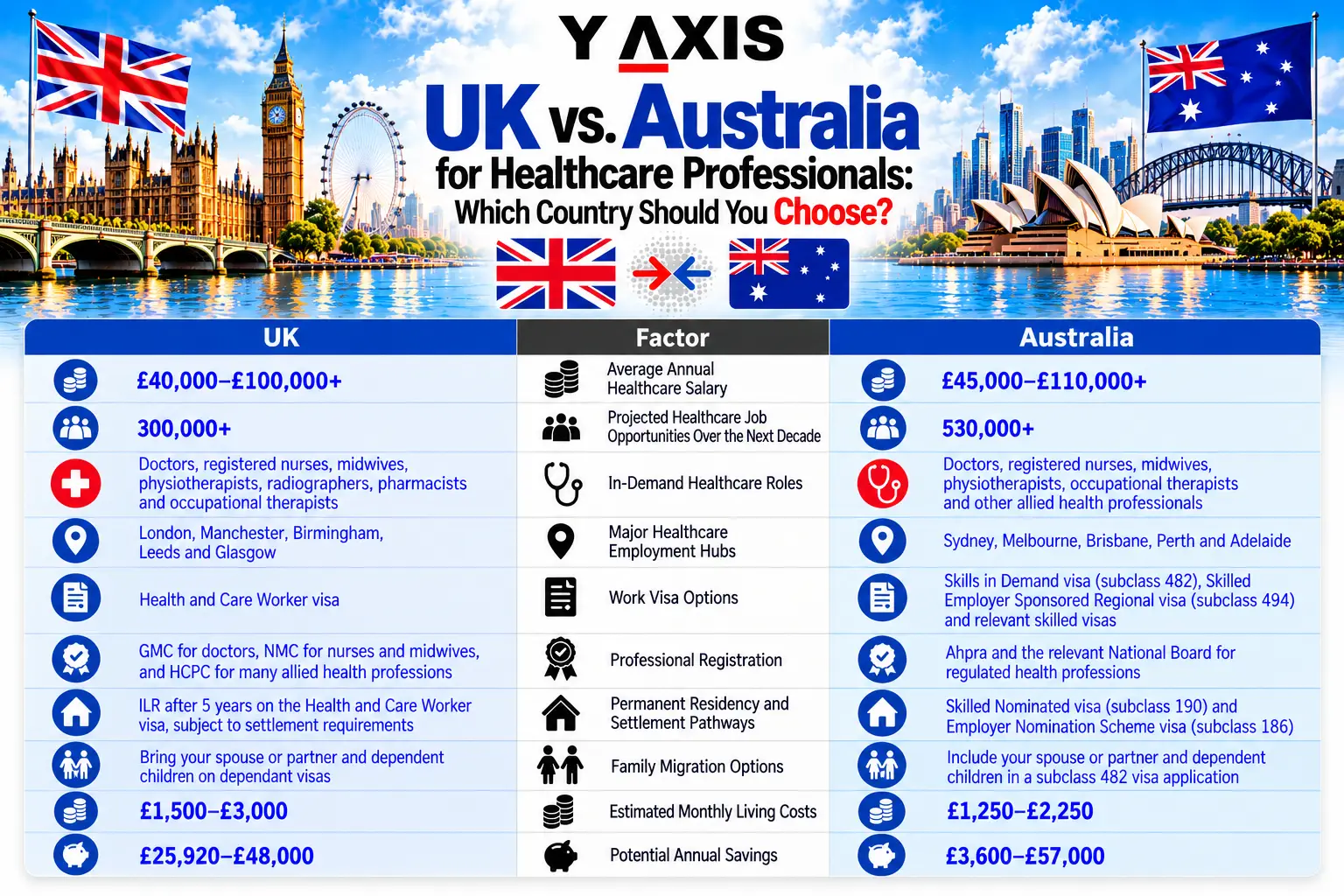
The UK and Australia offer healthcare professionals job opportunities across public and private healthcare systems. The UK provides direct access to NHS hospitals and private healthcare employers through routes such as the Health and Care Worker visa. Australia offers healthcare roles in major cities and regional communities, with temporary employer-sponsored visas and permanent residency pathways. Comparing take-home salaries, income tax, housing costs and everyday expenses helps doctors, nurses and allied health professionals choose the country that best fits their career goals.
*Want to work abroad? Let Y-Axis help you through application process.
UK vs Australia for Healthcare Professionals: Quick Comparison
Both countries offer strong earning potential, with different strengths. Australia pairs high salary ceilings with 12% employer superannuation, and the UK pairs structured NHS pay scales with the NHS Pension Scheme. Savings depend on role, city and household, and London, Sydney and Melbourne cost more than Manchester, Leeds, Adelaide and Perth.
|
Factor |
UK |
Australia |
|
Average Annual Healthcare Salary |
£40,000–£100,000+ |
AUD 90,000–AUD 220,000+ |
|
Projected Healthcare Job Opportunities Over the Next Decade |
300,000+ |
530,000+ |
|
In-Demand Healthcare Roles |
Doctors, registered nurses, midwives, physiotherapists, radiographers, pharmacists and occupational therapists |
Doctors, registered nurses, midwives, physiotherapists, occupational therapists and other allied health professionals |
|
Major Healthcare Employment Hubs |
London, Manchester, Birmingham, Leeds and Glasgow |
Sydney, Melbourne, Brisbane, Perth and Adelaide |
|
Work Visa Options |
Health and Care Worker visa |
Skills in Demand visa (subclass 482), Skilled Employer Sponsored Regional visa (subclass 494) and relevant skilled visas |
|
Professional Registration |
GMC for doctors, NMC for nurses and midwives, and HCPC for many allied health professions |
Ahpra and the relevant National Board for regulated health professions |
|
Permanent Residency and Settlement Pathways |
ILR after 5 years on the Health and Care Worker visa, subject to settlement requirements |
Skilled Nominated visa (subclass 190) and Employer Nomination Scheme visa (subclass 186) |
|
Estimated Monthly Living Costs |
£1,500–£3,000 |
AUD 2,500–AUD 4,500 |
|
Family Migration Options |
Bring your spouse or partner and dependent children on dependant visas |
Include your spouse or partner and dependent children in a subclass 482 visa application |
UK vs Australia: Which Country Offers Better Opportunities for Healthcare Professionals?
The UK offers healthcare professionals opportunities in NHS hospitals, private healthcare organisations and structured medical training programmes. Australia provides career opportunities across public hospitals, private clinics and regional health services, with options for employer-sponsored work and skilled migration.
The UK may be a better choice if you want:
- Lower salary thresholds than the standard Skilled Worker visa
- Faster visa processing and reduced application fees
- Exemption from the Immigration Health Surcharge
- Access to NHS and private healthcare jobs
- Structured specialist training and career progression
- Benefit from NHS pension benefits
*Want to work in the UK? Get expert guidance from Y-Axis professionals.
Australia may be a better choice if you want:
- High earning potential across many healthcare occupations.
- Employer superannuation contributions that build retirement savings.
- Salary packaging through participating employers.
- Permanent residency through subclass 189, 190 or 186 visas.
- Priority processing for specified skilled visa applications.
- Relocate with your spouse and dependent children.
*Want to work in Australia? Get expert guidance from Y-Axis professionals.
UK vs. Australia: Salary, Living Costs and Savings for Healthcare Professionals
Healthcare professionals can earn competitive salaries and build strong savings in both the UK and Australia. Australia offers attractive earning potential in several healthcare occupations, while the UK provides NHS pension benefits and structured pay scales for many hospital roles. Comparing take-home salaries, income tax, housing costs and everyday expenses helps doctors, nurses and allied health professionals identify where they can maximise savings and achieve their financial goals.
|
Factor |
UK |
Australia |
|
Annual Healthcare Salary (Before Tax) |
£40,000–£100,000 |
AUD 90,000–AUD 220,000 |
|
Monthly Gross Salary |
£3,333–£8,333 |
AUD 7,500–AUD 18,333 |
|
Estimated Monthly Take-Home Pay |
£2,650–£5,500 |
AUD 5,600–AUD 12,000 |
|
Monthly Rent for a 1-Bedroom City-Centre Apartment |
£1,100–£2,300 |
AUD 1,300–AUD 3,600 |
|
Monthly Grocery Costs |
£250–£450 |
AUD 350–AUD 600 |
|
Monthly Public Transport Costs |
£80–£200 |
AUD 100–AUD 220 |
|
Monthly Utilities, Internet and Mobile |
£150–£300 |
AUD 260–AUD 500 |
|
Estimated Total Monthly Living Costs |
£1,500–£3,200 |
AUD 2,500–AUD 5,000 |
|
Potential Monthly Savings |
£2,160–£4,000 |
AUD 600–AUD 9,500 |
|
Potential Annual Savings |
£25,920–£48,000 |
AUD 7,200–AUD 114,000 |
|
Lower-Cost Cities for Healthcare Professionals |
Manchester, Leeds and Glasgow |
Adelaide, Perth and Brisbane |
|
Higher-Cost Healthcare Cities |
London |
Sydney and Melbourne |
|
Retirement Benefits |
NHS Pension Scheme |
12% employer superannuation contribution |
*Plan Your Healthcare Career Abroad? Book a Free Consultation with Y-Axis Today.
FAQs
Which is better for healthcare professionals, the UK or Australia?
The UK offers NHS career progression, structured medical training and an exemption from the Immigration Health Surcharge for Health and Care Worker visa holders. Australia offers employer superannuation and healthcare jobs across major cities and regional areas. Compare salaries, registration requirements and migration pathways to choose the country that fits your career goals.
Do healthcare professionals earn more in the UK or Australia?
Salaries vary by occupation, experience and location. Indicative annual salaries range from £40,000 to £100,000 in the UK and AUD 90,000 to AUD 220,000 in Australia. Senior doctors and specialists may earn more in Australia, while NHS pay scales provide structured progression. Compare take-home pay after tax and living costs to estimate savings.
How can healthcare professionals settle permanently in the UK?
Health and Care Worker visa holders can generally apply for indefinite leave to remain (ILR) after five years of qualifying residence, provided they meet the settlement requirements in force at the time of application. Check current GOV.UK guidance before applying, as immigration rules can change.
Can healthcare professionals bring their family to the UK or Australia?
Healthcare professionals can bring their spouse or partner and dependent children if their visa permits it. Some UK care worker roles have dependant restrictions. In Australia, eligible subclass 482 applicants can include family members, with their rights determined by the visa conditions.
Which country has more healthcare job opportunities?
The UK offers healthcare jobs across NHS hospitals and private providers, including roles for doctors, nurses, midwives, physiotherapists and radiographers. Australia offers similar roles across public hospitals, private clinics and regional health services. Job availability varies by occupation, specialisation and location.
Posted on October 16 2026
Trending Article
Posted On October 23 2026
Australia vs. Germany for Engineering Professionals: Which Country Should You Choose?