


Connect with Dima Beyrouti, RCIC Licence No. R709716
Last Updated: October 20, 2026
Canada Express Entry 2026 for UK Professionals: CRS Score, Eligibility & How to Apply for PR
Canada Express Entry is the fastest route to Canadian permanent residency for skilled professionals in the UK. It uses a points-based system to assess your work experience, education and language ability, and most applications are processed within 6 months. Canada is targeting 2 million new permanent residents under the Immigration Levels Plan 2026-28, actively welcoming skilled professionals across IT, healthcare, engineering, trades and finance.
Why Apply for Canada Express Entry?
Canada Express Entry is the most sought-after immigration pathway for skilled professionals looking to relocate to Canada.
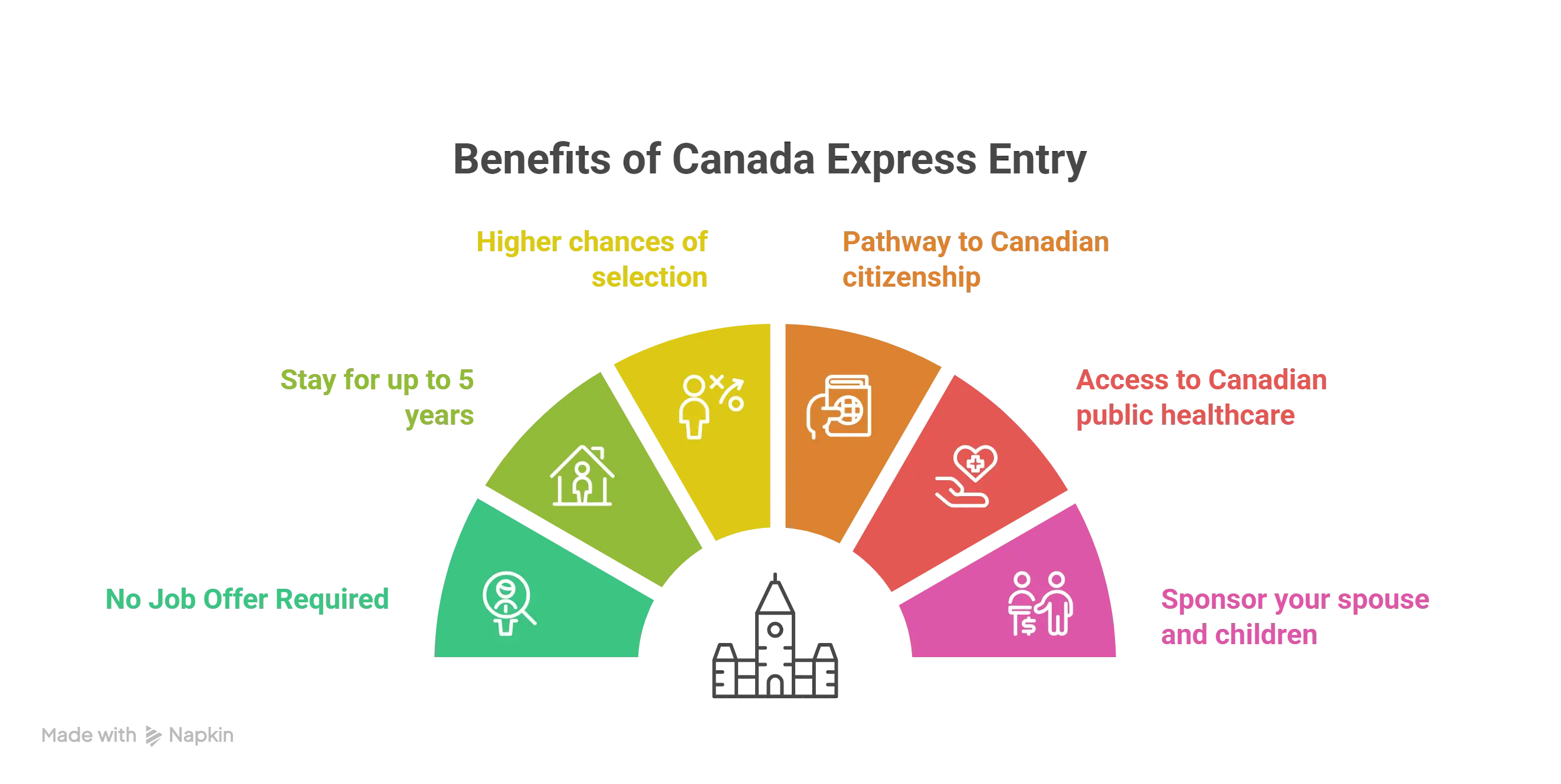
- Over 100,000 applicants invited for permanent residency through Express Entry.
- Fast processing with invitations often in 6 to 8 months.
- Higher chances of selection
- Quick processing time
- Issued 119,865 ITAs in 2026 so far
- High success rate for applicants
- Opportunity for Canadian citizenship
*Want to migrate to Canada? Y-Axis UK can connect you with Dima Beyrouti, RCIC Licence No. R709716, for regulated guidance on your options.
What is Canada Express Entry?
Canada Express Entry is an online immigration management system used by IRCC to select skilled workers for Canadian permanent residency. It manages three federal immigration programmes, the Federal Skilled Worker Program (FSWP), Federal Skilled Trades Program (FSTP) and Canadian Experience Class (CEC), using the Comprehensive Ranking System (CRS) to rank candidates. IRCC holds draw rounds every two weeks and issues Invitations to Apply (ITAs) to the highest-ranking candidates.
Canada Express Entry Programmes
Canada Express Entry manages three federal immigration programmes for skilled workers. Each programme is designed for a different applicant profile based on your work experience, qualifications and background.
| Programme | Who is Eligible | Work Experience | Job Offer Required |
|---|---|---|---|
| Federal Skilled Worker Program (FSWP) | Skilled workers with foreign work experience | Minimum 1 year in eligible occupation | No |
| Federal Skilled Trades Program (FSTP) | Skilled tradespeople in eligible trades | Minimum 2 years in eligible trade | Yes (or certificate of qualification) |
| Canadian Experience Class (CEC) | Candidates with Canadian work experience | Minimum 12 months within Canada in last 3 years | No |
Also Read…
What's New in Canada Express Entry System?
Canada Express Entry Category-Based Selection
IRCC introduced category-based selection to address ongoing labour shortages in specific occupations across Canada. Skilled workers in high-demand sectors are invited through targeted draws with lower CRS cutoffs. IRCC has expanded the priority occupations to 10 categories in 2026, with a minimum work experience requirement of 1 year within the previous 3 years.
| Category | Priority Occupations |
|---|---|
| French Language Proficiency | Candidates with strong French language skills |
| Healthcare and Social Services | Nurses, doctors, social workers |
| STEM Occupations | Engineers, scientists, IT professionals |
| Trade Occupations | Electricians, plumbers, welders |
| Education Occupations | Teachers, educational assistants |
| Transport Occupations | Truck drivers, logistics professionals |
| Physicians with Canadian Work Experience | Medical doctors with Canadian experience |
| Senior Managers with Canadian Work Experience | Senior executives with Canadian experience |
| Researchers with Canadian Work Experience | Academic and scientific researchers |
| Skilled Military Recruits | Canadian Armed Forces eligible candidates |
Canada Express Entry Eligibility
To be eligible for Canada Express Entry, you must meet the minimum requirements for at least one of the three federal immigration programmes. The Federal Skilled Worker Program also requires a minimum score of 67 points on the FSW eligibility grid before entering the pool.
- Minimum 1 year full-time skilled work experience in an eligible occupation
- CLB 7 language proficiency in English or French
- Minimum secondary school diploma
- Educational Credential Assessment (ECA) for all educational qualifications outside Canada
- Proof of funds as per IRCC requirements
- No criminal record
*Want to migrate to Canada? Let Y-Axis help you through application process.
Canada Express Entry Requirements
To apply for Canada Express Entry, have all your documents ready before creating your profile. IRCC requires all supporting documents to be submitted within 60 days of receiving your Invitation to Apply.
- Valid passport or travel document
- Language proficiency test results (IELTS, CELPIP, PTE Core, TEF or TCF)
- Educational Credential Assessment (ECA) report
- Proof of work experience (employment letters, contracts, payslips)
- Proof of funds (bank statements or official bank letter)
- Police clearance certificate
- Birth certificate
- Marriage certificate (if applicable)
- Medical examination results (required at PR application stage)
- Provincial nomination letter (if applicable)
Canada Express Entry CRS Score Calculator
The Comprehensive Ranking System (CRS) is the points-based system used by IRCC to rank candidates in the Express Entry pool. Your CRS score determines your chances of receiving an Invitation to Apply for Canadian permanent residency, with a maximum of 1,200 points awarded across four factor groups - core human capital, spouse factors, skill transferability and additional points.
| CRS Factor | Maximum Points |
|---|---|
| Age | 110 |
| Education | 150 |
| First Official Language | 136 |
| Second Official Language | 24 |
| Canadian Work Experience | 80 |
| Spouse Education | 10 |
| Spouse First Official Language | 20 |
| Spouse Canadian Work Experience | 10 |
| Education + Language | 50 |
| Education + Canadian Work Experience | 50 |
| Foreign Work Experience + Language | 50 |
| Foreign Work Experience + Canadian Work Experience | 50 |
| Certificate of Qualification + Language | 50 |
| Provincial Nomination | 600 |
| Canadian Study Experience | 15–30 |
| Sibling in Canada | 15 |
| French Language Skills | 25–50 |
| Maximum Total CRS Score | 1,200 |
Canada Express Entry CRS Cutoff Scores in 2026
The minimum CRS score required to receive an ITA varies with each draw depending on the number of candidates in the pool, the draw type and IRCC's immigration targets.
| Draw Type | CRS Cutoff Range |
|---|---|
| All-Programme Draw | 488 – 495 |
| Canadian Experience Class (CEC) | 507 – 515 |
| French Language Proficiency | 393 – 400 |
| Provincial Nominee Programme (PNP) | 710 – 802 |
| Healthcare and Social Services | 462 – 510 |
| Trade Occupations | 388 – 430 |
| Physicians with Canadian Work Experience | 169 |
| Senior Managers with Canadian Work Experience | 429 |
How to Improve Your CRS Score for Canada Express Entry?
A higher CRS score increases your chances of receiving an Invitation to Apply for Canadian permanent residency. Here are some of the most effective ways to boost your score and get Canada PR.
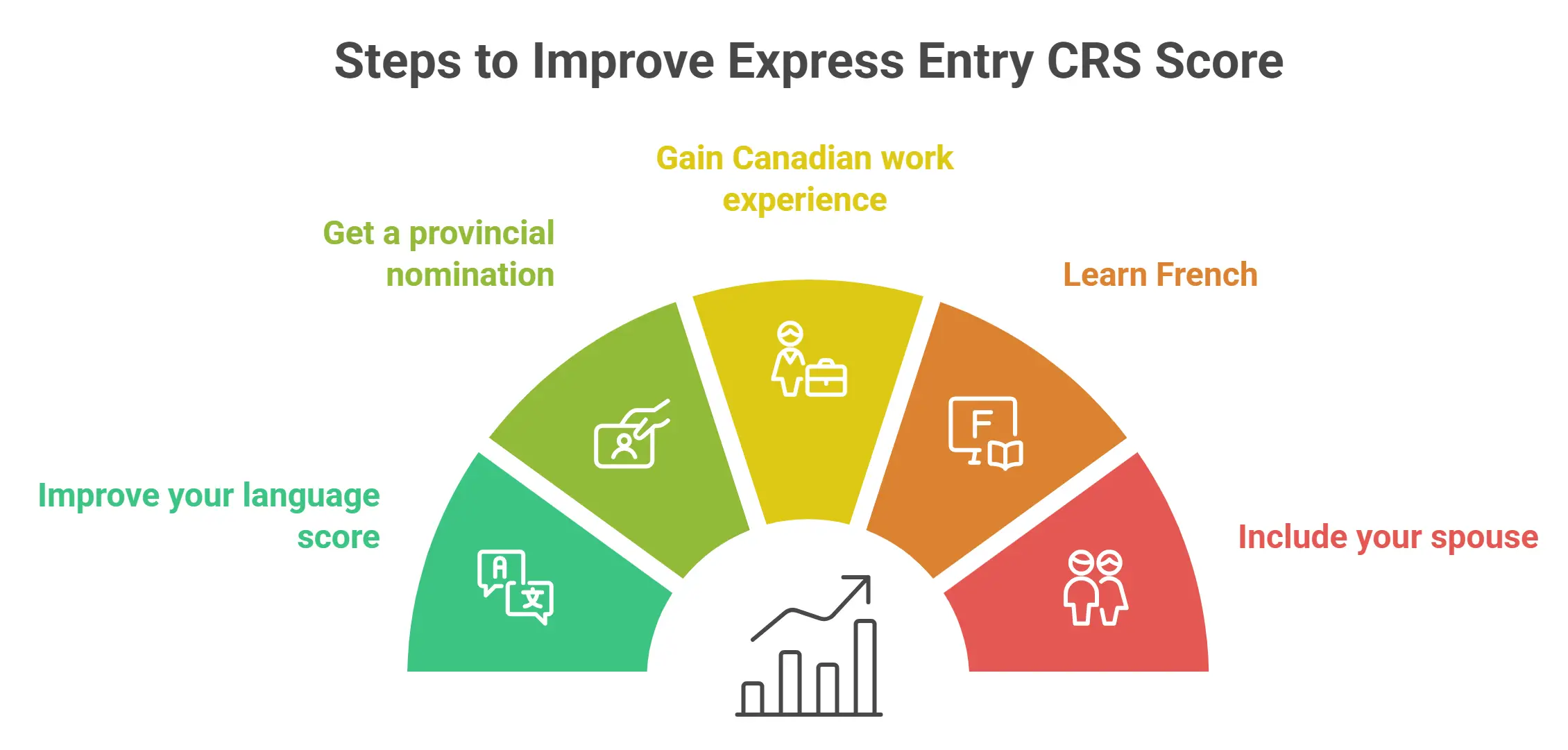
- Improve your language score: Retake IELTS, CELPIP or PTE Core to achieve CLB 9 or higher
- Get a provincial nomination: Adds 600 CRS points instantly, virtually guaranteeing an ITA
- Gain Canadian work experience: Each additional year in Canada adds up to 80 CRS points
- Learn French: Qualifies for category-based draws with CRS cutoffs as low as 393
- Include your spouse: A strong spouse profile adds up to 40 additional CRS points
How to Apply for Canada Express Entry from the UK?
To apply for Canada Express Entry from the UK, follow the step-by-step process below. The entire application is managed online through the IRCC portal, from creating your profile to receiving your Invitation to Apply for Canada PR.
Step 1: Check Your Eligibility
Confirm you meet the minimum requirements for at least one of the three federal immigration programmes — FSWP, CEC or FSTP.
Step 2: Take Your Language Test
Complete an IRCC-approved language test such as IELTS General Training, CELPIP or PTE Core.
Step 3: Get Your Educational Credential Assessment (ECA)
Submit your UK qualifications to an IRCC-approved ECA body such as WES Canada or IQAS.
Step 4: Create Your Express Entry Profile
Sign in to your IRCC account at canada.ca and enter your personal details, education, work experience and language scores.
Step 5: Receive an Invitation to Apply (ITA)
If your CRS score meets the cutoff in a draw round, IRCC will issue you an ITA. You have 60 days to submit a complete PR application.
Step 6: Submit Your PR Application
Upload all required documents and pay all applicable fees through the IRCC portal.
Step 7: Complete Your Landing in Canada
Once approved, complete your landing at a Canadian port of entry to activate your permanent residence status.
Y-Axis UK is a registered immigration Agent supporting [Dima Beyrouti, RCIC Licence No. R709716, a Regulated Canadian Immigration Consultant (RCIC) licensed by the College of Immigration and Citizenship Consultants (CICC).
Canada Express Entry Fees
The total cost of Canada Express Entry from the UK is approximately CAD 2,375 to CAD 2,775 (£1,283 to £1,499) for a single applicant and CAD 3,180 (£1,717) for a couple. Costs are paid in stages across language tests, ECA, government fees, biometrics and medical examinations.
| Fee Type | Fee (CAD) | Approx. GBP Equivalent |
|---|---|---|
| Application Processing Fee (principal applicant) | CAD 990 | £535 |
| Right of Permanent Residence Fee (RPRF) | CAD 600 | £324 |
| Biometric Fee (per person) | CAD 85 | £46 |
| Dependent Child Fee (per child) | CAD 270 | £146 |
| ECA Report | CAD 200–300 | £108–162 |
| IELTS / Language Test | CAD 300–350 | £162–189 |
| Medical Examination | CAD 200–450 | £108–243 |
| Total — Single Applicant | CAD 2,375–2,775 | £1,283–1,499 |
Canada Express Entry Processing Time
Canada Express Entry applications are processed within 6 to 8 months from the date IRCC receives your complete application. This makes it the fastest permanent residency pathway in Canada.
| Application Type | Processing Time |
|---|---|
| Express Entry — FSW, CEC, FSTP | Approximately 6 to 8 months |
| Express Entry via Provincial Nominee Programme | 12 to 19 months |
| ECA Report | 7 to 20 business days |
| Time to Submit PR Application After ITA | 60 days |
Latest Canada Express Entry Draws 2026
IRCC holds Express Entry draws approximately every two weeks, inviting the highest-ranking candidates from the pool to apply for Canadian permanent residency. Each draw specifies the programme type, the number of Invitations to Apply issued and the minimum CRS cutoff score required for selection.
- Invitation Round : #450 Canadian Experience Class
- Express Entry Latest Draw Date: October 28, 2026
- Number of Invitations: 5000
- CRS score: 435
The latest Express Entry draw was held on October 28, 2026, and ITAs were issued. The #450 Express Entry draw invited French Language Proficiency (2026 – Version 2) candidates and a CRS score of to apply for Canada PR.
| Draw No. | Date | Programme | Invitations Issued |
|---|---|---|---|
| 450 | 19 October 2026 | French Language Proficiency (2026 – Version 2) | 5000 |
| 449 | 15 October 2026 | Canadian Experience Class | 2500 |
| 448 | 13 October 2026 | Provincial Nominee Program | 752 |
| 447 | 1 October 2026 | Trades Occupations 2026 – Version 3 | 3500 |
| 446 | 29 September 2026 | Canadian Experience Class | 2000 |
| 445 | 28 September 2026 | Provincial Nominee Program | 733 |
| 444 | 16 September 2026 | Senior Managers with Canadian Work Experience, 2026 – Version 1 | 250 |
| 443 | 15 September 2026 | Canadian Experience Class | 2000 |
| 442 | 14 September 2026 | Provincial Nominee Program | 576 |
| 441 | 4 September 2026 | Healthcare and Social Services Occupations, 2026 – Version 3 | 3500 |
| 440 | 3 September 2026 | Physicians with Canadian Work Experience (2026 – Version 1) | 229 |
| 439 | 1 September 2026 | Canadian Experience Class | 2000 |
| 438 | 31 August 2026 | Provincial Nominee Program | 562 |
| 437 | 19 August 2026 | French Language Proficiency (2026 – Version 2) | 5000 |
| 436 | 18 August 2026 | Canadian Experience Class | 1000 |
| 435 | 17 August 2026 | Provincial Nominee Program | 442 |
| 434 | 7 August 2026 | Transportation Occupations 2026 - Version 3 | 300 |
| 433 | 6 August 2026 | French Language Proficiency (2026 - Version 2) | 5000 |
| 432 | 5 August 2026 | Canadian Experience Class | 3000 |
| 431 | 4 August 2026 | Provincial Nominee Program | 507 |
| 430 | 23 July 2026 | Skilled Military Recruits, 2026-Version 1 | 4 |
| 429 | 22 July 2026 | French Language Proficiency (2026 – Version 2) | 5000 |
| 428 | 21 July 2026 | Canadian Experience Class | 2000 |
| 427 | 20 July 2026 | Provincial Nominee Program | 511 |
| 426 | 10 July 2026 | Senior managers with Canadian Work Experience, 2026-Version 1 | 500 |
| 425 | 9 July 2026 | French Language Proficiency (2026 - Version 2) | 5000 |
| 424 | 7 July 2026 | Canadian Experience Class | 2000 |
| 423 | 6 July 2026 | Provincial Nominee Program | 534 |
| 422 | 25 June 2026 | Healthcare and Social Services Occupations, 2026-Version 3 | 4000 |
| 421 | 24 June 2026 | Physicians with Canadian Work Experience (2026 - Version 1) | 271 |
| 420 | 23 June 2026 | Canadian Experience Class | 4000 |
| 419 | 22 June 2026 | Provincial Nominee Programme | 955 |
| 418 | 28 May 2026 | French-Language Proficiency (2026 - Version 2) | 4500 |
| 417 | 27 May 2026 | Canadian Experience Class | 3000 |
| 416 | 25 May 2026 | Provincial Nominee Program | 334 |
| 415 | 11 May 2026 | Provincial Nominee Programme | 380 |
| 414 | 29 April 2026 | French Language Proficiency (2026 - Version 2) | 4,000 |
| 413 | 28 April 2026 | Canadian Experience Class | 2,000 |
| 412 | 27 April 2026 | Provincial Nominee Programme | 473 |
| 411 | 15 April 2026 | French Language Proficiency 2026 - Version 2 | 4,000 |
| 410 | 14 April 2026 | Canadian Experience Class | 2,000 |
| 409 | 13 April 2026 | Provincial Nominee Programme | 324 |
| 408 | 2 April 2026 | Trades Occupations 2026 - Version 3 | 3,000 |
| 407 | 31 March 2026 | Canadian Experience Class | 2,250 |
| 406 | 30 March 2026 | Provincial Nominee Programme | 356 |
| 405 | 18 March 2026 | French Language Proficiency 2026 - Version 2 | 4,000 |
| 404 | 17 March 2026 | Canadian Experience Class | 4,000 |
| 403 | 16 March 2026 | Provincial Nominee Programme | 362 |
| 402 | 5 March 2026 | Senior Managers with Canadian Work Experience | 250 |
| 401 | 4 March 2026 | French Language Proficiency | 5,500 |
| 400 | 3 March 2026 | Canadian Experience Class | 4,000 |
| 399 | 2 March 2026 | Provincial Nominee Programme | 264 |
| 398 | 20 February 2026 | Healthcare and Social Services Occupations | 4,000 |
| 397 | 19 February 2026 | Physicians with Canadian Work Experience | 391 |
| 396 | 17 February 2026 | Canadian Experience Class | 6,000 |
| 395 | 16 February 2026 | Provincial Nominee Programme | 279 |
| 394 | 6 February 2026 | French Language Proficiency | 8,500 |
| 393 | 3 February 2026 | Provincial Nominee Programme | 423 |
| 392 | 21 January 2026 | Canadian Experience Class | 6,000 |
| 391 | 20 January 2026 | Provincial Nominee Programme | 681 |
| 390 | 7 January 2026 | Canadian Experience Class | 8,000 |
| 389 | 5 January 2026 | Provincial Nominee Programme | 574 |
When is the Next Canada Express Entry Draw?
IRCC holds Express Entry draws every two weeks, typically on Wednesdays. Candidates in the pool are automatically considered for every draw they qualify for. All-programme draws invite the highest-ranked candidates across all programmes, while category-based draws target specific occupations with lower CRS cutoffs.
- Check draw updates at canada.ca
- Sign up for IRCC email notifications through your IRCC account
- Follow Y-Axis for real-time Express Entry draw updates
Language Requirements for Canada Express Entry
Language proficiency is one of the most important eligibility factors for Canada Express Entry. A higher language score directly improves your CRS score and increases your chances of receiving an ITA.
| Language | Accepted Test | Minimum Requirement |
|---|---|---|
| English | IELTS General Training | CLB 7 (6.0 in each band) |
| English | CELPIP General | CLB 7 |
| English | PTE Core | CLB 7 |
| French | TEF Canada | NCLC 7 |
| French | TCF Canada | NCLC 7 |
Proof of Funds for Canada Express Entry
Canada Express Entry applicants must show proof of settlement funds to support themselves and their family upon arrival in Canada. The amount varies based on family size and is verified by IRCC at the time of your PR application. Skilled professionals already working in Canada and applying through the Canadian Experience Class are exempt.
| Number of Family Members | Proof of Funds Required (CAD) |
|---|---|
| 1 | $15,263 |
| 2 | $19,001 |
| 3 | $23,360 |
| 4 | $28,362 |
| 5 | $32,168 |
| 6 | $36,280 |
| 7 | $40,392 |
| Each additional member | $4,112 |
Note: GBP equivalents are approximate and based on current exchange rates. Verify the latest rate before applying.
Canada Express Entry vs UK Skilled Worker Visa
Canada Express Entry and the UK Skilled Worker Visa are both popular immigration pathways for skilled professionals. Canada Express Entry offers a direct route to permanent residency without employer sponsorship, making it an ideal choice for professionals looking to build a long-term future in Canada.
| Factors | Canada Express Entry | UK Skilled Worker Visa |
|---|---|---|
|
Visa Type |
Canadian permanent residency |
Permission to work in the UK |
|
Job Offer |
Not required |
Required |
|
Processing Time |
Within 6 months |
3–8 weeks |
|
Path to Permanent Settlement |
PR after application |
ILR after 5 years |
|
Path to Citizenship |
After 3 years of PR |
After 1 year of ILR |
|
Employer Sponsorship |
Not required |
Required |
|
Family Members |
Included in same application |
Separate application required |
Benefits of Canadian Permanent Residency
Once your Express Entry application is approved, you and your family become Canadian permanent residents with the following benefits.
- Live and work anywhere in Canada
- Access public healthcare and social benefits
- Enrol children in free public schools
- Sponsor eligible family members for PR
- Work for any employer without restrictions
- Access unemployment insurance and pension plans
- Apply for Canadian citizenship after 3 years
Latest Canada Express Entry Updates 2026
Canada's Express Entry system has introduced several key changes in 2026. Here is what UK applicants need to know before applying.
- New Priority Categories Added: Medical Doctors, Researchers, Senior Managers, Transport Occupations and Skilled Military Recruits are now included in the category-based selection list
- Work Experience Requirement: Minimum work experience for category-based draws increased from 6 months to 1 year within the previous 3 years
- Agriculture Category Removed: Agriculture and agri-food occupations have been removed from the 2026 category list
- Application Fees Increase: PR fees were updated on 30 April 2026 with the principal applicant fee now CAD 990 and RPRF CAD 600
How Y-Axis Supports Your Canada Application?
Y-Axis UK acts as a registered immigration Agent supporting Dima Beyrouti, RCIC Licence No. R709716, a Regulated Canadian Immigration Consultant (RCIC) registered with the College of Immigration and Citizenship Consultants (CICC).
As your administrative support team, Y-Axis can assist you with:
- Gathering and organising your supporting documents
- Coordinating appointments and communication on your behalf
- Providing general, publicly available information about Canadian immigration programmes
- Referring you to Dima Beyrouti for all regulated advice, eligibility assessments, and application representation
- All regulated immigration advice, eligibility assessments, and application representation are the exclusive responsibility of Dima Beyrouti, RCIC Licence No. R709716.
Verify Dima Beyrouti on the CICC Public Register:
https://register.college-ic.ca/Public-Register-EN/Licensee/Profile.aspx?ID=11831
Ready to take the next step? Contact us to be connected with Dima Beyrouti.
Connect with Dima Beyrouti, RCIC Licence No. R709716
Looking for Inspiration
Explore what Global Citizens have to say about Y-Axis in shaping their future
Frequently Asked Questions