


Don't know what to do ?
Get Free Counseling
Last Updated: November 05, 2026
Germany Visit Visa from the UK: Requirements, Fees and Application Process
Germany is a top destination for UK travellers, offering a wonderful mix of historic landmarks, vibrant cities, cultural experiences, and beautiful natural landscapes. Whether you're planning to explore Berlin, visit Munich, or enjoy the scenic beauty of the Bavarian Alps, understanding Germany's tourist visa requirements is an essential first step.
British citizens can visit Germany for up to 90 days in any 180-day period without a visa. However, UK residents who hold passports from countries requiring a visa to enter the Schengen Area must apply for a Schengen visa before travelling. The standard short-stay visa fee is €90 for adults, and applications submitted through the relevant German visa application centre in the UK are generally processed within 15 calendar days, although additional time may be required in some cases.
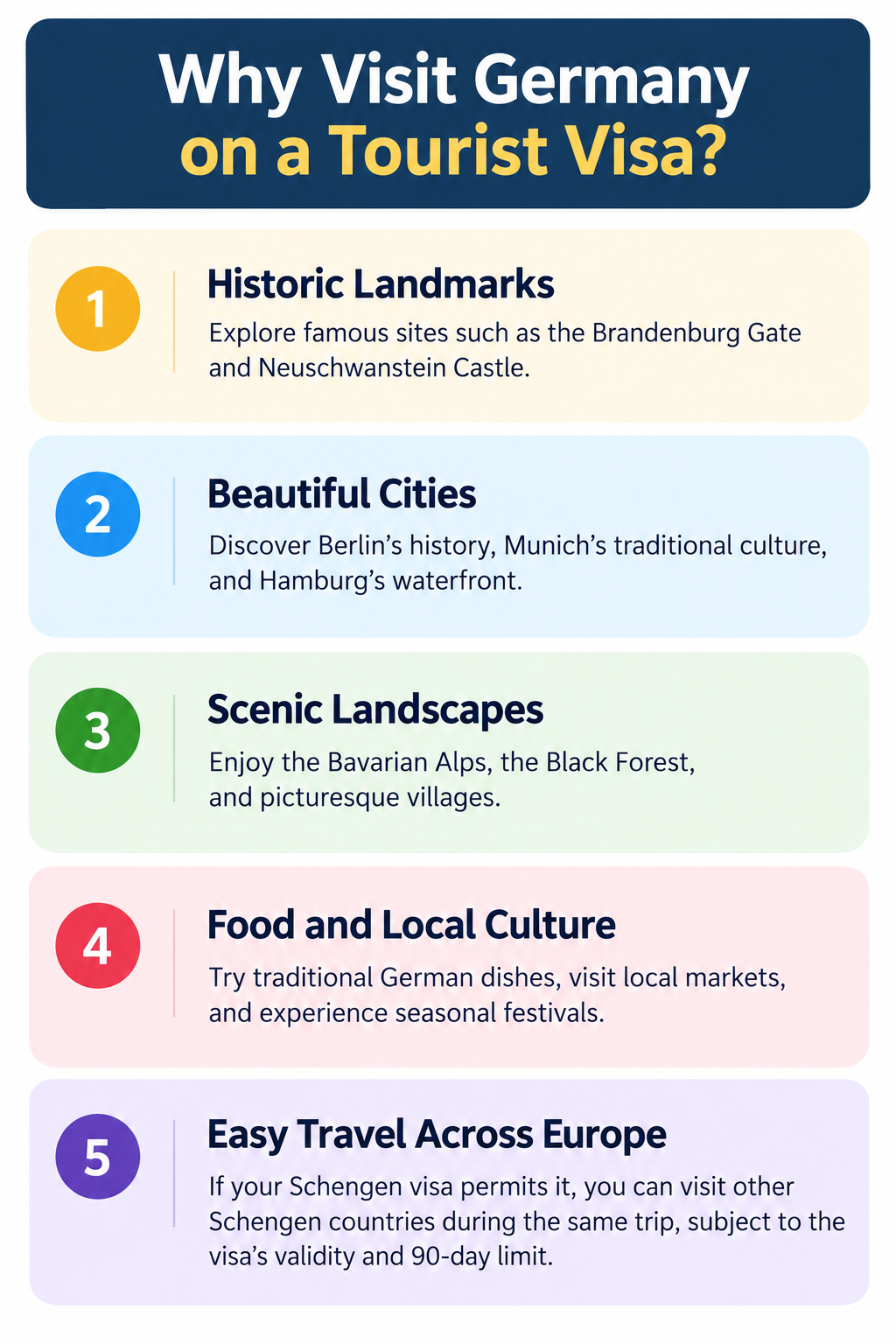
Why Visit Germany on a Tourist Visa?
Germany is a great destination for travellers who want to explore history, culture, nature, and modern city life. From famous landmarks to charming villages, there is something for every type of visitor.
Here are some reasons to visit Germany:
- Historic landmarks: Explore famous sites such as Brandenburg Gate in Berlin and Neuschwanstein Castle in Bavaria.
- Beautiful cities: Discover Berlin's history, Munich's traditional culture, and Hamburg's waterfront.
- Scenic landscapes: Enjoy the Bavarian Alps, the Black Forest, and picturesque villages.
- Food and local culture: Try traditional German dishes, visit local markets, and experience seasonal festivals.
- Easy travel across Europe: If your Schengen visa permits it, you can visit other Schengen countries during the same trip, subject to the visa's validity and the 90-day limit.
Types of Germany Tourist Visas
Germany issues short-stay Schengen visas with different entry options. The type you receive depends on your travel plans and the decision made by the visa authorities.
- Single-Entry Visa: Allows you to enter the Schengen Area once. If you leave the area, you generally cannot return using the same visa, even if it is still valid.
- Double-Entry Visa: Allows you to enter the Schengen Area twice during the visa's validity. This may suit travellers who plan to leave and return once.
- Multiple-Entry Visa: Allows you to enter and leave the Schengen Area several times while the visa remains valid. Depending on your circumstances and travel history, it may be issued for a period of up to five years.
Important: All these visa types follow the 90-days-in-any-180-day-period rule for short stays. A visa's validity period does not mean you can stay in Germany or the Schengen Area continuously for the entire period.
*Want to migrate to Germany? Contact Y-Axis for complete guidance and support.
Who Needs a Visa to Visit Germany from the UK?
Whether you need a visa to visit Germany depends on your nationality and passport. British citizens can usually visit Germany for up to 90 days within any 180-day period without a Schengen visa. However, UK residents who are not British citizens may need a visa, depending on their nationality. EU/EEA citizens generally do not need a visa for short visits to Germany.
Short Stays (Up to 90 Days)
- British citizens: You can visit Germany for tourism or short visits for up to 90 days within any 180-day period without a visa.
- Non-British UK residents: If your nationality requires a Schengen visa, you must apply before travelling. A UK residence permit does not automatically exempt you from German visa requirements.
- Work restrictions: Visa-free tourist visits do not generally allow you to take up employment in Germany. Some specific business and professional activities may be permitted under separate rules.
- Travel documents: Carry a valid passport and be prepared to show proof of accommodation, sufficient funds, and your return or onward travel plans if requested by border officials.
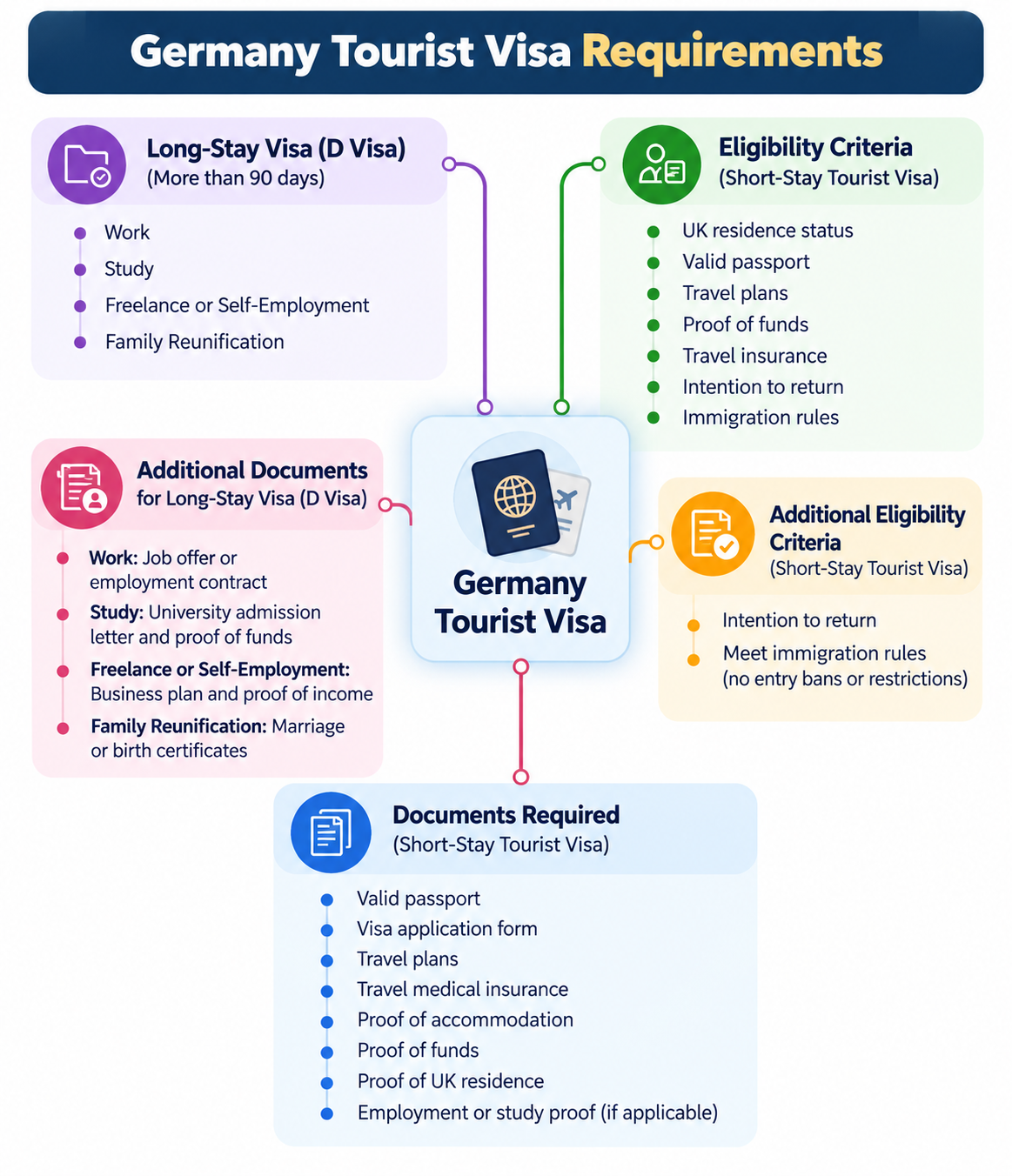
Long-Stay Visa (D Visa) and Residence Permit
If you plan to stay in Germany for more than 90 days for work, study, family reunification, or self-employment, you may need a national visa (D visa) and/or a residence permit. British citizens can generally enter Germany without obtaining a long-stay visa in advance for certain purposes and apply for a residence permit after arrival.
They must meet the relevant requirements and cannot start employment until they have permission to work. Other nationalities may need to obtain a visa before travelling. If a residence permit is required, contact the local immigration office (Ausländerbehörde) in Germany. British citizens who move to Germany generally need to register their address within two weeks and apply for the relevant residence permit within the first 90 days.
Airport Transit Rules
British passport holders generally do not need an airport transit visa when changing flights at a German airport. However, transit rules can vary depending on your nationality, passport, and travel arrangements. Check the official requirements if you hold a non-British passport or need to pass through border control.
ETIAS: New Travel Authorisation for British Citizens
Latest Update: The European Travel Information and Authorisation System (ETIAS) is an upcoming online travel authorisation for British citizens and other visa-exempt travellers visiting Germany and other participating European countries for short stays. The official EU website currently states that ETIAS is expected to start in the last quarter of 2026. The exact launch date has not yet been announced, and applications are not currently being accepted. Once the system launches, eligible British citizens will generally need ETIAS authorisation before travelling to Germany.
Key points about ETIAS:
- Expected fee: €20 per application. Applicants under 18 or over 70 are generally exempt from the fee.
- How to apply: Apply online through the official EU website once applications open.
- Validity: An approved ETIAS authorisation is generally valid for up to three years or until the passport expires, whichever comes first.
- Current status: No application is required at present. Check the official website before your trip for the latest launch date and requirements.
Germany Tourist Visa Eligibility Criteria
If you live in the UK and need a Schengen tourist visa to visit Germany, you must meet the following requirements:
- UK residence status: You must legally live in the UK and provide proof of your immigration status, such as your eVisa or a valid residence permit.
- Valid passport: Your passport must have been issued within the last 10 years and remain valid for at least three months after your planned departure from the Schengen Area.
- Travel plans: You must explain the purpose of your visit and provide details such as your travel dates, accommodation, and return journey.
- Proof of funds: You must show that you have enough money to cover your travel and living expenses during your stay.
- Travel insurance: You need travel medical insurance with at least €30,000 in coverage, valid throughout the Schengen Area.
- Intention to return: You must show that you plan to leave the Schengen Area before your visa expires.
- Immigration rules: You must meet the visa requirements and should not have any entry bans or other restrictions that prevent you from entering Germany.
Documents Required for a Germany Tourist Visa
If you live in the UK and need a German tourist visa, you must submit documents to support your application. The exact list depends on your nationality and personal situation.
- Valid Passport: Issued within the last 10 years and valid for at least three months after leaving the Schengen Area, with at least two blank pages.
- Visa Application Form: Completed and signed Schengen visa application form.
- Travel Plans: Travel dates, flight itinerary, and purpose of the visit.
- Travel Medical Insurance: Minimum €30,000 coverage for medical emergencies and repatriation across the Schengen Area.
- Proof of Accommodation: Hotel bookings or an invitation from friends or family.
- Proof of Funds: Recent bank statements, payslips, or sponsorship documents.
- Proof of UK Residence: eVisa or other accepted proof of legal residence in the UK.
- Employment or Study Proof: Employer's letter and leave approval, or a school or university letter, if applicable.
Additional Documents for a Long-Stay Visa (D Visa)
If you plan to stay in Germany for more than 90 days, the documents you need will depend on the reason for your stay.
- Work: A job offer or employment contract and any required qualification documents.
- Study: An admission letter from a German university or educational institution, proof of funds, and any required education certificates.
- Freelance or Self-Employment: A business plan, proof of income or funding, and documents showing your planned business activities.
- Family Reunification: Marriage or birth certificates and documents proving your relationship with the family member in Germany.
Step-by-Step Application Process for a Germany Tourist Visa
For Short-Stay (Schengen C Visa)
Step 1: Check whether you need a visa. British passport holders usually do not need one for visits of up to 90 days within any 180-day period.
Step 2: If required, complete the online Schengen visa application form.
Step 3: Book an appointment through TLScontact, Germany's official visa application partner in the UK.
Step 4: Attend your appointment, submit your documents, and provide your fingerprints and photograph if required.
Step 5: Wait for the visa decision. Processing usually takes around 15 working days, but the German Missions in the UK currently advise allowing up to 45 days.
Step 6: If approved, receive your passport and check the visa details before travelling to Germany.
For Long-Stay (National D Visa) – More Than 90 Days
Step 1: Choose the correct visa type based on your purpose, such as work, study, or family reunification.
Step 2: Prepare the required documents, including proof of your purpose, finances, and health insurance.
Step 3: Apply online through the German Consular Services Portal if your visa category is eligible. Otherwise, follow the German Mission's application instructions.
Step 4: Attend your appointment at the relevant German Embassy, Consulate, or visa application centre. Submit original documents and provide biometrics as required.
Step 5: Wait for the decision. Processing times vary depending on your visa type and personal circumstances.
Step 6: Once your visa is approved, travel to Germany within its validity period.
Step 7: After moving into your accommodation, register your address with the local registration office (Meldebehörde) within two weeks.
Step 8: Apply for a residence permit at the local immigration office (Ausländerbehörde) within the first 90 days, if required.
Germany Tourist Visa Fees
The cost of a Germany tourist visa depends on the applicant's age and the service fees charged by the visa application centre.
| Applicant Category | Visa Fee |
|---|---|
| Adults (12 years and above) | £78.10 (€90) |
| Children aged 6 to under 12 | £39.10 (€45) |
| Children under 6 | Free |
| Mandatory TLScontact service fee | £27.76 (€32) |
| Optional services, such as courier or SMS | Extra charges may apply |
Germany Tourist Visa Processing Time
The time needed to get a Germany tourist visa depends on appointment availability and how long the authorities take to review your application.
| Stage | Estimated Time |
|---|---|
| Appointment availability | Varies depending on location and demand |
| General Schengen visa processing | 15 calendar days |
| Extended processing | Up to 45 calendar days |
| Recommended application time | Apply as early as possible, allowing at least 6–8 weeks where practical |
Important for UK applicants: The German Missions in the UK currently state that the standard processing period is 45 days. Apply well in advance and check the latest guidance before booking your trip.
Germany Tourist Visa Validity and Stay Duration
A Germany tourist visa allows eligible travellers to visit Germany and other Schengen countries for short stays, subject to the visa conditions.
| Category | Details |
|---|---|
| Maximum Stay | Up to 90 days within any 180-day period |
| Visa Validity | Depends on the visa issued and the decision of the authorities |
| Entry Types | Single-entry, double-entry, or multiple-entry |
| Schengen Area Access | Travel across all 29 Schengen countries, subject to the visa's validity and entry conditions |
| Stay Limit | You cannot exceed 90 days in any rolling 180-day period |
| Overstay Consequences | May include fines, removal, entry restrictions, or problems with future visa applications |
How Can Y-Axis Help You?
Y-Axis can guide UK residents through each step of applying for a German Tourist Visa. We offer:
- A free assessment to check if you qualify, based on your nationality and UK residency status.
- A checklist of needed documents that is specific to your situation.
- Assistance scheduling appointments at German visa centres.
- Help creating cover letters, finding travel insurance, and planning your trip.
- Continuous help until you get your visa and are ready to travel.
Our Accreditations |
|||
 |
 |
 |
 |
Don't know what to do ?
Get Free Counseling
Looking for Inspiration
Explore what Global Citizens have to say about Y-Axis in shaping their future
Frequently Asked Questions

