

Study in Spain

Don't know what to do?
Get Free Counseling
Last Updated: August 7, 2026
Why Study in Spain?
One of the liveliest and most culturally diverse nations in Europe, Spain offers top-notch education, reasonably priced housing, and a way of life that combines Mediterranean charm with academic brilliance. Spain is quickly emerging as a top option for UK students looking for a fulfilling study abroad experience, with over 240,000 international students enrolled in Spanish universities in 2023.
Studying in Spain provides access to both professional and personal development opportunities throughout Europe, regardless of your reasons for choosing it, its sunny climate, highly regarded universities, or the opportunity to learn Spanish.
Top Reasons to Study in Spain
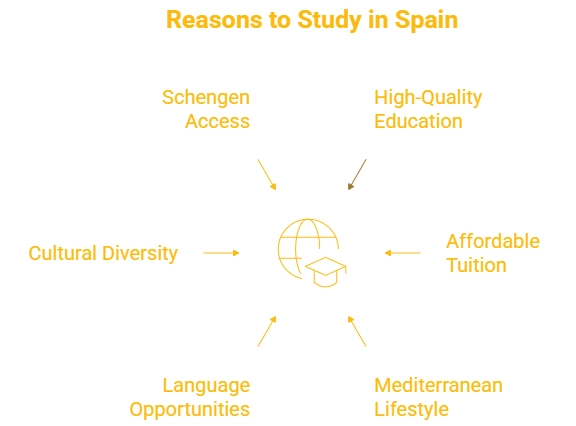
High-Quality Education: Spain is home to more than 75 universities, many of which are ranked among the best in both Europe and the world.
Reasonably tuition fees: For EU students, public universities charge as little as €800–€1,200 annually.
Mediterranean Lifestyle: Savour sunny skies, stunning beaches, and a laid-back way of life.
Language Opportunities: Study in English-taught programs or pick up Spanish, the second most spoken language in the world.
Cultural Diversity: Spain offers a singularly immersive experience through its rich history, festivals, and regional cultures.
Schengen Access: Throughout your studies, you can travel freely throughout 26 European nations.
Eligibility for Spain Student Visa
After Brexit, UK students are regarded as non-EU citizens and need to apply for a student visa if their course lasts longer than ninety days. You qualify if:
- You have been admitted to a reputable Spanish university for a full-time course.
- The duration of your program exceeds 90 days.
- You show the proof of funds (about €600 a month).
- You have valid health insurance coverage in Spain.
Spain Visa Processing Time
Visa processing typically takes:
|
Visa Type |
Processing Time |
|
Short-Term (≤90 days) |
15-30 calendar days |
|
Long-Term (Student Visa) |
4-8 weeks |
To prevent delays, apply at least two to three months before the start of your course, particularly during busy times.
Spain Student Visa Requirements
In order to apply for a student visa, you will require:
- Filled out the national visa application
- A passport that is valid for at least six months
- A passport-sized photo
- Acceptance letter from a Spanish university
- Proof of funds (about €600 per month)
- Private health insurance with no deductibles or copays
- Proof of accommodations
- Medical certificate in Spanish
- Apostilled and translated criminal record certificate
Top Universities in Spain
Here are some of the most prestigious institutions for international students:
|
University |
Location |
Global Ranking (THE 2025) |
|
University of Barcelona |
Barcelona |
#149 |
|
Pompeu Fabra University |
Barcelona |
#176 |
|
Autonomous University of Madrid |
Madrid |
#351 |
|
University of Navarra |
Pamplona |
#251 |
|
Complutense University of Madrid |
Madrid |
#501 |
These universities offer a wide range of programs in English and Spanish, with strong international student support.
Top Courses to Study in Spain
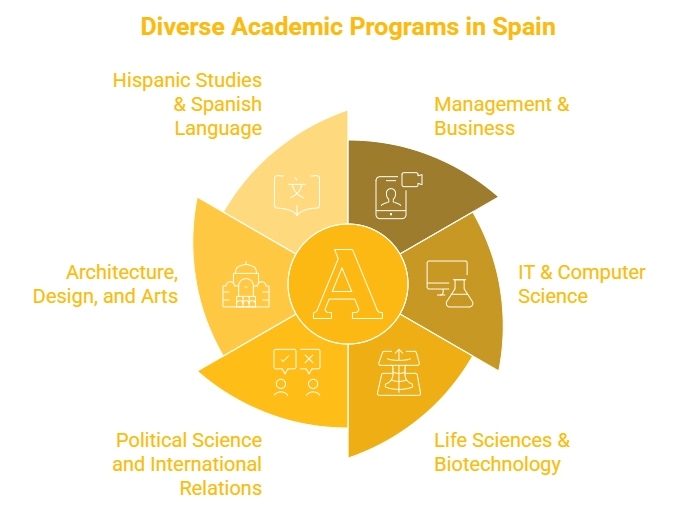
Academic programs in Spain are varied. Popular options consist of:
- Management & Business (IESE, ESADE, IE Business School)
- IT & Computer Science (UPC, UC3M)
- Life Sciences & Biotechnology
- Political science and international relations
- Architecture, Design, and Arts
- Hispanic Studies & Spanish Language
There are numerous English-language programs available, particularly at the master's level.
Cost of Studying in Spain
|
Degree Level |
Public Universities (EU) |
Private Universities |
|
Bachelor’s |
€800–€1,200/year |
€4,000–€20,000/year |
|
Master’s |
€1,000–€2,500/year |
€5,000–€30,000/year |
|
MBA |
€30,000–€105,000/year |
Top-tier business schools |
Fees are calculated per ECTS credit. Retaking modules may increase costs.
Living Costs in Spain
Monthly expenses vary by city. Here’s an average breakdown:
|
Expense Category |
Estimated Monthly Cost (€) |
|
Accommodation |
€300-€600 |
|
Food & Groceries |
€150-€300 |
|
Transportation |
€40-€80 |
|
Utilities & Internet |
€100-€200 |
|
Entertainment |
€50-€100 |
Barcelona/Madrid: €1,000–€1,500 per month
Seville/Valencia: €800–€1,200 per month
Scholarships in Spain for International Students
Spain provides a number of scholarships to students from the UK and other countries:
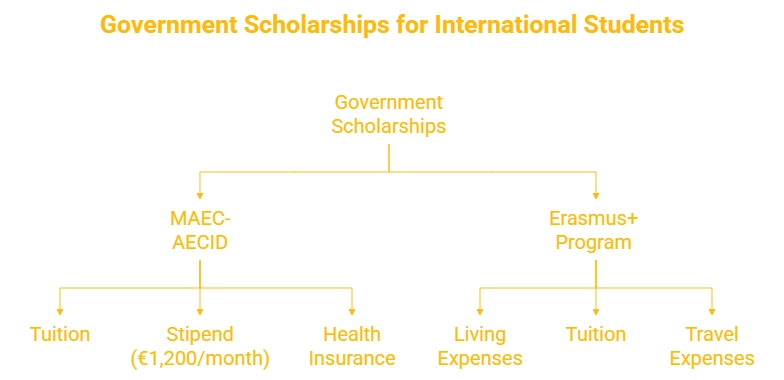
Government Scholarships
- Scholarships from MAEC-AECID
- Tuition, stipend (€1,200/month), and health insurance are all fully funded.
- The Erasmus+ Program
- Covers exchange and full-degree students' living expenses, tuition, and travel expenses.
Scholarships at Universities
- Scholarships for Excellence at UIC Barcelona: 20% off tuition
- Scholarships at the University of Navarra Santander: €1,000 award
- Community Scholarships at Pompeu Fabra UPF: Full or partial reimbursement for tuition
- La Caixa Foundation Private Scholarships: Funding for master's and doctoral degrees with a monthly allowance
- Scholarships from EADA and ESADE: Tuition discounts for business programs of up to 50%
Steps to apply for a Spain Student Visa
This is a detailed guide for students in the UK:
Step 1: Receive a formal letter of admission from an accredited university.
Step 2: Compile the necessary paperwork
Assemble all required documentation, such as bank statements, health insurance, and translations.
Step 3: Make an appointment at the UK's VFS centre or the Spanish consulate.
Step 4: Pay the visa fee, attend your appointment, and submit the documents.
Step 5: Processing a visa takes 5 to 8 weeks. Track your application online.
Step 6: After being accepted, travel and register your address within 30 days of your arrival.
Post-Study Work Visa in Spain
For foreign graduates, Spain provides a Job Search Visa:
Key Features
- Valid for 12 months
- Enables business setup or job searching
- Apply 60 days before or 90 days after student visa expiry
Eligibility
- Must hold a Level 6 or higher degree from a Spanish university
- Proof of income and health insurance are necessary.
- Submit your resume, motivation letter, and legal paperwork.
Next Actions
- Convert to a work permit after you're hired.
- Can also apply for an EU Blue Card or an Entrepreneur Visa.
Why Choose Y-Axis?
- Professional Advice for UK Applicants: Tailored assistance for UK students submitting applications to universities in Europe.
- End-to-End Application Support: Everything under one roof, from choosing a university to applying for a visa.
- Scholarship Help: We assist you in locating and submitting applications for the top scholarships for which you qualify.
- Preparation and Review of Documents: Proper documentation is necessary to prevent application delays or rejections.
- Trusted by Thousands: More than 1 million customers have used Y-Axis to successfully complete their international education.
Frequently Asked Questions