


Posted on November 28 2025
Top 10 Scholarships to Study in Germany for International Students

By , Editor
Updated November 28 2025
Germany offers some of the top scholarships for international students, including DAAD, Heinrich Böll Foundation, Konrad-Adenauer-Stiftung (KAS), Deutschlandstipendium, and the Humboldt Research Fellowship. These scholarships reduce the cost of studying by covering living expenses, health insurance, travel, and academic costs.
With over 300 public universities offering low or no tuition fees and more than 450,000 international students, Germany is one of Europe’s most affordable study destinations. Monthly scholarship funding typically ranges from €300 to over €3,600, making it easier for students to pursue globally recognised degrees with strong post-study work opportunities and high graduate employability.
|
Scholarship |
Amount Awarded |
|
DAAD Scholarships |
€992 – €1,400 |
|
Heinrich Böll Foundation Scholarship |
€812 – €1,450 |
|
Konrad-Adenauer-Stiftung (KAS) Scholarship |
€992 – €1,400 |
|
Rosa Luxemburg Foundation Scholarship |
€934 – €1,520 |
|
Humboldt Research Fellowship |
€3,000 – €3,600 |
|
Erasmus+ Programme |
€292 – €900+ |
|
Deutschlandstipendium |
€300 |
|
Bayer Foundation Scientific Fellowships |
Up to €10,000 (one-time grant) |
|
Baden-Württemberg-STIPENDIUM |
€600 – €1,400 |
|
Friedrich Ebert Stiftung (FES) Scholarship |
€934 – €1,200 |
*Want to study in Germany? Let Y-Axis guide you through every step of the process.
Top Universities in Germany Offering Scholarships
Many leading universities in Germany provide scholarships and financial support for international students through government partnerships, private foundations, and internal funding schemes. These universities not only offer high academic standards but also actively support students through merit-based and need-based scholarships.
- Technical University of Munich (TUM): Offers extensive scholarships for international students in engineering, technology, and research-driven programmes.
- Ludwig Maximilian University of Munich (LMU): Provides merit-based and research scholarships across science, humanities, and management disciplines.
- Heidelberg University: Supports international students with funded research scholarships and academic excellence grants.
- RWTH Aachen University: Known for scholarships linked to engineering innovation and industry-focused research programmes.
- Humboldt University of Berlin: Offers scholarships for international students in social sciences, humanities, and research fields.
- Freie Universität Berlin: Provides funding opportunities for global studies, sustainability, and academic research programmes.
- Karlsruhe Institute of Technology (KIT): Supports international students through science and technology-focused scholarship schemes.
- University of Bonn: Provides funded programmes for international students in economics, mathematics, and research areas.
Eligibility Criteria for German Scholarships
To apply for scholarships in Germany, international students must meet specific academic and documentation requirements. While each scholarship has its own conditions, most follow a similar set of eligibility criteria that assess a student’s academic strength, language skills, and overall profile.
Key Eligibility Requirements include:
- Strong academic record relevant to your chosen course
- Admission or offer letter from a recognised German university
- Proof of English or German language proficiency
- Well-written motivation letter outlining study and career goals
- Updated CV highlighting academic background
- Academic transcripts and certificates
- Recommendation letters (if required)
- Research proposal required for applicants applying to Master’s thesis or PhD programmes
How to Apply for Scholarships in Germany as an International Student?
The scholarship application process in Germany follows a structured approach. By completing each step carefully and on time, international students can significantly improve their chances of securing funding.
Step 1: Shortlist your preferred course and university in Germany
Step 2: Identify scholarships that match your academic profile and study goals
Step 3: Check eligibility criteria and application deadlines carefully
Step 4: Prepare all required documents such as CV, academic transcripts, motivation letter, and references.
Step 5: Apply for university admission if it is required before scholarship submission
Step 6: Submit your scholarship application through official portals or university websites
Step 7: Attend interviews or assessments if requested
Step 8: Monitor your application status and respond to any follow-ups
* Need guidance on scholarships and applications? Get expert help from Y-Axis.
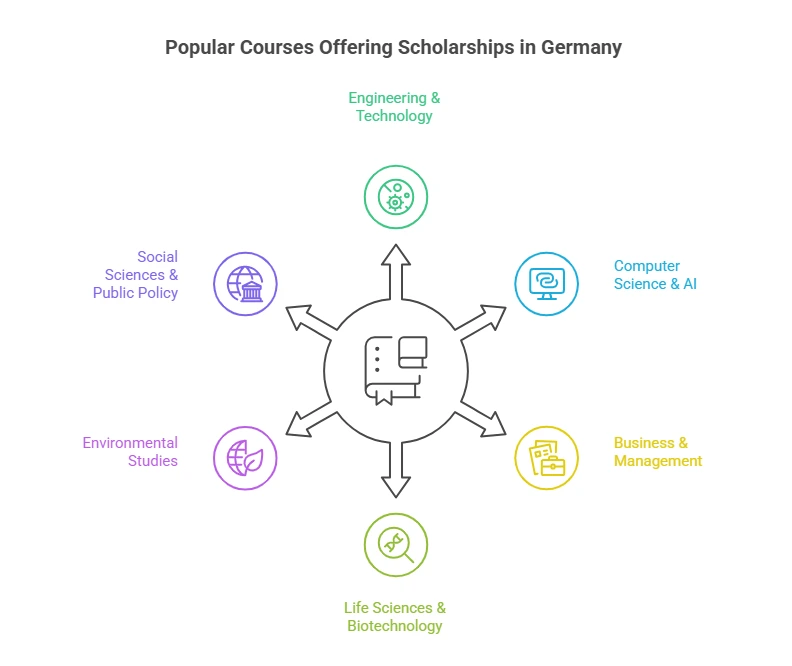
Popular Courses Offering Scholarships in Germany
Germany provides scholarships across a wide range of high-demand academic fields, especially those linked to research, innovation, and global workforce needs. These courses attract strong funding support from government bodies, universities, and private foundations.
- Engineering & Technology: Mechanical, Electrical, Automotive, Civil, and Mechatronics programmes with extensive scholarship opportunities.
- Computer Science & Artificial Intelligence: Strongly funded fields covering AI, data science, cybersecurity, and software engineering.
- Business & Management: Includes MBA, finance, international business, and entrepreneurship courses supported by merit-based scholarships.
- Life Sciences & Biotechnology: Biology, biomedical sciences, and biotechnology programmes with research-focused funding.
- Environmental & Sustainability Studies: Climate change, renewable energy, and sustainability management scholarships.
- Social Sciences & Public Policy: International relations, development studies, and political science programmes with government-backed funding.
*Confused about which course to study in Germany? Avail Y-Axis Course Recommendation Services for personalised assistance!
What are the Scholarships in Germany for Master’s & PhD Students?
Germany offers a range of well-known scholarships dedicated to postgraduate study, supporting both academic coursework and research programmes.
|
Study Level |
Scholarships Available |
|
Master’s Programmes |
DAAD Scholarships, Deutschlandstipendium, Heinrich Böll Foundation Scholarship, Friedrich Ebert Stiftung Scholarship, Konrad-Adenauer-Stiftung Scholarship |
|
PhD Programmes |
DAAD PhD Scholarships, Humboldt Research Fellowship, DAAD EPOS Scholarships, Rosa Luxemburg Foundation Scholarship, Political Foundation Scholarships |
Is University Free in Germany for International Students?
Yes, most public universities in Germany charge little to no tuition fees, even for international students. However, students must still pay semester contributions and cover living costs such as accommodation, food, transport, and health insurance. This is why scholarships remain important, as they help reduce overall expenses and make studying in Germany more affordable.
Do I Need German Language Skills to Get a Scholarship?
No, German language skills are not always required to secure a scholarship in Germany. Many scholarships support English-taught programmes, especially at Master’s and PhD level, and only require proof of English proficiency such as IELTS or TOEFL. However, some scholarships and degree programmes taught in German may require German language certification.
Having basic German language skills can strengthen your overall application and make day-to-day life easier, particularly for internships, part-time work, or programmes that involve interaction with local institutions.
When Should I Apply for Scholarships in Germany?
You should apply for scholarships in Germany 6–12 months before your course starts. Applications for the winter intake usually open from May to October, while summer intake applications typically run from December to January. Since deadlines vary by scholarship and are strictly enforced, applying late can result in missed opportunities. Starting early gives you enough time to prepare documents, meet eligibility requirements, and submit a strong application.
How Can I Improve My Chances of Getting a German Scholarship?
To improve your chances of getting a German scholarship, focus on submitting a strong and well-targeted application. Scholarship providers value academic excellence, clear career goals, and evidence of motivation.
Key steps to follow:
- Maintain a strong academic record
- Write a clear, personalised motivation letter
- Apply for scholarships aligned with your course
- Secure strong recommendation letters
- Highlight leadership, internships, or research experience
- Apply early and avoid last-minute submissions
*Are you looking for step-by-step assistance for Germany Immigration? Contact Y-Axis, the world's No.1 Overseas Immigration Consultancy.
FAQs
What are the top 10 scholarships to study in Germany for international students?
The top 10 scholarships to study in Germany for international students include DAAD Scholarships, Deutschlandstipendium, Heinrich Böll Foundation Scholarships, Friedrich Ebert Stiftung Scholarship, Konrad Adenauer Stiftung Scholarship, Erasmus+ Programme, Humboldt Research Fellowship, DAAD EPOS Scholarships, Bavarian Government Scholarships, and university-specific scholarships in Germany. These scholarships support Bachelor’s, Master’s, and PhD students by covering tuition fees, living expenses, insurance, and travel costs.
Can international students get full scholarships to study in Germany?
Yes, international students can secure full scholarships to study in Germany through programmes such as DAAD, Humboldt Research Fellowships, and foundation-based awards. These full scholarships cover tuition fees, monthly stipends, accommodation, travel costs, and health insurance. They are competitive and require strong academics and a compelling motivation letter.
How do I apply for scholarships in Germany for international students?
To apply for scholarships in Germany, choose a recognised university and study programme, then shortlist suitable scholarship options. Prepare key documents such as transcripts, a motivation letter, CV, proof of language proficiency, and recommendation letters. Some scholarships require confirmed university admission before applying. Start early to maximise your chances.
Are scholarships in Germany for Master’s and PhD students fully funded?
Many scholarships in Germany for Master’s and PhD students are fully funded, especially those offered by DAAD and major foundations. These awards cover tuition fees, monthly stipends, research support, accommodation assistance, and health insurance. Some scholarships provide partial funding, so check individual programme details before applying.
Is university free in Germany for international students with a scholarship?
Public universities in Germany charge little to no tuition fees, even for international students. However, semester contributions and living expenses still apply. Scholarships can cover these costs entirely or partially, making education in Germany highly affordable and attractive for international students.
What are the best German scholarships for international students?
Some of the best German scholarships include DAAD Scholarships, Deutschlandstipendium, Heinrich Böll Foundation, Friedrich Ebert Stiftung, Konrad Adenauer Stiftung, and Erasmus+. These scholarships support students across various fields and academic levels and encourage global research and academic excellence.
Who is eligible for scholarships in Germany for international students?
Eligibility depends on the scholarship but generally includes strong academic results, motivation letters, language proficiency, and relevant achievements. Some scholarships require research experience, work experience, or admission to a German university. Meeting these criteria improves your chances of being selected.
Do German universities offer scholarships for international students?
Yes, many German universities offer scholarships for international students through internal merit-based and need-based funding schemes. These university-specific scholarships may cover living expenses, tuition-related fees, or research costs. Students should check university scholarship pages regularly for updates.
How hard is it to get a scholarship to study in Germany?
Scholarship competition in Germany can be high, especially for fully funded programmes. However, students with excellent academic performance, strong motivation letters, clear goals, and complete documentation have a good chance. Applying to multiple scholarships increases the likelihood of receiving funding.
When should I apply for scholarships to study in Germany?
Students should apply for scholarships 10 to 12 months before their intended intake. Most scholarships in Germany have early deadlines and limited spots. Starting early gives you enough time to prepare documents, obtain recommendations, and meet scholarship requirements, improving your chances of success.
Tags:
top 10 scholarships to study in Germany
scholarships in Germany
German scholarship
Germany scholarship for international students
scholarships in Germany for PhD
master scholarships in Germany
daad scholarship
best scholarships in Germany
Share
Y-Axis Services

Get it on your mobile

Get News alerts

Contact Y-Axis
Latest Article
Popular Post
Trending Article

Posted On March 06 2026
Top 10 Countries for Chefs: Salary, Demand & PR Opportunities Compared