

Posted on April 24 2026
Can I Study in Germany for Free as an International Student?

By , Editor & Director
Updated May 03 2026
Yes, international students can study in Germany for free at public universities. Germany does not charge tuition fees at public universities, making it one of the most affordable study destinations in the world for international students. Students pay a small semester contribution fee between €150 and €350 per semester, but there are no tuition charges. Germany has over 400 public universities, more than 1,800 English-taught programs, and a strong post-study work visa allowing graduates to stay for up to 18 months to find a job.
* Want to study in Germany for free? Let Y-Axis guide you through the entire process.
Why is Education Free in Germany for International Students?
Germany offers free education at public universities because state governments fund these institutions directly, allowing international students to benefit from the same tuition-free policy as German students. It is one of the best countries in the world to earn a globally recognised degree without paying tuition fees.
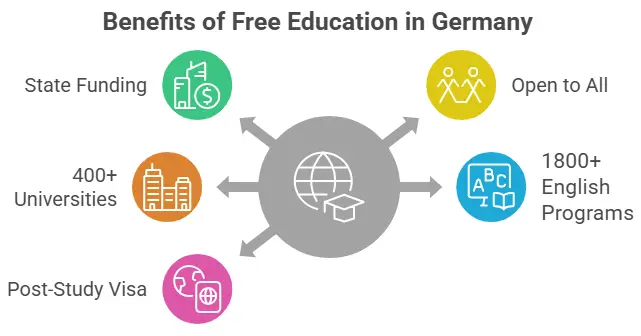
Key Reasons for Germany offering Free Education:
- State-funded universities: Public universities receive direct government funding, removing tuition fees for all students
- Open to all nationalities: The tuition-free policy applies equally to German and international students
- 400+ public universities: Globally recognised institutions offering degrees across all major fields
- 1,800+ English-taught programs: Study in Germany without needing to learn German first
- 18-month post-study work visa: Graduates can stay in Germany after their degree to search for jobs
Who is Eligible to Study in Germany for Free?
International students from all countries are eligible to study in Germany for free at public universities. The tuition-free policy applies to both EU and non-EU students. Students studying in Baden-Württemberg state are charged €1,500 per semester, while all other public universities across Germany remain tuition-free.
Key Eligibility Criteria to Study in Germany for Free:
- All nationalities: Students from any country can apply to tuition-free public universities in Germany
- Bachelor's applicants: Must hold a recognised secondary school certificate equivalent to the German Abitur
- Master's applicants: Must hold a recognised undergraduate degree in a relevant field
- EU and EEA students: Fully eligible for tuition-free education at all public universities across Germany
- Non-EU students: Eligible for tuition-free education at most public universities except those in Baden-Württemberg state
- Recognised qualifications: Qualifications must be recognised by German universities, which can be checked through the anabin database
Top 10 Universities Offering Free Education in Germany for International Students
Germany has over 400 public universities that charge no tuition fees for international students. These universities are state-funded and offer globally recognised degrees across all major fields of study. Many also offer programs taught in English, making them accessible to students from around the world.
Top 10 Universities Offering Free Education in Germany:
- Technical University of Munich (TUM): One of Germany's top-ranked universities known for engineering, technology, and natural sciences
- Ludwig Maximilian University (LMU): A leading research university in Munich offering programs across sciences, humanities, and business
- Heidelberg University: Germany's oldest university, highly recognised for medicine, law, and natural sciences
- Humboldt University Berlin: A prestigious research university known for humanities, social sciences, and natural sciences
- RWTH Aachen University: One of Europe's leading technical universities specialising in engineering and natural sciences
- University of Hamburg: A well-established university offering programs in business, sciences, and law
- Freie Universität Berlin: Known for international studies, social sciences, and humanities
- University of Stuttgart: A strong technical university offering programs in engineering and architecture
- University of Cologne: One of Germany's largest universities known for business, economics, and social sciences
- University of Frankfurt: A leading university for finance, social sciences, and natural sciences
Also Read…
Best Intake to Study in Germany for International Students
English-Taught Programs in Germany for International Students
International students do not need to speak German to study in Germany. Germany offers over 1,800 English-taught programs, especially at postgraduate level, covering high-demand fields such as engineering, business, computer science, and life sciences, making it one of the most accessible study destinations in Europe.
Top Fields Available in English in Germany for International Students:
- Engineering: Mechanical, civil, electrical, and automotive engineering programs available at top technical universities
- Computer Science and IT: Software development, data science, artificial intelligence, and cybersecurity programs with strong industry demand
- Business and Management: Finance, marketing, international business, and MBA programs offered across major universities
- Natural Sciences: Physics, chemistry, biology, and environmental science programs with strong research opportunities
- Medicine and Healthcare: Medical, public health, and life sciences programs recognised globally
- Social Sciences: Psychology, sociology, political science, and international relations programs with diverse career options
- Architecture and Urban Planning: Design, construction, and urban development programs offered at leading technical universities across Germany
- Law: International and comparative law programs available at several top public universities in Germany
Requirements to Study in Germany for International Students
International students need to prepare a set of documents as part of the university admission and visa application process. Having all documents ready in advance helps ensure a smooth and successful application.
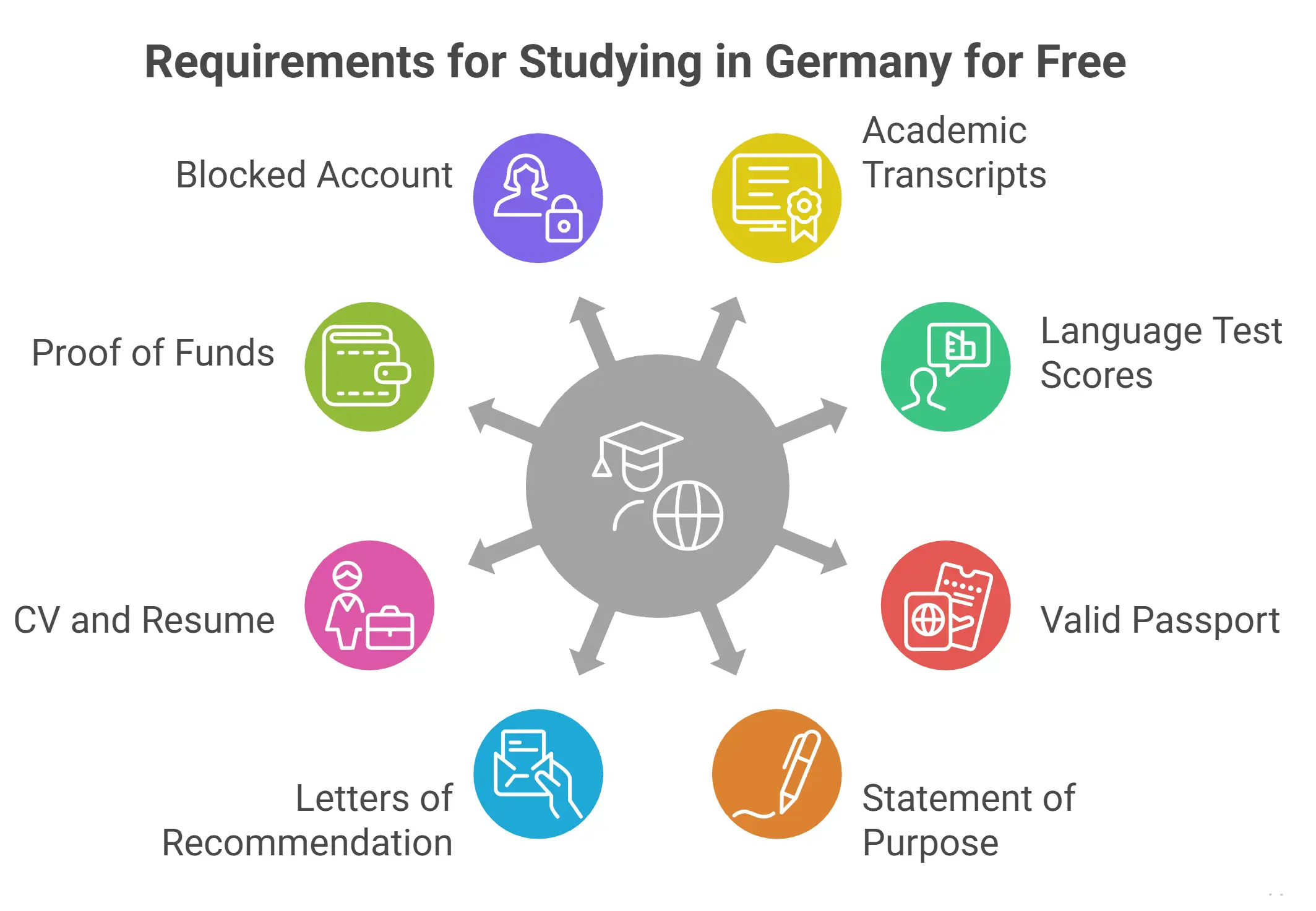
Key Requirements to Study in Germany for International Students:
- Academic transcripts and certificates: Previous education records required for admission evaluation
- Language test scores: IELTS or TOEFL for English-taught programs, TestDaF or DSH for German-taught programs
- Valid passport: Required for university application and student visa processing
- Statement of Purpose (SOP): Explains academic background, study goals, and reasons for choosing the program
- Letters of Recommendation (LORs): Academic or professional references supporting the application
- CV and Resume: Required for most postgraduate and some undergraduate programs
- Proof of funds: Financial documents confirming ability to cover living expenses during studies
- Blocked account: International students need a blocked account holding €11,904 as proof of financial resources for the student visa
How to Study in Germany for Free as an International Student?
Studying in Germany for free is achievable with the right preparation and planning. Most public universities follow a similar admission process, and applying early improves the chances of securing admission and scholarships.
Step-by-Step Process to Study in Germany for Free:
Step 1: Research and shortlist programs using the DAAD database to find English-taught programs that match your academic background
Step 2: Check entry requirements for your chosen university and verify your qualifications through the anabin database
Step 3: Prepare your documents including academic transcripts, language test scores, SOP, LORs, CV, and a valid passport
Step 4: Apply through uni-assist or directly to your chosen university through their official application portal
Step 5: Receive your admission letter confirming your place in the program
Step 6: Apply for a German student visa at the German Embassy or Consulate in your home country
Step 7: Open a blocked account and deposit €11,904 to meet the German visa financial requirement
Step 8: Arrange accommodation and travel before the semester begins
* Planning to study in Germany? Let Y-Axis guide you through the entire process.
Cost of Studying in Germany for International Students
Studying in Germany is free in terms of tuition fees, but students need to cover living expenses. Most international students spend between €820 and €1,420 per month depending on the city and lifestyle, which is considerably lower compared to other popular study destinations like the UK or Australia.
Average Monthly Cost of Studying in Germany for International Students:
|
Expense |
Estimated Monthly Cost |
|
Accommodation |
€300 – €700 |
|
Food and Groceries |
€200 – €300 |
|
Transport |
€80 – €100 |
|
Health Insurance |
€110 – €120 |
|
Books and Supplies |
€30 – €50 |
|
Personal and Miscellaneous |
€100 – €150 |
|
Total |
€820 – €1,420 |
Study Intakes and Application Deadlines in Germany
Germany has two main intakes for international students. Applying on time is important as most universities have strict application deadlines.
- Winter Semester (Fall Intake): The main and most popular intake offering the widest range of programs and scholarship opportunities. Applications generally open between May and July, with deadlines varying by university
- Summer Semester (Spring Intake): A secondary intake with fewer program options but suitable for students who miss the winter deadline. Applications generally open between November and January, with deadlines varying by university
|
Intake |
Start Month |
Application Period |
|
Winter Semester |
October |
May – July |
|
Summer Semester |
April |
November – January |
Top Fully Funded Scholarships in Germany for International Students
Germany offers a wide range of fully funded scholarships that help international students cover living expenses, travel costs, and health insurance. These scholarships are offered by the German government, universities, and international organisations, making studying in Germany even more affordable.
Top Fully Funded Scholarships in Germany for International Students:
- DAAD Scholarships: Germany's largest scholarship programme covering monthly stipend, travel costs, and health insurance for undergraduate, postgraduate, and doctoral students
- Deutschlandstipendium: A merit-based scholarship offering €300 per month to high-achieving students at German universities, funded jointly by the government and private sponsors
- Erasmus+ Scholarships: Available for students from partner countries covering tuition, living expenses, and travel costs for study programs across Europe
- Heinrich Böll Foundation Scholarships: Open to international students committed to democracy and sustainability, covering tuition and living expenses
- Friedrich Ebert Foundation Scholarships: Available for academically strong students with a focus on social democracy and political engagement
- Konrad Adenauer Foundation Scholarships: Offered to high-achieving international students with strong leadership potential and academic excellence
Read More…
Top 10 Scholarships to Study in Germany for International Students
Post-Study Work Opportunities in Germany for International Students
Germany offers strong post-study work opportunities for international graduates. After completing a degree, international students can apply for an 18-month job seeker visa to find employment related to their field of study, making Germany one of the most attractive study destinations for building a long-term career abroad.
Key Post-Study Work Opportunities in Germany:
- 18-month job seeker visa: Graduates can stay in Germany for up to 18 months after completing their degree to search for a job related to their field of study
- EU Blue Card: Graduates who secure a skilled job with a gross annual salary of at least €50,700 can apply for an EU Blue Card providing long-term residence and work rights
- Shortage occupation benefit: Graduates in STEM, IT, engineering, or medicine can qualify for an EU Blue Card with a lower salary threshold of €45,934.20
- Part-time work during studies: International students can work up to 120 full days or 240 half days per year while studying
- Pathway to permanent residence: Graduates who work in Germany for a qualifying period can apply for permanent residence
* Want to work in Germany? Let Y-Axis guide you through the application process.
Tips to Improve Your Chances to Study in Germany for Free
Studying in Germany for free is achievable with the right planning and preparation. Following these tips helps international students improve their chances of securing admission, scholarships, and a smooth visa process.
Tips to Study in Germany for Free as an International Student:
- Apply early: Submit applications well before deadlines to improve admission and scholarship chances
- Choose public universities: Focus on state-funded public universities to benefit from the tuition-free policy
- Apply for scholarships: Apply for DAAD, Deutschlandstipendium, and other funding options to cover living expenses
- Prepare a strong SOP and LORs: Clear academic goals and strong references significantly strengthen the application
- Learn basic German: Basic German helps with daily life and improves job prospects after graduation
- Open a blocked account early: Setting up a blocked account well in advance avoids delays in the visa process
Apply Now
FAQs
Can international students study in Germany for free?
Yes, international students can study in Germany for free at public universities. Germany does not charge tuition fees at public universities, making it one of the most affordable study destinations in the world. Students only pay a small semester contribution fee between €150 and €350 per semester covering administrative costs and student services. Scholarships are also available to help cover living expenses.
Which universities in Germany offer free education for international students?
Several top public universities in Germany offer free education for international students, including Technical University of Munich, Ludwig Maximilian University, Heidelberg University, Humboldt University Berlin, and RWTH Aachen University. These universities are state-funded and do not charge tuition fees. Students pay only a small semester contribution fee and can access globally recognised degrees across all major fields of study.
Do I need to speak German to study in Germany?
No, international students do not need to speak German to study in Germany. Germany offers over 1,800 English-taught programs, especially at postgraduate level, covering fields such as engineering, business, computer science, and life sciences. However, learning basic German is recommended as it helps with daily life and improves job prospects after graduation in Germany.
What is the cost of living in Germany for international students?
The average cost of living in Germany for international students ranges between €820 and €1,420 per month depending on the city and lifestyle. This includes accommodation, food, transport, health insurance, and personal expenses. Germany is considerably more affordable compared to other popular study destinations such as the UK or Australia, making it a practical choice for international students.
What is a blocked account and how much do I need?
A blocked account is a special bank account required by the German government as proof that international students have sufficient funds to cover living expenses during their studies. The current required amount is €11,904 per year, which allows a monthly withdrawal of €992. It is one of the key requirements for obtaining a German student visa and must be set up before applying.
Is IELTS required to study in Germany?
IELTS is required for most English-taught programs at German universities. A score of 6.0 to 6.5 is generally accepted, though requirements vary by university and program. Some universities may accept TOEFL as an alternative. For German-taught programs, students need to provide German language test scores such as TestDaF or DSH instead of IELTS or TOEFL scores.
How long does it take to get a German student visa?
A German student visa generally takes between four and twelve weeks to process depending on the German Embassy or Consulate in the home country. Applying well in advance of the semester start date is strongly recommended. Required documents include a valid passport, admission letter, blocked account proof, health insurance, and completed visa application form.
Can I work while studying in Germany?
Yes, international students can work while studying in Germany. Students are allowed to work up to 120 full days or 240 half days per year without needing additional work permits. This helps students manage living expenses while studying. After graduation, students can apply for an 18-month post-study work visa to find employment related to their field of study in Germany.
What are the best courses to study in Germany for free?
Some of the best courses to study in Germany for free include engineering, computer science, business and management, natural sciences, medicine, and social sciences. These programs are widely available at tuition-free public universities and offer strong career opportunities both within Germany and internationally. Many of these courses are also available in English, making them accessible to international students.
What is the application deadline for German universities?
Application deadlines for German universities vary by institution and program. For the Winter Semester, applications generally open between May and July. For the Summer Semester, applications are generally open between November and January. It is important to check deadlines directly with the chosen university as they can vary. Applying early improves the chances of securing admission and available scholarships.
What is uni-assist and do I need to use it?
Uni-assist is an online portal used by many German universities to process applications from international students. It centralises the application process, making it easier for international students to apply to multiple universities through a single platform. Not all universities use uni-assist, as some accept direct applications through their own portals. Checking the chosen university's admission page confirms whether uni-assist is required.
Are degrees from German universities recognised worldwide?
Yes, degrees from German public universities are widely recognised by employers and academic institutions worldwide. Germany has a strong reputation for academic excellence, particularly in engineering, technology, sciences, and business. Graduates from top universities such as Technical University of Munich and Heidelberg University are highly sought after by employers across Europe, Asia, and beyond.
What scholarships are available to study in Germany for free?
Several fully funded scholarships are available for international students in Germany. The most notable include DAAD Scholarships, Deutschlandstipendium, Erasmus+ Scholarships, Heinrich Böll Foundation Scholarships, and Friedrich Ebert Foundation Scholarships. These scholarships cover monthly stipends, travel costs, and health insurance, helping international students manage living expenses while studying at tuition-free public universities in Germany.
Is studying in Germany worth it for international students?
Yes, studying in Germany is worth it for international students. Germany offers tuition-free education at public universities, globally recognised degrees, strong post-study work opportunities, and an 18-month job seeker visa after graduation. Combined with affordable living costs and over 1,800 English-taught programs, Germany provides excellent academic and professional value for international students from around the world.
Can I get PR after studying in Germany?
Yes, international students can apply for permanent residence in Germany after completing their studies and gaining work experience. Graduates who secure employment and meet the residency requirements can apply for a permanent residence permit. The EU Blue Card is also a popular pathway for skilled graduates, providing long-term residence and work rights in Germany with a qualifying job offer.
What is the difference between a public and private university in Germany?
Public universities in Germany are state-funded and do not charge tuition fees, while private universities charge between €10,000 and €30,000 per year. Public universities offer a wider range of programs and globally recognised degrees. Most international students choose public universities for the combination of free education and high academic standards. Private universities are smaller and often offer more specialised programs taught in English.
How many intakes does Germany have for international students?
Germany has two main intakes for international students. The Winter Semester, also known as the Fall Intake, starts in October and is the most popular intake offering the widest range of programs. The Summer Semester, also known as the Spring Intake, starts in April and has fewer program options. Application deadlines vary by university, so checking directly with the chosen institution is recommended.
Do I need health insurance to study in Germany?
Yes, health insurance is mandatory for all students studying in Germany, including international students. Public health insurance is available for students under 30 years old and costs approximately €110 to €120 per month. Students over 30 may need to opt for private health insurance. Proof of health insurance is required as part of both the university enrollment process and the student visa application.
Can I study a master's degree in Germany for free?
Yes, international students can study a master's degree in Germany for free at public universities. Germany does not charge tuition fees for master's programs at public universities, making it one of the best countries for affordable postgraduate education. Students pay only a small semester contribution fee. Many master's programs are also available in English, making them accessible to international students from around the world.
How do I find English-taught programs in Germany?
The best way to find English-taught programs in Germany is through the DAAD database, which lists over 1,800 English-taught programs across all major fields of study. University websites also provide detailed information on available programs, entry requirements, and application deadlines. Y-Axis can also help international students find the right English-taught program based on academic background and career goals.
Tags:
Study in Germany
Free Education
International Students
Germany Universities
Study Abroad Germany
Tuition-Free Universities
Germany Student Visa
DAAD Scholarships
Germany Education System
Study in Europe
Share
Y-Axis Services

Get it on your mobile

Get News alerts

Contact Y-Axis
Latest Article
Popular Post
Trending Article

Posted On October 23 2026
Australia vs. Germany for Engineering Professionals: Which Country Should You Choose?