


Posted on December 18 2025
Fast-Track Hiring Options in Japan for Skilled Professionals

By , Editor
Updated December 18 2025
Japan has four main fast-track hiring pathways for skilled professionals to address more than 800,000 current job vacancies across high-demand sectors such as information technology, engineering, healthcare, education, finance, and hospitality. These vacancies are expected to rise to nearly 2 million by 2040 due to ongoing labour shortages, and the government plans to introduce more fast-track hiring pathways to recruit skilled workers.
The Japanese government is investing ¥120 trillion by 2030 to develop new industries and expand key growth sectors to create more employment opportunities. This investment is driving demand for skilled workers and reinforcing employer-sponsored fast-track visa pathways.
*Want to work in Japan through fast-track hiring? Let Y-Axis guide you through application process.
List of Fast-Track Hiring Options in Japan for Skilled Professionals
Japan offers fast-track hiring pathways for skilled professionals to help employers respond quickly to skill shortages. These employer-sponsored options are designed to shorten recruitment timelines and support faster work visa processing across key industries.
The main fast-track hiring pathways include the Highly Skilled Professional (HSP) Visa, Specified Skilled Worker (SSW) Visa, Engineer / Specialist in Humanities / International Services Visa, and the Intra-Company Transferee Visa.
Some of the main fast-track hiring pathways include:
Highly Skilled Professional (HSP) Visa
This is a points-based route for highly qualified professionals with strong academic backgrounds, work experience, and higher salaries. It offers priority processing, longer residence periods, and faster access to permanent residency. It is commonly used in technology, engineering, research, finance, and senior business roles.
Specified Skilled Worker (SSW) Visa
This pathway supports industries facing severe labour shortages. It allows skilled workers with practical experience to work under employer sponsorship, particularly in sectors such as healthcare, construction, manufacturing, hospitality, and food services.
Engineer / Specialist in Humanities / International Services Visa
One of the most commonly used work visas, this option covers a wide range of skilled roles including IT, engineering, business, education, finance, and marketing. Applicants must have a relevant qualification and a confirmed job offer.
Intra-Company Transferee Visa
Designed for multinational organisations, this route allows companies to transfer existing employees to their Japan offices. It is often used for managers, technical specialists, and experienced staff, with fewer procedural requirements and faster processing.
Benefits of Fast-Track Hiring for Skilled Professionals in Japan
Fast-track hiring in Japan is designed to reduce delays and make it easier for skilled professionals to secure employment in sectors facing urgent labour shortages. These pathways benefit both employers and applicants by simplifying recruitment and speeding up access to work opportunities.
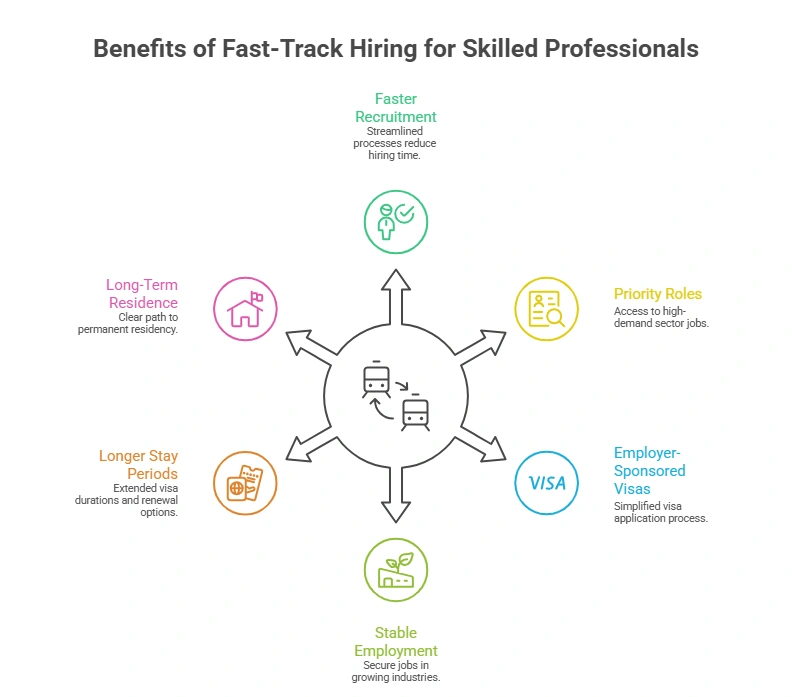
Key benefits of fast track hiring for skilled workers include:
- Faster recruitment and work visa processing
- Priority consideration for roles in high-demand sectors
- Employer-sponsored visas, reducing application complexity
- Access to stable employment and growing industries
- Longer stay periods and renewal options, depending on visa type
- Clear pathways to long-term residence and career growth in Japan
Eligibility Requirements for Fast-Track Hiring in Japan
Eligibility for fast-track hiring in Japan depends on the specific visa pathway and the role offered by the employer. While requirements vary by category, skilled professionals must meet certain core criteria to qualify for priority hiring and faster work visa processing.
Key eligibility requirements for fast track hiring include:
- A valid job offer from a Japan-based employer
- Relevant university degree or equivalent professional experience
- Work experience aligned with the job role
- Employer sponsorship for the Certificate of Eligibility (CoE)
- Sector-specific skills or certifications, where required
- Language requirements depending on the role and industry
- Compliance with Japanese immigration and employment regulations
Documents Required for Fast-Track Hiring to Work in Japan
To apply through Japan’s fast-track hiring pathways, skilled professionals must prepare a set of visa and employment documents that support both the job offer and work visa application. Having complete and accurate documents is essential, as missing paperwork can delay the Certificate of Eligibility (CoE) and visa approval.
The documents required for fast-track hiring in Japan include:
- A valid passport
- Completed work visa application form
- Recent passport-size photograph
- Job offer letter or signed employment contract from a Japan-based employer
- Certificate of Eligibility (CoE) issued by Japanese immigration
- Educational certificates and academic transcripts
- Proof of relevant work experience, such as reference letters or employment records
- Role-specific licences or professional certifications, where applicable
- Certified translations for documents not issued in Japanese or English
Step-by-Step Process for Fast-Track Hiring to Work in Japan
The fast-track hiring process in Japan follows a clear sequence, starting with securing a job offer and ending with visa approval and relocation. While timelines vary by visa type, following these steps helps avoid delays and keeps the application on track.
Step 1: Secure a Job Offer
Step 2: Check Your Eligibility
Step 3: Employer applies for the Certificate of Eligibility (CoE)
Step 4: Gather Required Documents
Step 5: Apply for the Japan Work Visa Application
Step 6: After visa approval and Plan Relocation
*Want to apply for fast-track Work Visa in Japan? Get expert guidance from Y-Axis.
Processing Time for Fast-Track Work Visas in Japan
Processing times for fast-track work visas in Japan vary depending on the visa category, employer readiness, and how quickly documents are submitted. However, fast-track hiring pathways are designed to significantly reduce delays, especially when the Certificate of Eligibility (CoE) is approved without additional checks.
Average processing times include:
|
Fast-Track Pathway |
Average Processing Time |
|
Highly Skilled Professional (HSP) Visa |
2–4 weeks |
|
Engineer / Specialist in Humanities / International Services Visa |
4–8 weeks |
|
Intra-Company Transferee Visa |
2–6 weeks |
|
Additional Document Review (if requested) |
1–3 weeks |
|
Certificate of Eligibility (CoE) |
1–3 months |
|
Work Visa Application (after CoE) |
5–10 working days |
Processing Costs for Fast-Track Japan Work Visas
The cost of applying for a fast-track work visa in Japan varies depending on the visa type and individual circumstances. In most cases, expenses include government visa fees along with additional costs related to documentation and verification.
Estimated processing costs for Japan fast-track Work Visa:
|
Category |
Processing Cost |
|
Work Visa Application Fee |
¥3,000 |
|
Work Visa Application Fee (Multiple Entry) |
¥6,000 |
|
Certificate of Eligibility (CoE) |
No government fee |
|
Document Translation & Notarisation |
¥5,000 – ¥20,000 |
|
Medical Checks (if required) |
¥5,000 – ¥15,000 |
|
Police / Background Clearance |
¥1,000 – ¥5,000 |
|
Relocation Expenses |
Varies by location and employer support |
Can fast-track Work Visa lead to Permanent Residency in Japan?
Yes, fast-track work visas can lead to permanent residency in Japan, depending on the visa category and continued employment. Most work visas allow renewals as long as eligibility conditions and employer sponsorship are maintained, enabling skilled professionals to build long-term careers in the country.
Certain pathways, such as the Highly Skilled Professional (HSP) Visa, offer a faster route to permanent residency compared to standard work visas. Skilled professionals who maintain stable employment, meet income requirements, and comply with visa conditions may become eligible for permanent residency sooner. This makes fast-track hiring an attractive option for those seeking long-term settlement and career growth in Japan.
Top Companies Hiring Skilled Professionals in Japan
Japan is actively hiring skilled professionals through fast-track, employer-sponsored work visa pathways across sectors such as technology, manufacturing, engineering, finance, aviation, and professional services. Some of the leading companies hiring skilled professionals in Japan include:
- Toyota Motor Corporation: Automotive engineering, manufacturing, and advanced technology roles
- Sony Group: IT, electronics, digital media, and engineering positions
- Hitachi: Infrastructure, engineering, data, and industrial technology roles
- Rakuten: Software development, data science, and business operations
- SoftBank Group: Technology, telecommunications, and investment-related roles
- Panasonic: Electronics, manufacturing, and research and development
- Japan Airlines (JAL): Aviation, engineering, operations, and support roles
Is Japanese Required to Work in Japan for Skilled Professionals?
Japanese language skills are not always required to work in Japan, especially for skilled professionals in technical and specialised roles. Many positions in information technology, engineering, research, and other technical fields operate primarily in English, particularly with multinational or globally focused employers.
However, basic Japanese is often preferred for smoother workplace communication and daily life. Japanese proficiency is typically required for roles in healthcare, education, and customer-facing positions where interaction with local clients or patients is essential. Some employers also offer language training or support programmes to help overseas professionals adapt to the workplace.
Tips to Increase Your Chances of Fast-Track Hiring in Japan
Fast-track hiring in Japan offers a quicker route to employment, but preparation plays a key role in securing employer sponsorship and timely visa approval. Taking the right approach can significantly improve your chances of success.
Some of the practical tips to strengthen your application:
- Focus on roles in high-demand sectors such as IT, engineering, healthcare, and manufacturing
- Target employers with experience hiring overseas professionals
- Ensure your qualifications and work experience closely match the job requirements
- Prepare all required documents early to avoid delays
- Highlight specialised skills, certifications, and international experience
- Familiarise yourself with Japanese workplace culture and professional expectations
*Looking to move to Japan for work? Y-Axis provides expert guidance and complete support for skilled professionals.
Apply Now
FAQs
What is fast-track hiring in Japan for skilled professionals?
Fast-track hiring in Japan refers to priority recruitment and faster work visa processing for skilled professionals in high-demand sectors. These pathways allow employers to sponsor overseas talent through simplified procedures and reduced processing times. Fast-track hiring helps skilled professionals secure jobs and Japan work visas more quickly, especially in sectors facing long-term labour shortages such as IT, engineering, healthcare, and manufacturing.
Which visas are fast-track hiring options in Japan?
The main fast-track hiring options in Japan include the Highly Skilled Professional (HSP) Visa, Engineer / Specialist in Humanities / International Services Visa, Specified Skilled Worker (SSW) Visa, and Intra-Company Transferee Visa. These employer-sponsored work visas offer faster processing for skilled professionals working in priority sectors. The HSP Visa provides additional benefits such as longer stay periods and faster permanent residency eligibility.
Who is eligible for fast-track hiring in Japan?
Eligibility for fast-track hiring in Japan depends on the visa type and job role. Skilled professionals must have a confirmed job offer from a Japan-based employer willing to sponsor the work visa. Applicants usually need relevant educational qualifications or professional experience aligned with the role, along with compliance with Japanese immigration and employment regulations.
What are the high-demand sectors for fast-track hiring in Japan?
High-demand sectors for fast-track hiring in Japan include information technology, engineering, manufacturing, healthcare, education, finance, construction, and hospitality. These industries face ongoing labour shortages due to Japan’s ageing population and shrinking workforce. Skilled professionals with experience in technical, healthcare, and specialised roles are prioritised under fast-track hiring and employer-sponsored work visa pathways.
How long does fast-track work visa processing take in Japan?
Fast-track work visa processing in Japan depends on the visa category and employer readiness. The Certificate of Eligibility (CoE) usually takes 1–3 months, while the work visa application after CoE approval takes about 5–10 working days. Highly Skilled Professional (HSP) visas often receive priority processing and may be approved faster than standard work visas.
Is Japanese language required for fast-track hiring in Japan?
Japanese language skills are not always required for fast-track hiring in Japan, especially for skilled professionals in IT, engineering, research, and technical roles. Many international employers operate in English. However, basic Japanese is often preferred for workplace communication and daily life. Japanese proficiency is usually required for healthcare, education, and customer-facing positions.
Can fast-track hiring in Japan lead to permanent residency?
Yes, fast-track hiring in Japan can lead to permanent residency, depending on the visa type and continued employment. Most Japan work visas are renewable if eligibility is maintained. The Highly Skilled Professional (HSP) Visa offers the fastest route to permanent residency, with eligibility possible after meeting income, employment, and compliance requirements over a shorter period.
What documents are required for fast-track hiring in Japan?
Documents required for fast-track hiring in Japan typically include a valid passport, job offer or employment contract, Certificate of Eligibility (CoE), educational certificates, and proof of relevant work experience. Some roles may require professional licences or certifications. Documents not in Japanese or English must be officially translated to avoid delays in work visa processing.
Do employers need to sponsor fast-track work visas in Japan?
Yes, employer sponsorship is mandatory for fast-track work visas in Japan. The employer provides the job offer, applies for the Certificate of Eligibility (CoE), and supports the visa application. Skilled professionals cannot apply independently for fast-track work visas. Employers experienced in overseas recruitment can significantly speed up the fast-track hiring process.
How can skilled professionals improve their chances of fast-track hiring in Japan?
Skilled professionals can improve their chances of fast-track hiring in Japan by targeting high-demand sectors, applying to employers familiar with overseas hiring, and aligning qualifications closely with job requirements. Preparing documents early, highlighting specialised skills, and understanding basic Japanese workplace culture can also strengthen applications under fast-track work visa pathways.
Tags:
Japan work visa
fast-track hiring
skilled professionals
jobs in Japan
Japan immigration
overseas employment
Share
Y-Axis Services

Get it on your mobile

Get News alerts

Contact Y-Axis
Latest Article
Popular Post
Trending Article

Posted On March 04 2026
Top 10 Countries for Physicians: Salary, Demand & PR Opportunities Compared