

Posted on December 17 2025
Is there a Chance for International Students to Get ILR in the UK?

By , Editor
Updated December 17 2025
Yes, international students can apply for Indefinite Leave to Remain (ILR) in the UK after completing their studies and fulfilling specific eligibility requirements. After graduation, students can apply for a Graduate Visa, which allows them to stay and work in the UK to gain valuable work experience.
To become eligible for ILR, students must switch to a Skilled Worker Visa, as only the time spent on this visa counts towards the five-year residency requirement. After meeting all requirements students can submit their ILR application online through the UK government portal. Once approved, UK ILR allows graduates to live, work, and access public services without visa restrictions.
*Want to migrate to the UK? Sign up with Y-Axis to assist you with the process.
Pathways to get Indefinite Leave to Remain (ILR) for International Students in the UK
International students in the UK have 2 main pathways to achieve Indefinite Leave to Remain (ILR), depending on their visa type, work experience, and length of residence.
Some of the main pathways for UK ILR include:
Skilled Worker Route
After graduation, students can transition from a Graduate visa to a Skilled Worker visa.
- Continuous employment in a qualifying role for five years allows eligibility for ILR.
- This is the most common pathway for graduates in in-demand sectors like STEM, healthcare, IT, and finance.
Long Residence Route
Students can accumulate 10 years of lawful residence in the UK on any combination of visas, including student visas.
- This pathway considers all lawful residence but has stricter absence limits and other eligibility requirements.
Graduate Visa Transition Route
The Graduate visa allows international students to work in the UK after completing their studies.
- Time on the Graduate visa alone does not count toward ILR.
- Students must secure a Skilled Worker visa to accumulate qualifying residence for ILR.
Top Courses that can lead to UK ILR for International Students
Certain UK degrees can significantly increase the chances of obtaining Indefinite Leave to Remain (ILR). Programs in high-demand fields such as IT, Engineering, Healthcare, Finance, and Science often lead to jobs with licensed UK sponsors, which are essential for the Skilled Worker route. Graduates from these courses can more easily secure qualifying employment, making the transition from study to permanent residency smoother. Choosing a relevant course early can strategically position students to plan and fast-track their path to ILR.
|
Field of Study |
Courses |
Occupations |
|
Information Technology & Computer Science |
BSc/MSc in Computer Science, Software Engineering, Data Science, Cybersecurity |
Software Developer, Data Analyst, IT Business Analyst, Cybersecurity Specialist |
|
Engineering |
Mechanical, Civil, Electrical, Chemical, Aerospace Engineering |
Mechanical Engineer, Civil Engineer, Electrical Engineer, Design and Development Engineer |
|
Healthcare & Medicine |
Medicine, Nursing, Pharmacy, Physiotherapy, Radiography |
Doctor, Nurse, Pharmacist, Physiotherapist, Radiographer |
|
Finance & Accounting |
Accounting, Finance, Economics, Actuarial Science |
Accountant, Financial Analyst, Management Accountant, Actuary |
|
Science & Research |
Biological Sciences, Chemistry, Physics, Biotechnology |
Biological Scientist, Chemist, Research Scientist, Biochemist |
|
Education & Teaching |
PGCE, Education Studies |
Secondary School Teacher, Special Needs Teacher, Further Education Teacher |
|
Architecture & Built Environment |
Architecture, Surveying, Town Planning |
Architect, Town Planner, Building Surveyor, Civil Engineering Technician |
Benefits of Indefinite Leave to Remain (ILR) in the UK for International Students
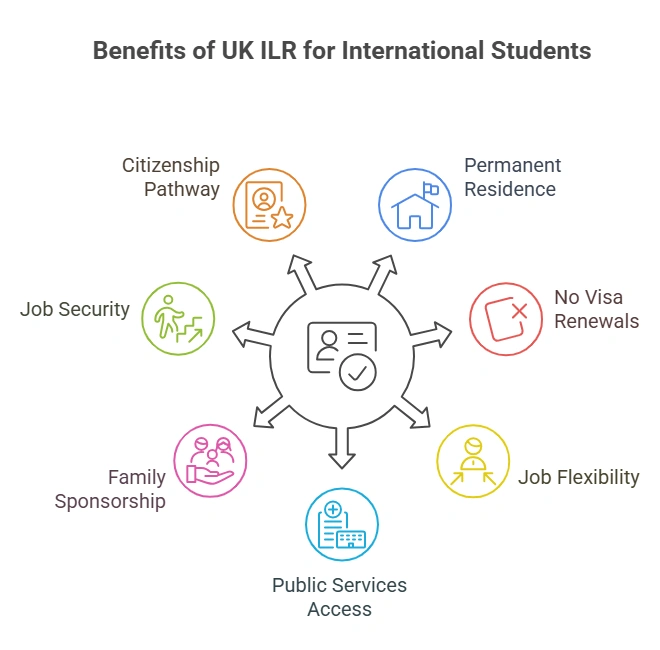
Obtaining Indefinite Leave to Remain (ILR) offers long-term security and flexibility in the UK. It removes most immigration restrictions and allows international students to build a stable career and life in the country.
- Permanent right to live and work in the UK with no time limits
- No visa renewals or employer sponsorship required
- Freedom to change jobs or employers without immigration approval
- Access to public services and benefits, if eligible
- Ability to sponsor eligible family members
- Greater job security and career flexibility
- Pathway to British citizenship after meeting residence and character requirements
Eligibility Criteria for Indefinite Leave to Remain (ILR) in the UK for International Students
International students must meet specific criteria to qualify for Indefinite Leave to Remain (ILR) in the UK. Key requirements include completing the required period of lawful residence, holding the correct visa type, demonstrating English language proficiency, and passing the Life in the UK test.
- Completed UK Degree: Applicants must have completed a bachelor’s, master’s, or doctoral degree from a recognised UK institution.
- Eligible Visa Status: Time spent on a Student Visa or Graduate Route does not count towards ILR. Applicants must switch to a Skilled Worker visa or another eligible long-term visa.
- Continuous Lawful Residence: Applicants must complete five years on a Skilled Worker visa or ten years under the long residence route, while maintaining valid immigration status and complying with visa conditions.
- Good Character Requirement: Applicants must demonstrate good character with no serious criminal convictions or immigration violations.
- English Language Requirement: Applicants must meet English language requirements through an approved English test or a degree taught in English.
- Life in the UK Test: Applicants must pass the Life in the UK Test, covering British history, culture, and laws.
*Check your eligibility for UK ILR with Y-Axis Immigration Points Calculator.
Step-by-Step Application Process to get Indefinite Leave to Remain (ILR) for International Students in the UK
The process of obtaining Indefinite Leave to Remain (ILR) in the UK is straightforward if planned carefully. International students must follow specific steps, including completing the required period on the appropriate visa, meeting residence and work requirements, and fulfilling language and test criteria.
Steps to secure UK ILR for International Students:
Step 1: Apply for a Graduate Visa and gain work experience
Step 2: Secure a UK Skilled Worker Visa
Step 3: Complete the UK Skilled Worker Visa Residence Requirements
Step 4: Meet Work and Salary Requirements
Step 5: Complete Required Tests
Step 6: Submit Your ILR Application
Step 7: After approval, you will be granted Indefinite Leave to Remain, officially allowing permanent residency in the UK.
Processing time to get Indefinite Leave to Remain (ILR) for International Students in the UK
Standard Indefinite Leave to Remain (ILR) applications are typically processed within up to 6 months from the date of submission. Processing times may vary depending on application volume and individual case complexity.
Applicants may be able to use priority or super-priority services, where available, to receive a decision within 5 working days or 24 hours. Availability depends on eligibility and Home Office capacity.
Processing Cost of UK ILR for International Students
The current Indefinite Leave to Remain (ILR) application fee is £3,029 per applicant. This fee applies to each individual, including dependants included in the application.
Additional charges may apply for optional services such as priority or super-priority processing, biometric appointments, and document scanning or translation. Fees are subject to change, so applicants should always confirm the latest costs before submitting their application.
Tips to Improve your ILR Approval Chances for International Students
Applying for UK ILR requires careful planning and full compliance with immigration rules. Following these tips can help reduce delays and improve your chances of approval.
- Switch to an eligible work visa early
- Maintain continuous UK residence within absence limits
- Stay fully compliant with visa and sponsorship rules
- Meet minimum salary requirements at all times
- Keep clear records of employment and residence
- Pass Life in the UK and English language tests early
- Apply before your visa expires
*Looking for step-by-step assistance with UK immigration? Contact Y-Axis, the world’s No. 1 overseas immigration consultancy, for end-to-end support.
Apply Now
FAQs
Can international students get ILR in the UK?
International students cannot obtain ILR directly on a Student visa, as it is temporary and does not count towards settlement. To qualify for ILR, students must switch to a qualifying work visa, most commonly the Skilled Worker visa. ILR eligibility is usually reached after completing five years of continuous lawful residence on an eligible visa route.
How long must a student stay in the UK to be eligible for ILR?
Time spent on a Student visa does not count towards ILR. International students must switch to a qualifying visa, such as the Skilled Worker visa, and complete five continuous years on that visa. Alternatively, students may qualify under the ten-year long residence route if they maintain lawful status across multiple visas.
Does a UK student visa lead to ILR for dependents?
A UK Student visa does not lead to ILR for dependents. Dependents can only qualify for ILR after the main applicant switches to a qualifying settlement visa. Once on a Skilled Worker or eligible visa, dependents can start counting residence time, provided they meet continuous residence, relationship, and immigration compliance requirements.
What are the main pathways for students to apply for ILR in the UK?
The primary ILR pathway for international students is switching from a Student visa to a Skilled Worker visa after graduation. Other qualifying work visas may also apply. ILR eligibility is usually achieved after five years of continuous lawful residence on qualifying visas. Selecting an eligible post-study work route is essential for settlement.
Can post-study work experience help students qualify for ILR?
Yes, post-study work experience is critical for ILR progression. While the Graduate visa itself does not count towards ILR, it allows graduates to gain UK work experience and secure sponsorship. Once a student switches to a Skilled Worker visa, the five-year ILR residence period begins, making post-study work a key transition stage.
Is the Graduate Visa considered for ILR?
The Graduate visa does not count towards ILR residence requirements. However, it serves as a bridge between study and skilled employment. Graduates can use this period to secure a sponsored Skilled Worker role. The ILR qualifying period starts only after switching to a visa that counts towards settlement.
Are there restrictions for student visa holders applying for ILR?
Yes, student visa holders face clear restrictions. Time spent on a Student visa does not count towards ILR. Applicants must switch to a qualifying visa, maintain continuous lawful residence, meet salary and employment rules, pass English language and Life in the UK tests, and have no serious criminal or immigration violations.
Can family members apply for ILR with international students?
Family members cannot apply for ILR while the main applicant holds a Student visa. Once the student switches to a qualifying work visa, dependents can start accumulating residence time. Dependents must meet continuous residence requirements, maintain lawful status, and provide valid relationship evidence when applying for ILR.
How does switching to a Skilled Worker visa affect ILR eligibility?
Switching to a Skilled Worker visa is essential for ILR eligibility. The five-year ILR residence clock starts only after moving to this qualifying visa. Applicants must remain with an approved sponsor, meet salary thresholds, and comply with visa conditions. Dependents can also count residence time after the switch.
What documents are required for international students to apply for ILR?
ILR applicants must submit a valid passport, biometric residence permit, proof of continuous lawful residence, English language evidence, and Life in the UK test results. Skilled Worker applicants also need payslips, employment contracts, and sponsorship details. Dependents must provide relationship documents. Complete and accurate records reduce refusal risks.
Tags:
UK immigration
UK ILR
international students
UK visas
Skilled Worker visa
Graduate visa
permanent residence UK
Share
Y-Axis Services

Get it on your mobile

Get News alerts

Contact Y-Axis
Latest Article
Popular Post
Trending Article

Posted On March 06 2026
Top 10 Countries for Chefs: Salary, Demand & PR Opportunities Compared