With its stunning waterways, excellent standard of living, and top-notch educational system, Norway is drawing more and more attention from students in the UK. In 2025, there will be more than 24,000 international students attending Norwegian universities, demonstrating the nation's distinctive fusion of cultural diversity, sustainability, and academic brilliance.
Studying in Norway can be a life-changing experience, regardless of your preference for the innovation hubs of Oslo and Trondheim or the Arctic scenery of Tromsø.
Norway is a popular choice for UK students because it provides an alluring combination of affordability, academic rigor, and lifestyle benefits.

Norway is ranked third in the world for inclusivity and second for LGBTQ+ equality, making it a safe and inclusive society.
If a UK student's course lasts longer than 90 days, they must apply for a student residence permit.
You qualify if:
| Visa Type | Processing Time |
| Short-Term (≤90 days) | 15-30 calendar days |
| Long-Term (Student Visa) | 6-8 weeks |
To prevent delays, apply at least two months before the start of your course.
Students in the UK must apply as follows:
| University | QS Ranking 2026 | Location |
| #119 | Oslo | |
| Norwegian University of Science & Tech (NTNU) | #267 | Trondheim |
| University of Bergen | #287 | Bergen |
| University of Tromsø – Arctic University | #648 | Tromsø |
| Norwegian University of Life Sciences | #791 | Ås |
| University of Stavanger | #851 | Stavanger |
These institutions offer a wide range of programs in English and are known for cutting-edge research and innovation
In the areas of creativity, sustainability, and STEM, Norway is a leader. Among the well-known programs are:

| Degree Level | Public Universities (EU/EEA) | Private Universities |
| Bachelor’s | Free or NOK 80,000–150,000/year | NOK 80,000–250,000/year |
| Master’s | Free or NOK 90,000–200,000/year | NOK 100,000–300,000/year |
| MBA | NOK 120,000–350,000/year | BI, NHH, etc. |
UK students may be charged tuition depending on bilateral agreements
Estimated monthly expenses for students:
| Expense Category | Monthly Cost (NOK) |
| Accommodation | 4,500–9,000 |
| Food & Groceries | 2,500–4,500 |
| Transportation | 500–800 |
| Utilities & Internet | 1,000–2,500 |
| Personal & Leisure | 1,000–2,000 |
Total: NOK 10,000–18,000/month (~£750–£1,350) depending on city
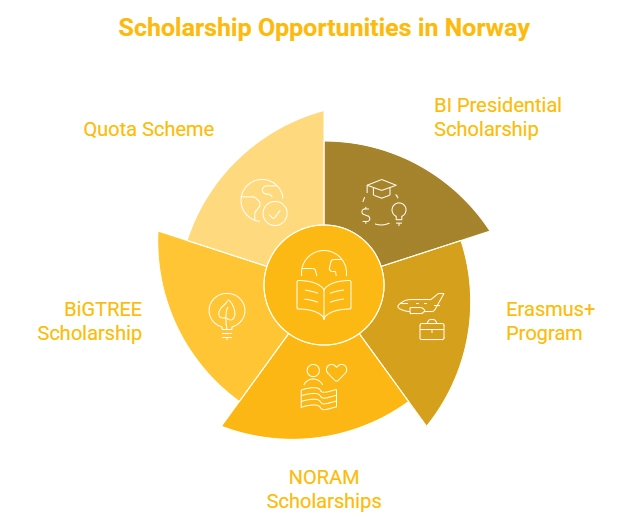
While Norway offers limited government scholarships, several universities and organizations provide funding:
Top Scholarships
Step 1: Apply and receive an offer from a recognized Norwegian university.
Step 2: Gather your health insurance, passport, financial documentation, admission letter, and accommodation details.
Step 3: Pay the fee and submit your application through the UDI portal.
Step 4: Make an appointment for biometrics at the Norwegian consulate or embassy.
Step 5: Attend your appointment and submit all required paperwork.
Step 6: It usually takes six to eight weeks to receive a visa decision.
Step 7: After being given permission, depart and register with the local police within seven days of your arrival.
For recent graduates, Norway provides a Job Seeker Residence Permit:
Key characteristics

UK students must first secure admission from a Norwegian university, then apply for a student residence permit through the Norwegian Directorate of Immigration (UDI). The process includes submitting proof of admission, financial means, accommodation, health insurance, and biometric data at a visa application centre. Approval is required before travelling to Norway for studies longer than 90 days.
Norway offers low or no tuition fees at public universities, making it more affordable academically than many European countries. However, living costs are higher compared to countries like Germany, France, or Spain. Overall, Norway balances higher living expenses with minimal tuition costs and high-quality education.
Most public universities in Norway do not charge tuition fees for degree programmes, even for international students. However, some institutions may require a semester or administrative fee, and private universities charge tuition. Costs vary depending on the institution and programme.
Many Norwegian universities offer English-taught Bachelor’s and Master’s programmes, particularly at the postgraduate level. These programmes are common in fields such as engineering, technology, social sciences, business, and environmental studies, making Norway accessible for UK students without Norwegian language skills.
International students in Norway benefit from student welfare organisations that provide housing assistance, healthcare services, counselling, sports facilities, and career guidance. These services help students integrate into Norwegian academic and social life while supporting their well-being.
Official application deadlines for Master’s programmes are published on individual university websites and centralised admissions portals. Deadlines usually fall between December and March, depending on the programme and institution, so early preparation is strongly recommended.
Yes, UK students can study in Norway through exchange and mobility programmes offered by universities and international agreements. These programmes allow students to study in Norway for one or two semesters while earning credits that count toward their UK degree.
UK citizens must apply for a student residence permit for studies lasting more than 90 days. Requirements include proof of admission, sufficient financial resources, accommodation details, valid passport, and health insurance. Meeting all criteria is essential for approval.
The estimated monthly cost of living for students in Norway ranges between NOK 12,000 and NOK 15,000, covering accommodation, food, transport, and personal expenses. Costs vary by city, with Oslo generally being more expensive than smaller towns.
Bachelor’s degree applications in Norway are processed through a centralised admissions system that evaluates academic qualifications, grades, and eligibility criteria. Applicants submit a single application listing preferred programmes, and offers are issued based on academic merit and availability.
